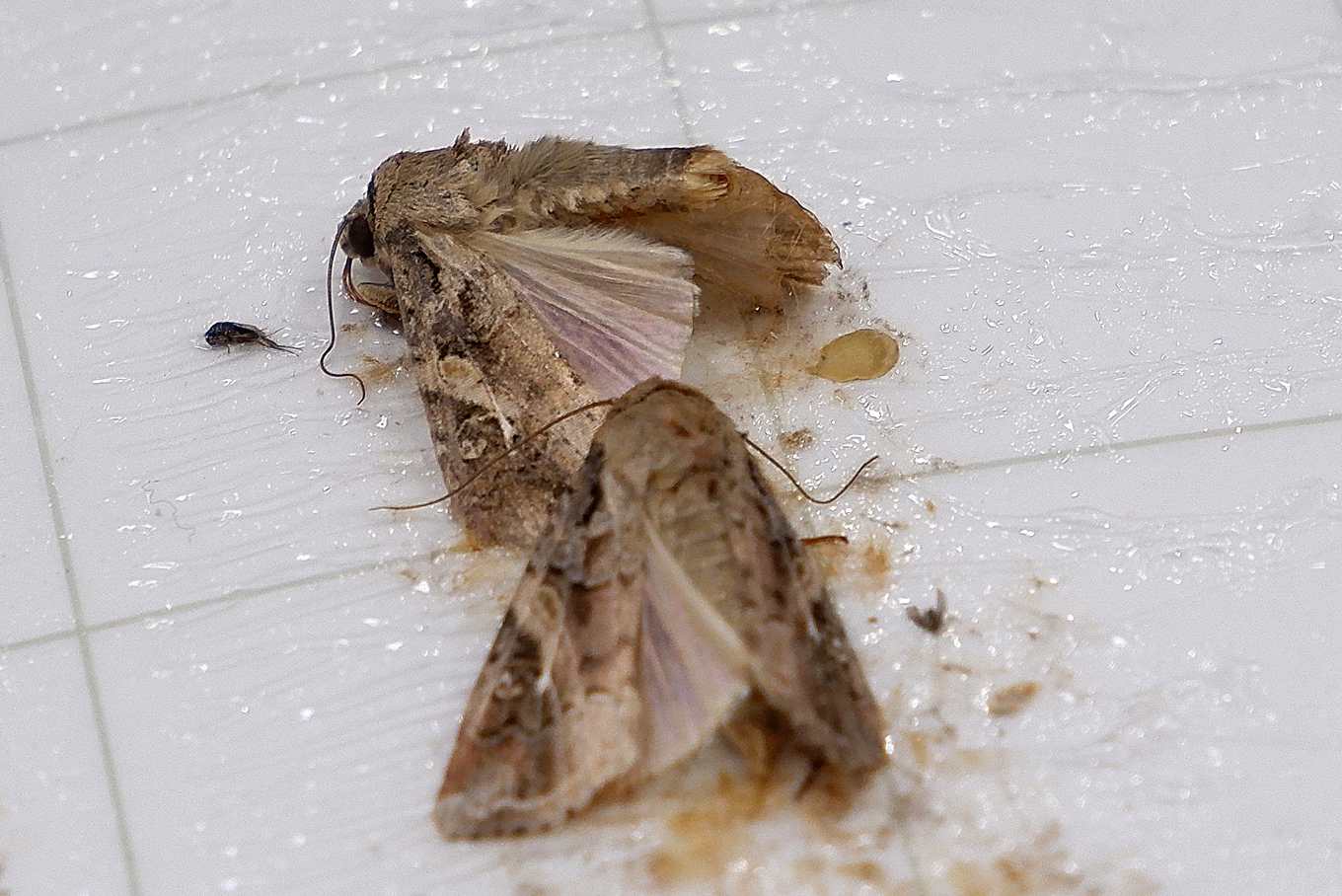
Is it appropriate for farmers to buy sex pheromones themselves to trap fall armyworms, and are there native natural enemies?
(Continued from the previous article) As the fall armyworm crisis strikes Taiwan, the Council of Agriculture recently announced entry into the "second phase of control," calling on farmers to report any fall armyworm eggs, pupae, larvae, or adults they find, so that local governments can launch pesticide spraying operations. Many farmers are asking whether sex pheromones can be used to trap the pest. Does this pest have native natural enemies? The fall armyworm may take root in Taiwan; how should we coexist with it in the future? "Upstream and Downstream" interviewed Hsu Ru-chun, professor in the Department of Entomology at National Taiwan University, Yen Sheng-hung, associate professor in the Department of Biological Sciences at National Sun Yat-sen University, and experts from the Bureau of Animal and Plant Health Inspection and Quarantine to explain the current specific epidemic prevention measures.
Q: Can farmers use sex pheromones on their own to control the fall armyworm?
Recently, the Pheromone Center of Chaoyang University of Technology posted a notice saying it had already formulated a sex pheromone for the fall armyworm and invited farmers willing to take part in monitoring tests to cooperate. Tseng Jui-chang, director of the Pheromone Center at Chaoyang University of Technology, explained that "pheromones" are like the communication language of animals. In the insect world, sex pheromones are mostly released by females. After males far away receive this "message," they follow the trail of the sex pheromone and try hard to find the female. The "sex pheromone trap" also uses this principle to attract males, making them think a female is living inside the trap, so they desperately crawl in and are finally trapped and captured.
He explained that the composition of each insect's sex pheromone is fixed and highly specific. To know the structure of the fall armyworm's sex pheromone, it is necessary to raise large numbers of fall armyworms in the laboratory, isolate the females, and provide sufficient food and environment. Researchers then collect the sex pheromone they release and analyze it to determine its exact structure. Because there had previously been no fall armyworm in the country, they referred to international data and synthesized the fall armyworm sex pheromone themselves. "The components and ratios of the sex pheromone must be confirmed. It is not that the more the dose, the better the effect. If the concentration is wrong, males may not necessarily be willing to go into the trap."
He pointed out that sex pheromones have three major applications: monitoring and early warning, mass trapping, and mating disruption. "Monitoring and early warning" is mainly to detect whether the pest is present in an area, so as to help formulate relevant control strategies. "Each pest has a suitable spacing for its sex pheromone (traps). The placement density is fixed; it is not that more is better." "Mass trapping" adds a trapping-and-killing task on top of the monitoring function, so the number of traps placed is increased to capture large numbers of males. "Mating disruption" is to increase the concentration of female sex pheromones so that nearby males are severely affected physiologically.