Fall armyworm flies in from China, putting Japan on high alert amid fears of invasion in Okinawa and Kyushu
Fall armyworm is wreaking havoc across Taiwan. According to statistics from the Council of Agriculture's Fall Armyworm Disaster Emergency Response Team, as of yesterday (the 14th), a total of 39 cases of fall armyworm larvae have been reported across Taiwan after molecular and morphological identification. Apart from Nantou County, Kaohsiung City and Pingtung County, where no cases have yet been found, virtually the entire island has been affected, while adult fall armyworms have also been trapped on the offshore islands of Matsu and Penghu.
Experts from the Council of Agriculture's Taiwan Agricultural Research Institute, using a model developed with Japanese experts, estimate that this wave of fall armyworm, carried by air currents, may already have reached Okinawa in Japan, and that Japan's Kyushu region may also be unable to avoid damage as it follows the wind direction and air currents. Japan, too, is on high alert as if facing a major enemy. And because July is typhoon season, both Japan and South Korea may face the threat of fall armyworm riding in on the wind.
Following the southwesterly airflow, fall armyworm flies across the Taiwan Strait on the currents
Where exactly did the fall armyworm come from? How did it spread across Taiwan in such a short time? Why is its distribution from south to north scattered like flowers strewn by a heavenly maiden? The Council of Agriculture and the Bureau of Animal and Plant Health Inspection and Quarantine estimate that recent weather changes and the influence of the southwesterly airflow over southern China caused the fall armyworm to follow the currents and fly across the Taiwan Strait.
According to data from the Food and Agriculture Organization (FAO), the fall armyworm's flying ability is astonishing: it can fly up to one hundred kilometers in a night, and riding the air currents it can even reach 250 kilometers. This is why southern China was overrun by fall armyworm across eighteen provinces in a short period of time.
The fall armyworm flew in from Guangdong around mid-May, covering the island like flowers strewn by a heavenly maiden
In fact, the Council of Agriculture's Taiwan Agricultural Research Institute has long cooperated with Japanese plant quarantine authorities, using meteorological data and long-term monitoring of plant pests and diseases, especially those in central and southern China, particularly Guangdong and Fujian provinces, which cross the strait via air currents to reach Taiwan as well as Okinawa and the four main islands of Japan.
According to simulations provided by Japan's National Agriculture and Food Research Organization (NARO), combining the local distribution of fall armyworm in southern China with meteorological and airflow data, and based on the estimated age in days of the first fall armyworm larva found at Flying Cow Ranch in Miaoli on June 8, the first wave of fall armyworm most likely flew to Taiwan on May 19 and 22 from Guangdong, China, and landed and dispersed in Taiwan on the 20th and 23rd.
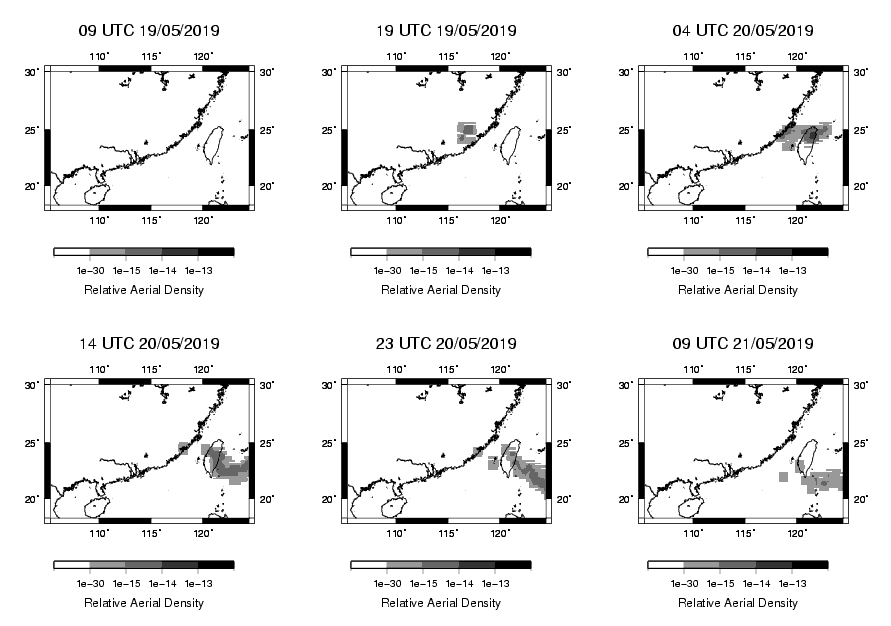
News & Market commissioned a weather expert to analyze the meteorological charts and see the truth
Did the fall armyworm really come riding the wind? How does Taiwan's actual meteorological data support this? News & Market commissioned weather expert Peng Chi-ming to produce charts and analysis. Over the past month, there has indeed been a strong, warm and humid southwesterly airflow blowing from southern mainland China toward Taiwan every week. Peng Chi-ming also noted that when he previously studied dust storms from Mongolia blowing to Taiwan, he found that they carried bacteria and other "biological sources" to Taiwan.
Peng Chi-ming further explained the meteorological data from around May 20, noting that there were indeed two or three strong waves of southwesterly airflow at the time, with cloud systems developing from Guangdong and Fujian approaching Taiwan, moving east and pressing south across the skies over Taiwan, while frontal cloud systems moved south with the northeasterly wind, bringing not only warm, humid moisture but even torrential rain across Taiwan.
We can also see from the satellite weather cloud maps compiled from Japan's Himawari-8 satellite for two periods, May 15 to May 31 and May 15 to yesterday (June 14), that the changes in the movement of the white and blue cloud and rain bands show that over the past month strong southwesterly airflows have indeed come wave after wave from southern China, bringing not only heavy rainfall but possibly also helping the fall armyworm fly across the sea to Taiwan, resulting in a distribution across the island like flowers strewn by a heavenly maiden (please press play for the video).
May 15 to May 31, map of airflow changes in satellite cloud imagery for Taiwan, southern China, Japan and South Korea, produced by WeatherRisk Explore Inc.
May 15 to June 14, map of airflow changes in satellite cloud imagery for Taiwan, southern China, Japan and South Korea, produced by WeatherRisk Explore Inc.
The analysis of satellite meteorological cloud imagery also seems to suggest that it cannot be ruled out that, through this month's vigorous southwesterly airflow, waves of fall armyworm flew in from southern China. Taiwan also seems bound to accept the fact that fall armyworm has become an endemic disease and must prepare for sustained, long-term epidemic prevention to coexist with it. After all, where the fall armyworm goes, not a blade of grass is left!