Characteristics, Advantages and Disadvantages of the New Banana Variety Tai Jiao No. 3 and Key Points for Its Cultivation and Management
"Tai Jiao No. 3" was a semi-dwarf variant discovered in the 80th year of the Republic of China by Mr. Chen Jin-shou, a banana farmer in Dashu Township, Kaohsiung County, in his banana plantation established from tissue-cultured plantlets of "Tai Jiao No. 1." After seven years of experimental research, the Taiwan Banana Research Institute proved that this variety combines semi-dwarf and yellow leaf disease tolerance characteristics, thus saving labor and withstanding wind, and its fruit shape and flavor are excellent, possessing the traditional characteristics of Taiwanese bananas. It passed review on September 14th of the 89th year of the Republic of China, was registered and named "Tai Jiao No. 3," and was officially included in promotion.
Characteristics of "Tai Jiao No. 3"
◎It is semi-dwarf type, with closely spaced petioles.
◎The leaves are relatively short and wide, and the tips of newly emerged leaves during the booting stage are twisted and split, which is its distinguishing feature.
◎The growth cycle is about 12~13 months, about one month longer than "Bei Jiao."
◎It has yellow leaf disease tolerance, similar to "Tai Jiao No. 1," and is of medium disease resistance level.
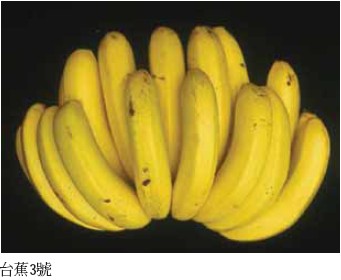
◎The plant is short, with strong wind resistance, and can reduce wind damage losses under strong winds. ◎Each bunch has more hands, reaching 8~11 hands, but the last hand is small. ◎The finger shape has the characteristics of Taiwanese bananas, with moderate size, suitable for domestic and export standards. ◎After ripening, the color changes uniformly, the peel is golden yellow, and the flesh flavor and quality are good. The hands of "Tai Jiao No. 3" color uniformly, appearing golden yellow. Incidence of yellow leaf disease in Tai Jiao No. 3 and control varieties over the years
Advantages and Disadvantages of "Tai Jiao No. 3"
Advantages
◎It has disease tolerance, and when planted in diseased areas, the yield is stable.
◎Because of its semi-dwarf nature, labor saving, wind resistance, and savings in support materials, it can also improve the efficiency of banana plantation management.
◎The occurrence rate of two-stage coloring on the bunch is low, and the hand size is moderate with traditional Taiwanese banana flavor, suitable for domestic and export markets.
Disadvantages
◎It is susceptible to damage by flower thrips, which cause rusty spots on the peel and affect commercial value.
◎Winter bananas produced by this variety and those planted in poor areas have smaller fruit and relatively low yield.
◎Although this variety has many hands, the terminal hand is too small and does not meet standards, so it should be removed.
Key Points for Cultivation and Management of "Tai Jiao No. 3"
This variety's adaptability to soil and climate is not as broad as that of "Bei Jiao." Therefore, when planting this strain, attention must be paid to its characteristics in order to achieve the expected results.
◎Banana plantation selection: This variety is a yellow leaf disease tolerant strain, suitable for planting in light to moderate disease areas in the south, but in heavily diseased areas or poorly drained diseased plantations, it will still develop the disease and is not suitable for planting. Therefore, banana plantations with deep soil, good drainage, and soil rich in organic matter should be selected. Banana plantations in the eastern and central regions are not suitable for planting this strain due to different climate patterns.
◎Planting period and planting density: The growth cycle of this variety is about 12~13 months. If in a banana plantation with good soil and drainage, it can be planted between March and April. If soil conditions are poor, planting can be advanced to February to March. A planting density of 7 X 7 chi can be adopted, with 2,000~2,200 plants per hectare.
◎Early cultivation management: Because this variety is dwarf, early plant height increases slowly, so excessive fertilizer is not necessary, but weed control should be noted. When applying herbicides, be careful not to spray onto the plants to avoid injury. When planting in February or March, aphid control needs to be strengthened to reduce the spread of mosaic disease. Covering with silver reflective plastic cloth can control weeds and prevent aphids.
◎Fertilizer application: Same as "Tai Jiao No. 1"; No. 4 compound fertilizer can be applied, with an annual usage of about 1.5 kg per plant, applied in small amounts multiple times for better fertilizer efficiency.
◎Wind damage prevention: Although this variety is relatively wind resistant, windbreak props still need to be inserted to prevent wind damage. However, the props can be about one meter shorter than traditional props.
◎Leaf protection: Same as general bananas (refer to the plant protection manual).
◎Rust spot control: Same as "Tai Jiao No. 1." The following methods can be selected for control: For plants booting in October~November, when the bud is about to emerge, broadcast 5% terbufos or 10% cadusafos granules on the leaf sheaths at the top of the stem, at 15 grams per plant, or during the booting period, spray 3,000-fold diluted deltamethrin (Decis) once every 10 days.
◎Sucker removal and retention: This variety clearly has fewer suckers than general bananas and grows more slowly, so the number of sucker removal operations can be reduced. If suckers are to be retained for planting, retention should begin slightly earlier than for "Bei Jiao."
◎Hand trimming and fruit thinning: Large hands should be appropriately thinned to reduce the effect of triple fingers on fruit shape. The terminal hand is too small and should be removed. It is recommended to retain 6~7 hands for winter bananas and Hualong bananas, and 7~8 hands for spring bananas.
◎Bagging: Blue PE bags or brown paper bags can be used. If PE bags are used, newspaper should be placed inside to prevent sunburn. During low temperatures, pay attention to field irrigation and bagging earlier to reduce the degree of cold damage to the fruit.
◎Control of harvest maturity: The bunch of this variety fills out more slowly, and the harvest period is about 2 to 3 weeks later than "Bei Jiao."