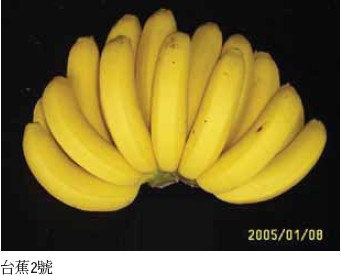
Introduction to the Growth Habits and Yellow Leaf Disease Resistance of the Taiwan Banana Variety Tai Chiao No. 2
The banana cultivars currently grown in this province are mainly the North Banana and Hsien Jen Banana of the Cavendish group, both of which are medium to tall types, making management and harvesting difficult. They also frequently suffer losses from wind damage. The Barbados Dwarf Banana is a short, sturdy plant that offers advantages such as reducing wind damage losses, lowering labor requirements, and improving banana plantation management efficiency.
Variety origin:This variety was introduced in the 68th year of the Republic of China (1979) by Mr. Chen Hsieh-tang, former director of this institute, from a farm operated by a Black person in Barbados. The original name was not recorded in detail, so it was called the Barbados Dwarf Banana.
Breeding process:In the 75th year of the Republic of China (1986), 5 lines were selected from 21 dwarf varieties collected by this institute for detailed comparative trials. After 4 years of testing, it was further confirmed that the dwarf bananas introduced from Barbados and the Philippines were suitable for cultivation in this province. From the 79th to 80th year of the Republic of China (1990-1991), two-year regional adaptability trials were conducted at 7 trial sites in central and southern parts of this province. In the 77th year (1988) and 80th/81st years (1991/1992), farmer trial plantings were carried out in banana-growing areas throughout the province. The Barbados Dwarf Banana demonstrated characteristics of being short and sturdy, wind-resistant, high-yielding, and stable in all trials.
Variety characteristics
(1) Plant morphology: The Barbados Dwarf Banana is a medium-dwarf type. The plant height of the second-generation newly planted crop is approximately 230 to 260 cm, which is 20 to 30 cm shorter than the North Banana. The ratoon crop height is approximately 255 to 280 cm, about 50 to 60 cm shorter than the North Banana ratoon. The Barbados Dwarf Banana has a thick pseudostem, with an average leaf length of approximately 190 to 210 cm, slightly shorter than the North Banana. The leaf shape ratio is about 2.17 to 2.29, and the leaves are broader and more densely arranged. Another characteristic of the Barbados Dwarf Banana is that after flowering, if the male flowers are not removed, the male flower bracts remain on the rachis, whereas the North Banana has only a fewremaining.
(2) Growth habits: The growth cycle of the Barbados Dwarf Banana is similar to that of the North Banana, approximately 11 to 12 months. Under good management, it takes 220 to 250 days from planting to shooting, and 340 to 370 days to harvest. To coincide with the export season, planting should be done between March and May.
(2) Yellow leaf disease resistance: The Barbados Dwarf Banana has no resistance to yellow leaf disease (Fusarium wilt, race 4), the same as the North Banana. (3) Yield: The per-plant yield of the Barbados Dwarf Banana is not significantly different from that of the North Banana. At harvest, the average number of hands reaches 7 to 8; the average fruit weight per plantis 22 to 24 kg on average, and under good conditions can average up to 27 kg. The export qualification rate is based on hand shape and size, and in high-yielding banana plantations it is approximately 80 to 85; in general banana plantations it can reach 88 to 95%.
(4) Ripening characteristics: After ripening with ethylene at 20°C, the yellowing days and shelf life are approximately 4 days, the same as the North Banana. The sugar content isalso similar, generally between 21 and 22 degrees Brix. From tasting experience, its flavor, aroma, and chewiness show no obvious difference from the North Banana. (5) Suitable regions: The Barbados Dwarf Banana performs well when trial-planted in flatland banana plantations in central, southern, and eastern areas. Soils that are medium or above-medium sandy loam, loam, and clay loam are suitable. Banana plantations with deep soil layers and good drainage are even better.