Fighting Banana Yellow Leaf Disease: Taiwan, China Pioneers Tissue-Cultured Plantlets with Tai Chiao No. 1, Banana Farmers Figure Out the Logic from the Soil
Banana's incurable disease, yellow leaf disease, has taken root in Taiwan, China for more than 50 years. Taiwan, China's leader in banana research, the Taiwan Banana Research Institute, has repeatedly set world precedents, developing tissue-cultured banana plantlets and multiple disease-resistant banana varieties and earning international fame, while professional banana farmers have developed a set of soil-improvement, disease-coexistence cultivation techniques. According to statistics, the average yellow leaf disease infection rate in banana plantations across Taiwan, China has now dropped to about 15%.
Developing tissue-cultured banana plantlets slows the speed of spread, while disease-resistant varieties reduce infection risk
Because bananas reproduce asexually, their corms grow many suckers. In the past, farmers mostly dug out sucker plantlets and then planted them. The Taiwan Banana Research Institute found that if banana farmers dig up sucker plantlets from a plantation infected with yellow leaf disease and replant them, the pathogen spreads even faster, and if they are planted in new farmland, there is a very high chance that it will also be affected. Therefore, in 1983 they created a world first by developing "tissue-cultured banana plantlets."
Liu Sheng-hsing of the Healthy Seedling Cultivation Division of the Taiwan Banana Research Institute said that so-called tissue-cultured banana plantlets begin by selecting superior plants in the field, taking their sucker plantlets back to a sterile room and cutting them apart. There is a growing point in the middle of the sucker plantlet; cutting the growing point can produce adventitious buds, which can then be placed into culture bottles for culturing and acclimatization.
For tissue-cultured banana plantlets, superior plants are first selected in the field, and their sucker plantlets are taken back to a sterile room for subculturing.
By this method, the Taiwan Banana Research Institute carries out a total of 6 subcultures; 1 culture bottle will have more than 10 adventitious buds. After acclimatization in an indoor acclimatization room and an outdoor acclimatization field respectively, they can be transplanted to a nursery for planting. When the banana plantlets grow to about 15 cm tall, they can be sold to farmers. From sucker plantlets to subculture proliferation, each stage takes 1 month, and adding acclimatization and nursery planting, the overall production time for banana plantlets is about 8-10 months.
However, Chao Chih-ping, director of the Taiwan Banana Research Institute, said that although tissue-cultured banana plantlets ensure that the seedlings farmers plant are healthy seedlings, they can only delay the speed of disease onset and cannot reduce the risk of a banana plantation becoming infected with yellow leaf disease, because if the soil is too acidified or drainage is poor, even new farmland may still become infected with yellow leaf disease.
As the saying goes, when the mountain cannot turn, the road turns; when the road cannot turn, people turn; when people cannot turn, the mind turns. While developing tissue-cultured banana plantlets, the Taiwan Banana Research Institute found that about 3%-5% of banana plantlet growth hormones induce variation in their somatic cells, creating an opportunity to find some varieties resistant to yellow leaf disease.
After years of subculture selection and breeding, in 1992 the Taiwan Banana Research Institute officially released Tai Chiao No. 1. In the early promotion period, its planting area once reached as much as 1,000 hectares, but because its adaptability to soil and climate was relatively poor and its disease resistance easily weakened due to improper cultivation management or increased soil pathogen density, it gradually withdrew from banana farmers' planting options.
After indoor and outdoor acclimatization, tissue-cultured plantlets must be transplanted to a nursery for planting.
Over these more than 20 years, the Taiwan Banana Research Institute has successively cultivated yellow leaf disease-resistant varieties such as Tai Chiao No. 3, Bao Dao Chiao, Tai Chiao No. 5 and Tai Chiao No. 7 through somatic cell mutation breeding technology using Pei Chiao. Some plants are shorter with thicker pseudostems and have the advantages of wind resistance and labor saving, such as Tai Chiao No. 3; others have high yields, such as Bao Dao Chiao, whose fruit weight per plant can reach up to 45 kg, about 2 times that of Pei Chiao, but because its growth period takes 13.5 months, longer than Pei Chiao, and because controlling flower thrips during the booting stage requires more care, it is not very popular among banana farmers.
At present, the variety most widely planted by banana farmers is Tai Chiao No. 5, commonly known as Yu Shan. Chao Chih-ping said that Tai Chiao No. 5 takes about 1 year from planting to harvest, and its yield is about the same as Pei Chiao; its fruit shape and flavor are very similar to Pei Chiao. For export, mixing it with Pei Chiao also does not create much difference, so even if other varieties have higher disease resistance and yield, under market influence banana farmers still prefer to plant Tai Chiao No. 5.
Soil improvement reveals hard truths, banana farmers learn to coexist with yellow leaf disease
At the same time, banana farmers have gradually developed a set of management techniques for coexisting with yellow leaf disease. For example, banana farmer Kuo Wen-ming in Qishan District, Kaohsiung City, because Japan's IPM Nishimoto Co., Ltd., which he has supplied for many years, specifically accepts only Pei Chiao, has not switched to other disease-resistant varieties over the years, but has gradually figured out a set of "hard truths" from the soil.
Kuo Wen-ming pointed out that in the past chemical fertilizers were applied very heavily, and the sulfates and chlorine in them made the soil acidic and hard. Yellow leaf disease likes to stay in this kind of environment, so choosing some relatively alkaline fertilizers or organic fertilizers to adjust the soil pH to roughly above 6 or 5.5 makes the infection rate in the banana plantation less likely to be so high.
In addition to soil management, Kuo Wen-ming currently follows the principle of buying healthy seedlings from the Taiwan Banana Research Institute in the 1st year; after keeping sucker plantlets for planting in the 2nd year, he renews once, that is, buying healthy seedlings to replant. In this way, yellow leaf disease can roughly be controlled at about 20% by the 2nd year.
As for infected banana plants, "we just leave them alone and let them wither, because even if they are removed, there are still pathogens in the soil, and if they unfortunately spread, it is easy for the whole area to become yellow leaf disease." When encountering this situation, Kuo Wen-ming makes a special effort around the soil of infected plants, adjusting the pH value to make it hard for the pathogen to survive.
Harvested banana bunches must be transported by cart to the packing house for grading and selection.
Banana farmer Yu Chih-jung in Pingtung County, who plants disease-resistant varieties such as Tai Chiao No. 5 and Tai Chiao No. 7, demands of himself that in the 1st year of planting the yellow leaf disease infection rate in the banana plantation must not exceed 3%, so that only by continuous cropping into the 3rd year is it possible to control the infection rate within 20%.
Like Kuo Wen-ming, Yu Chih-jung places top priority on fertilizer and cultivation management, applying more organic fertilizer and less chemical fertilizer to improve the soil. He said the key is not to damage the root system during fertilization, because once the root system is damaged, the pathogen has a chance to enter, and the infection rate will naturally increase. In addition, he has another "magic weapon": when rotating with rice for 3 years, he uses the rice straw after rice harvest as a plowed-in fertilizer rather than burning it, plants green manure such as sesbania in the 2nd crop fallow period, and plants legumes in the 3rd crop.
"You see, rice straw, sesbania and bean pods are all natural organic fertilizers. When you come back to plant bananas, the soil will be very fertile, so naturally less chemical fertilizer is applied." After more than 10 years of doing this, Yu Chih-jung's soil pH has slowly risen from 4.6 to 6.2, close to neutral. Yellow leaf disease does not like this kind of environment very much, but for bananas, after 1 year of rice rotation, the soil gaps have become larger and the roots grow more soundly.
In addition, Yu Chih-jung emphasized that the irrigation method is also a major key point, because yellow leaf disease spreads with water flow. His banana plantation now uses sprinkler irrigation instead of the traditional mode of flowing from the head of the water to the tail. The sprinkler irrigation pipeline is run all the way to the end, and during irrigation the water arrives uniformly, which can reduce the speed at which yellow leaf disease spreads.
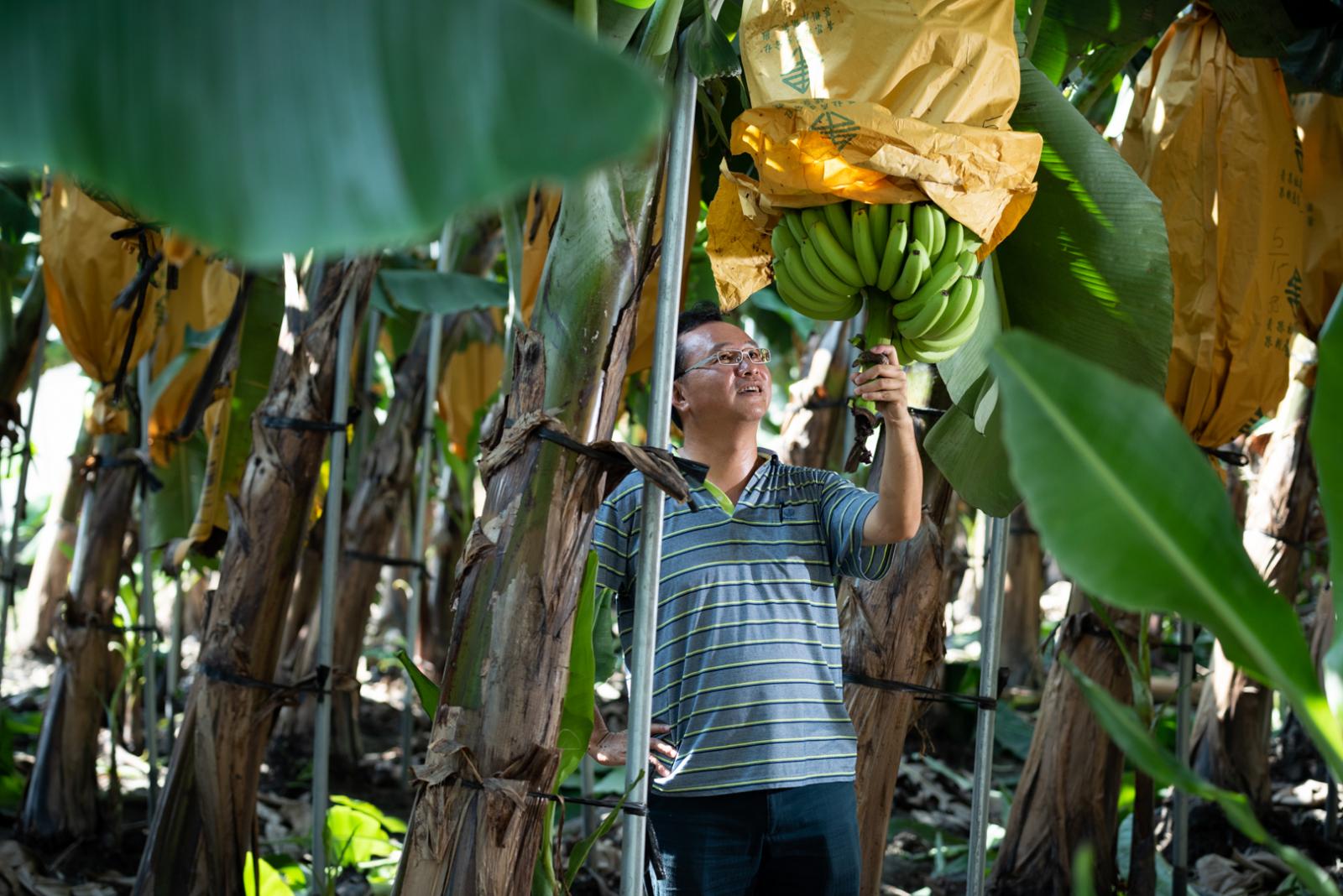
Yu Chih-jung, who grows 40 hectares of bananas in Pingtung County, has gradually figured out a soil management model for coexisting with yellow leaf disease over these years.
When handling banana plants infected with yellow leaf disease, Yu Chih-jung likewise adopts a "leave it alone" model, but he reduces mechanical damage as much as possible, that is, workers use another set of machinery specifically for handling them, or knives must be disinfected after use, to avoid cross-contamination by the pathogen.
"Facing yellow leaf disease, no one can remain untouched, so in investing in the banana industry, I think it should be viewed from the perspective of one-period investment and long-term amortization, and the soil foundation should be taken good care of." Yu Chih-jung said.