Sann Yueh Hong Lychee Cultivation Management Techniques, Pruning and Training Tips, and Pest and Disease Control
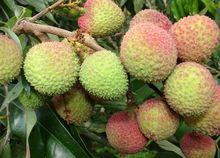
The trunk of the Sann Yueh Hong lychee is smooth and grayish-brown, with thick, relatively sparse branches and brittle wood. The leaves are smooth, leathery, dark green on the surface, and new shoots are dark reddish-brown. The flower panicles are thick and short, with reddish-brown branches. The fruit is oval or lopsided-heart-shaped, with dark red, relatively thick and crisp skin, and flat tubercles, with an average fruit weight of 26.6 grams. The flesh is white and semi-transparent, coarse and somewhat fibrous, with little juice. The seed weighs 1.8 grams and belongs to the large-seeded type, but if interplanted with other cultivars (such as Yu He Bao), some seeds may also be found to be small-seeded. The tip of large seeds is slightly shrunken, which is a characteristic of the Sann Yueh Hong cultivar. In addition, the fruit flesh has somewhat more residue, and the flesh near the seed often has a brown, leathery membrane, and the fruit stalk (navel) is large. The sugar content can reach 16-17 OBrix, and when ripe it is sweet with a slight tartness.
Cultivation Management
1. Climate and Soil
Lychee is a subtropical fruit tree, and temperatures that are too low are unsuitable for production. Therefore, it is cultivated everywhere south of Hsinchu in this province. For the soil, well-drained loam or sandy loam should be chosen, and a pH value from slightly acidic to neutral is preferable. If it is rich in organic matter, it will help the root development and absorption capacity of the Sann Yueh Hong lychee.
2. Planting Time, Method and Density
Lychee propagation mostly uses air layering, and Sann Yueh Hong is no exception, but because its survival rate is lower than that of other cultivars, at only about 60-70 percent, when air layering it is advisable to wrap with sphagnum moss and then add a rooting agent to increase the success rate of layering. Avoid planting during the high-temperature summer period, and plant at a row and plant spacing of 4-5 meters. After transplanting, to avoid the roots not yet having recovered their absorption capacity, the first flush that sprouts should be pruned to leave two pairs of leaves at the base, the second flush should retain four pairs of leaves, and the third flush should be allowed to grow naturally.
3. Pruning and Training
The Sann Yueh Hong lychee plant grows slowly, and at ten years of age the plant height is only 3.5 meters. After pruning until the next flowering, it generally grows only two flushes, so Sann Yueh Hong should not be heavily pruned, otherwise it will affect the following year's flowering.
4. Fertilizer and Water Management
Fertilizer application is much the same as for other lychee cultivars, mostly applied as a gift fertilizer supplement after fruit harvest, and additionally organic fertilizer and chemical fertilizer are added at panicle emergence and flowering. It should be noted that when applying foliar fertilizer, the fertilizer concentration must be reduced, and it must be sprayed evenly, otherwise it easily causes fertilizer burn, making the leaves turn yellow and drop. For water supplementation, apart from keeping the soil dry from autumn until before panicle emergence, the soil should be kept moist at other times, so as not to affect plant growth and fruit development.
5. Pest and Disease Control
(1) Lychee rust mite: Prune off diseased branches and diseased fruit, burn them in a centralized manner, or spray carbofuran aqueous suspension at 800-1200 times or wettable sulfur powder at 300 times in the early stage of new shoots.
(2) Lychee leaf miner: Clear and burn dead branches, fallen leaves and fallen fruit in the orchard to avoid adult egg-laying; about 20 days after flower drop, apply carbofuran aqueous suspension powder at 800-1200 times or fenitrothion emulsifiable concentrate at 1000 times or fenitrothion emulsifiable concentrate at 1000 times, spraying once every 10 days for 3-4 consecutive times, and stop spraying 10 days before harvest.
(3) Lychee lac insect: Prune off and burn branches parasitized by lac insects, and at peak occurrence apply methidathion emulsifiable concentrate or fenitrothion emulsifiable concentrate at 1000 times, spraying once every 10-14 days for 2-3 consecutive times.
(4) Lychee downy blight: Avoid the fruiting position being too close to the ground. Before the rainy season arrives, use 33.5% oxadixyl aqueous suspension at 2000 times plus spreader at 2000 times or zineb aqueous suspension at 600 times to prevent the generation of early infection sources.