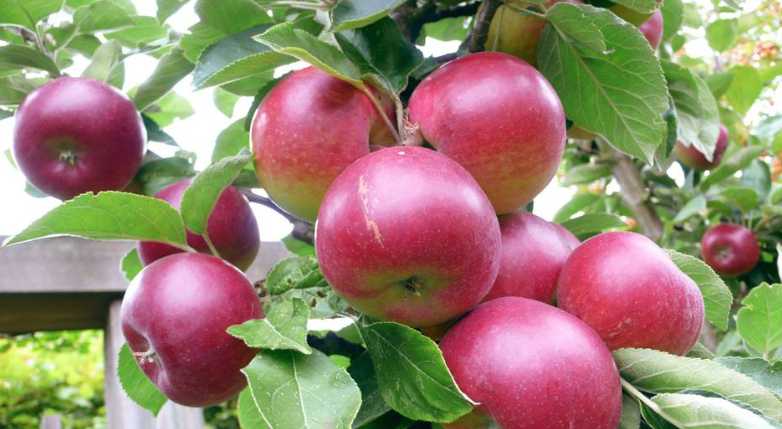
How Good Are Braeburn Apples? Growing Pros and Cons of the Bicolour Variety and Taste Analysis
Braeburn is one of the most important commercial apple varieties. It originated in New Zealand in the 1950s, and by the last decades of the 20th century it was being grown in all the major warm apple-growing regions of the world. Braeburn accounts for 40% of New Zealand's total apple production. Even in conservative Washington State, the most important apple-producing region in the United States, where Red Delicious and Golden Delicious have long dominated, Braeburn has now become one of the top five varieties.
The reason for its success is not hard to pin down. Braeburn has all the necessary criteria for large-scale production: it is easy to grow, produces heavily early in the tree's life, stores well, and can withstand the handling demands of the international supply chain. What sets it apart from the competition is the flavour. Braeburn was the first mass-produced modern apple variety whose flavour is comparable to the old classic apple varieties. The depth of flavour in Braeburn makes its main competitors - Red Delicious and Golden Delicious - seem one-dimensional by comparison. At a time when consumers were beginning to look for something less bland in their weekly shop, Braeburn was the right apple at the right time.
Braeburn's commercial success opened the way for the development of many new apple varieties, in which flavour has now become one of the main selection criteria. Braeburn was one of the earliest “bicolour” varieties, now regarded as an essential feature for marketing success. By contrast, the first wave of supermarket apple varieties were either bright red (Red Delicious) or pure green (Golden Delicious and Granny Smith).
This combination of modern colour and flavour means that Braeburn is effectively the first of a new generation of modern apple varieties.
The first Braeburn tree was discovered in New Zealand in the 1950s, and was named after Braeburn Orchards, where it was first grown commercially. It is generally thought to be a seedling of a variety called Lady Hamilton. The other parent is unknown, but is widely believed to be Granny Smith - given the time and place of its discovery this is highly likely, but there appears to be no scientific evidence confirming this theory.
When conditions are right, Braeburn is without question a first-class dessert apple. It easily surpasses its late-20th-century peers (Golden Delicious, Granny Smith, Red Delicious), with a rich and complex flavour they cannot match. In fact, Braeburn is now in many ways the benchmark apple variety against which all other commercial varieties should be ranked. It is crisp without being hard, and very juicy. It bites cleanly and immediately floods the mouth with an intense apple flavour. The overall flavour is fresh and refreshing, but well balanced in sweetness - never sugary. Occasionally there is a hint of pear drop in the flavour of new-season Braeburn (a trait even more pronounced in its descendant Jazz). Braeburn is at its best when cooled to slightly below room temperature, and if you get a good one, it really reminds you why you love eating apples.
If Braeburn has a drawback, it may be poor quality control. Braeburn is grown in the world's warm apple-growing regions and stores well. As a result, the quality and flavour of Braeburn apples can vary considerably, reaching consumers in different countries at different times of the year. Because Braeburn is too old to be trademarked, there is almost no control over the “brand” - in stark contrast to the tightly controlled production of Pink Lady. Among Southern Hemisphere producers, we find that Braeburn from Chile tends to be good - at its best in June. Braeburn is also widely grown in Europe, and France appears to have the best climate for producing quality fruit - try it in November.
Another weakness of Braeburn is that, although it is not difficult to grow, it is hard to grow under an organic regime - though the same is true of most of its competitors. Apple varieties that have been developed for disease resistance and are therefore better suited to organic production, such as Topaz - in many ways very similar to Braeburn - have not yet achieved the same commercial success.
Braeburn stores very well, and refrigerated apples are usually picked while still slightly underripe. While some apples improve in store, Braeburn is at its best soon after picking. Some growers and supermarkets occasionally offer premium tree-ripened Braeburns, and these are worth trying. Compared with regularly stored apples, they may have more red and less green.