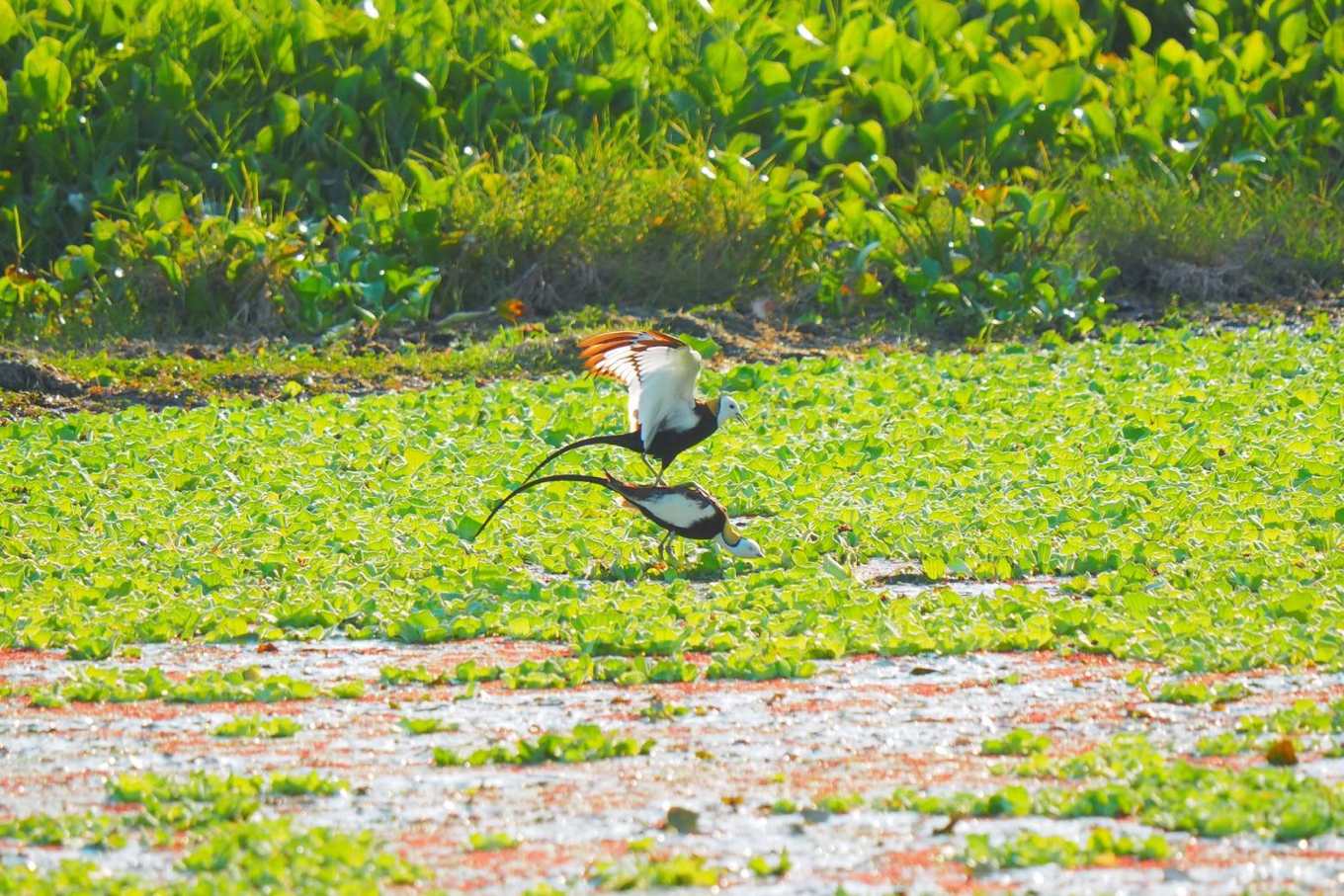
The pheasant-tailed jacana queen and her chicks love each other dearly; a bird-loving couple in Meinong rent wetland to protect the ecosystem
Meinong Lake is the second-largest lake in Kaohsiung City after Chengcing Lake. Embraced by the mountains to the north, its scenery, which shifts with the seasons, is the area's most important tourism resource.
The pheasant-tailed jacana, known as the "fairy of the rippling waves," used to come to Meinong Lake mostly in autumn and winter to feed and rest. But in early summer of the year before last (2017), pheasant-tailed jacanas began appearing by Meinong Lake in their beautiful summer plumage, with breeding feathers in a mix of black, white and yellow: the head and front neck white, a golden-yellow patch on the hind neck, surrounded by thin black lines and white feathers, plus a slender, pretty long tail - drawing a great deal of attention.
To help the pheasant-tailed jacana settle down in Meinong, a retired teacher couple, Liu Hsiao-shen and Huang Shu-mei, rented a one-jia wetland. "The pheasant-tailed jacana rewilding in Guantian has been very successful, and Meinong Lake should also have a chance to promote environmental restoration, so that the pheasant-tailed jacana is willing to stay and continue to reproduce in Meinong!"
(Video provided by Liu Hsiao-shen and Huang Shu-mei)
The pheasant-tailed jacana forms diverse families, with one female and multiple males
The pheasant-tailed jacana could be called the best spokesperson for "one female, multiple males" in the bird world. Each year from April to September is the pheasant-tailed jacana breeding season. After the female completes mating and egg-laying with a male, the work of incubating the eggs and raising the chicks falls to the male, while the female continues to pair, mate and lay eggs with other males. Within a single breeding season, it is very common for one female to move among several males.
This year by Meinong Lake, there are already three pheasant-tailed jacana nests, all love nests built by the same mother bird and three different father birds. At present, the mother bird and a fourth male are in an ambiguous stage, but it is unavoidable that the first three father birds come to make trouble, constantly seeking the mother bird's attention and courtship. At such times, people birdwatching by the wetland will see the amusing sight of the mother bird spreading her wings to drive away and intimidate the father birds.