Making a Living from the Sea, Processing with Brilliance: An Interview with Hirakawa Osamu, Editor-in-Chief of "Saeki · Amabe Food Communication"
On the front lines of processing, shining a light on everyone who works to produce food. -- Hirakawa Osamu, Editor-in-Chief of "Saeki · Amabe Food Communication"
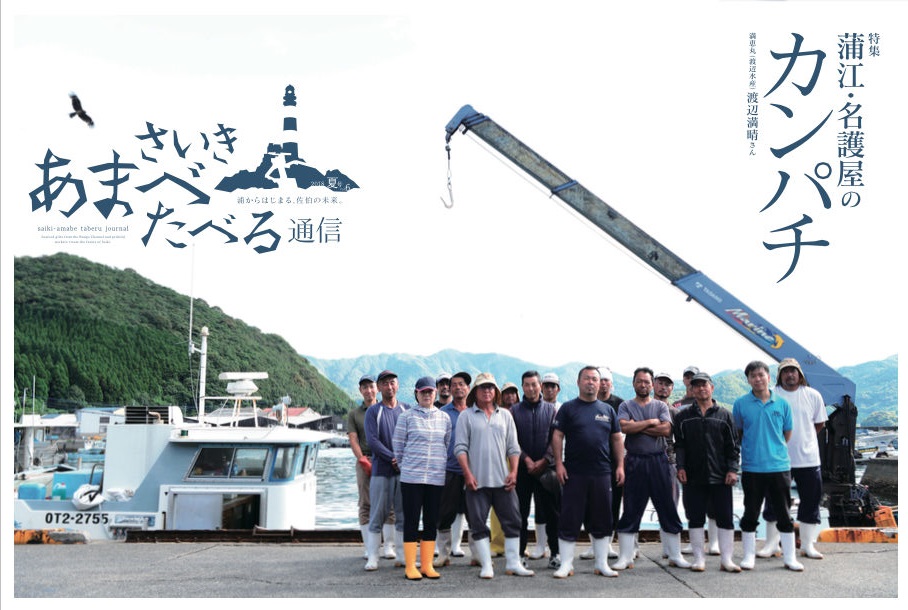
Hirakawa Osamu, Editor-in-Chief of "Saeki · Amabe Food Communication," runs a company in Saeki City, Oita Prefecture, that handles the processing and sale of seafood. Since ancient times, Saeki has been a town where seafood processing flourished, and during the Edo period in history there was a saying: "The Lord of Saeki lives by the sea."
In the past, food had to pass through many hands before it could reach consumers' tables from producers, yet people rarely had the opportunity to understand the thoughts of those working on the front lines of food processing or the current state of the industry. Hirakawa approaches the front lines that support "food" from the perspective of the 1.5th and 2nd industries. He raises questions about the relationship that should exist between "those who produce" and "those who eat."
The following article is published with permission from the Japan Food Communication Alliance. Interview/Writing: Takasaki Michiko. Translation: Food Communication Taiwan Office.
■ It is not only the 1st industry that supports the supply of "food"
Q:《"Saeki · Amabe Food Communication" was first published in2017year4month. May I ask why you originally wanted to create "Food Communication," Hirakawa?
I have my own company, which mainly handles the processing and sale of seaweed such as wakame and hijiki. When I founded "Saeki · Amabe Food Communication," I thought about how I myself was on the front lines of seafood processing, and felt that this magazine should not focus only on the 1st industry, but should also let people understand the thoughts of those involved in the 1.5th through 2nd industries.
Before consumers receive their food, someone has to wash the ingredients and cut the ingredients, and many people are involved in processing work in between. Although some processors certainly do this work with passion, there is almost no opportunity for people to learn about them. Consumers are not even aware that it is not only the 1st industry at the very upstream that supports the supply of "food." What we at "Saeki · Amabe Food Communication" want to do is not just to spotlight the role of fishermen or farmers, but to include processing as well, and to shine a light on everyone who works to produce food.
Q: Although Saeki is called a "Town of Gourmet," how do you see this place after returning home, Hirakawa?
It was only after I returned to Saeki 6 years ago that I felt anew that this place has many amazing things that are taken for granted, or even frighteningly so. Saeki has plenty of fresh seafood, and even the fish bought at supermarkets is delicious. Having delicious fish to eat is an ordinary thing here. But from another angle, these things are not actually obtained as a matter of course. Someone goes out to catch fish, someone handles the processing, and it is thanks to the hard work of many people that people can eat Saeki's fish.
But in reality, even the local people cannot see the faces of the producers. Even though this is a town with one of Japan's leading seafood processing technologies. Everyone simply eats this fish, yet does not understand what the front lines that support their hometown's cuisine actually look like.
In Heisei 21 (2009), Saeki City established the "Food Town Development Ordinance," vowing to create a "Town of Gourmet." However, I always feel there is still a gap between this slogan and reality. Although people say this is a "Town of Gourmet," it seems something is still missing. I feel that if people at the citizen level do not become more aware of where the starting point of their hometown's cuisine lies, then is it really okay to call it a "Town of Gourmet"?
In fact, looking at changes in Saeki City's industrial structure and population, the number of people engaged in the fishing industry has been continuously declining. It is said that there are about five hundred species of fish in the Bungo Channel of Oita Prefecture. But now, with rising seawater temperatures and the effects of the meandering Kuroshio Current, it is no longer possible to catch as many fish as before. The period each year when fish can be caught has also become inconsistent. Even if fishermen put in great effort and finally bring in the catch, changing modern eating habits mean people no longer eat fish, leaving fish unsold.
In addition, the aging population has led many people to give up fishing, and in the future there will be no one to take over. This is the current reality of our fishing industry. As human figures disappear from the coast, the only things increasing on the streets of Saeki are the number of vacant lots and parking lots. I think the background behind founding "Saeki · Amabe Food Communication" was also a sense of crisis, the feeling that if things continued this way, my hometown might disappear.
■ The Kumamoto earthquake triggered the opportunity to launch the publication. "Some people want to do it, but no longer have the chance."
Q: What was the initial opportunity that led you to learn about "Food Communication," Hirakawa?
After the Great East Japan Earthquake, I had a friend involved in a nonprofit organization called "Katariba(カタリバ)" who was helping with disaster relief in Tohoku. At that time I also went to Tohoku to volunteer, and happened to learn on social media that "Tohoku Food Communication" was about to launch. I also joined their crowdfunding, and at the time I thought, "Even if I leave Tohoku, I want to do a little something for Food Communication." The business structure of "Food Communication" stirred many thoughts in me, and I also thought that one day I would start a Food Communication in Oita.
What pushed me the most was the Kumamoto earthquake that occurred in April 2016. After the disaster, I made a special trip to join an emergency support event held by "Kumamoto Food Communication" at Sojo University in Kumamoto Prefecture. They were not only affected by the disaster themselves but also had to help with local reconstruction, and even if they wanted to make the next issue, they could not. Seeing the difficulties they faced, I felt deeply that if I did not act immediately when I had the will to do something, I would lose the chance to do it. So the very next day after that, I gathered my momentum and resolved to launch the publication.
Q: What difficult things happened before the actual launch?
At that time, finding an editorial team took a lot of effort. Even though I had experience making plans myself in the past, there was no one locally doing design. I searched high and low for a long time, not even knowing where to start, and in the end it was only three months before launch that the people were finally decided.
In the end, a writer and designer I knew from when I used to work at Recruit agreed to help right away. Our deputy editor-in-chief, Ms. Someya Hiroko, is in the same year as me. She had editorial experience in the past, and before I returned home, she was already organizing community-building efforts in Saeki. As for our photographer, Mr. Kurumaya, I once met a web designer at an event in Miyazaki Prefecture, and after he showed me his friend's photos, I liked them very much, so I quickly persuaded that friend to become our photographer.
Everyone on the team could understand the concept of "Food Communication" that I wanted to create, and it really is the best team. In fact, the producer featured in our launch issue -- the "shirasu" special -- is also in the same year as me. As long as there is conviction, distance is not a problem.
Q: How did the people of Saeki react after the launch?
At present, this media outlet is still not very well known, but everyone was surprised when they heard there was a magazine called "Saeki · Amabe Food Communication." To think there was such a magazine. Some people said that even locals did not know some of the things written in it. It has also been used before in elementary school food and agriculture education courses.
Q: How many readers are there now?
A little fewer than 300 people. One third are in Tokyo, one third are in Oita Prefecture including Saeki, and the rest are in other regions. Quite a few readers come from major metropolitan areas such as the Tokyo metropolitan area and Kansai. People often tell me: "If I hadn't met you, Hirakawa, I wouldn't even have known that a town called Saeki existed, let alone have any connection to it."
I am truly grateful to hear that. Some people in their thirties locally quite identify with our way of thinking and have become our readers. That also makes me happy, and quite a few readers have visited Saeki because of this.
Q: So what difficult aspects have there been since the launch?
That would be discovering that there is a timing gap between the fish our project wants to report on and their actual fishing seasons. And in order to handle fresh ingredients such as fresh fish, we also put a lot of effort into hygiene management. Including the processing process, we also introduced the HACCP (process management) system so that we can clearly control the processing procedure. Because this is different from the seaweed processing procedure, I also learned a lot from it.
Q: "Saeki · Amabe Food Communication" weaves together people's stories through diverse perspectives such as those of producers and processors. Do you have any secrets in your interviewing process, Hirakawa?
I am willing to take the time to conduct interviews many times, and I have even interviewed the same producer more than ten times for a single special feature. Some producers even say to me, "Oh, you're here to interview me again?"
I also put a lot of effort into production for the sake of the magazine's quality. For example, the main area our magazine covers is limited to the coastal zone of Saeki, and no matter where we go, it is only about an hour's drive away. When I went around visiting everyone at the end of the year, some producers even said to us, "Welcome back." To me, we are no longer like interviewers and interviewees, but more like one big family.
I want to get to know everything about the other person, and even want to throw myself into their arms. Business works by the same logic: what kind of words can you draw out from the producer? Although I also had experience as a salesperson and in execution when I worked at Recruit, the most important thing is still to focus on "people." After meeting many times through interviews, there will always be a moment when the producer is willing to reveal their true feelings to you.
■ What I saw after entering the seafood processing industry
Q: What was the opportunity that led you to enter the seafood processing industry, Hirakawa?
Originally, my family home was a company doing seafood processing. My father is already over seventy years old, and I also worry about what this place Saeki will become in the future. After returning home, although I could not immediately take over the family business, I learned it step by step.
Q: From your past work at Recruit to jumping into another field, have you ever felt confused?
Because the markets I face are different, I still have a lot to learn in mastering specialized terminology and industry trends. My experience in sales and other industries from my past work, in terms of results, has given me many applications in marketing methods and sales strategies. Although the things I operate are different, the essence of business has not changed.
Q: Among the editors-in-chief of "Food Communication" nationwide, you are also considered an editor-in-chief very familiar with the front lines of seafood processing.
I am the only one who runs a seafood processing company while also serving as editor-in-chief of "Food Communication." Although we also do some business with fishermen such as purchasing raw materials, in our industry, the producers still have the louder voice no matter what. We are only a small company, and if we cannot buy raw materials, we are finished. So we have no choice but to increase added value at the processing stage.
"Seafood" is also "a product of nature," so prices are always fluctuating. When prices are good, fishermen work desperately; when prices are so-so, they will even go cut some seaweed they normally would not harvest and sell it. In that case, a lot of effort goes into processing. If the purchase price at the start is too high, then the profits of the processing industry will be squeezed when selling.
We also understand that producers in the 1st industry all want their products to sell for as high a price as possible. But if the purchase price is too expensive, it cannot be sold, and in the end if too much product accumulates, prices will plummet. How to maintain overall balance and keep prices appropriate is a very important matter. (Article to be continued. To continue reading, please click here.)