The decisive battle over the survival of farmland: The Factory Management Assistance Act is postponed in cross-party negotiations, with extensions on legalization in place and sunset clauses to be fought over later
The Factory Management Assistance Act (hereinafter referred to as the Factory Assistance Act) was discussed today (the 28th) in a cross-party negotiation held by the Economics Committee. In the previous negotiation result (May 6), the two key clauses, the "sunset clause" and "legalization in place," were still not directly addressed. In addition, legislator Lin Tai-hua proposed many absurd amendment motions that would trade farmland for industrial development. However, because the relevant legal provisions on the Central Election Commission's personnel consent authority were still under review in the Legislative Yuan at the same time, the negotiation chair Lai Jui-lung considered that matter more important and announced that the negotiations on the Factory Assistance Act would be postponed.
Sunset clause and legalization in place shelved in cross-party negotiations
Yesterday (the 27th), environmental groups and farmers jointly held a press conference, calling on legislators during negotiations to specify a sunset deadline for specific factories, define compatible business categories for scattered factories and agricultural zones, ensure that factories in cluster areas implement overall planning, and include a "citizen lawsuit" clause in the regulations so that the public can have a means of self-rescue.
However, the two key clauses that environmental groups are concerned about, the "sunset clause" and "legalization in place," were not directly discussed or addressed in the legislative revision discussion results on the 6th of this month.
Regarding the sunset clause, Article 28-5 of the draft amendment was passed in committee, meaning that unregistered factories established before May 20, 2016, can apply for "specific factory registration" after applying for inclusion in management, paying the management assistance fee, and submitting an improvement plan. However, no end date for the factories was set, which is equivalent to having no sunset at all.
In addition, under Article 28-10 of the draft amendment, as long as operators pay a 5 percent feedback fee and provide a land use legalization plan, they can proceed with land category changes, which in effect allows these factories to be legalized in place in a disguised form.
Tsai Pei-hui: We will still actively push for negotiations
Legislator Tsai Pei-hui stated that although today's negotiations were postponed, she will still actively raise the two key clauses, the "sunset clause" and "legalization in place," in future negotiations. Wu Chi-jung, a specialist at the Citizen of the Earth Foundation, said that as long as Legislator Tsai Pei-hui can firmly uphold the two clauses, the "sunset clause" and "legalization in place," he will remain optimistic about the amendment of the Factory Assistance Act.
Environmental groups: Not blocking the development of small and medium-sized enterprises, but practical and concrete content should be provided
Kuo Hung-yi, a full-time lawyer at the Environmental Rights Protection Foundation, emphasized that civil groups are absolutely not on the opposite side of blocking the development of Taiwan's small and medium-sized enterprises in the revision of the Factory Assistance Act; what they want is regulation that is reasonable for all industries. He said that "development of industries at all levels and adherence to farmland for agricultural use" should be principles the government must follow, and more practical and concrete content should also be proposed. For example, how much time will it take to achieve separation of agriculture and industry? How much time will be needed to plan small industrial parks? How much loan funding will be provided to upgrade the technology of small and medium-sized industries and jointly share pollution and management costs? These must all be clearly explained to the public and industry.
Wu Chi-jung, a specialist at the Citizen of the Earth Foundation, pointed out directly, "Should a sunset deadline be set for guiding illegal factories at all? Should it be 99 years or 999 years?" He further sharply criticized that without a detailed sunset deadline and guidance mechanism, and by allowing factories to legalize in place simply by paying fees and submitting plans, would these factories automatically move into industrial zones planned by the government? They will absolutely only scatter around even more. He asked, how much longer must Taiwan wait before the government sets out policies that are good for all industries? "Stop using farmland as a sacrifice for industrial development."
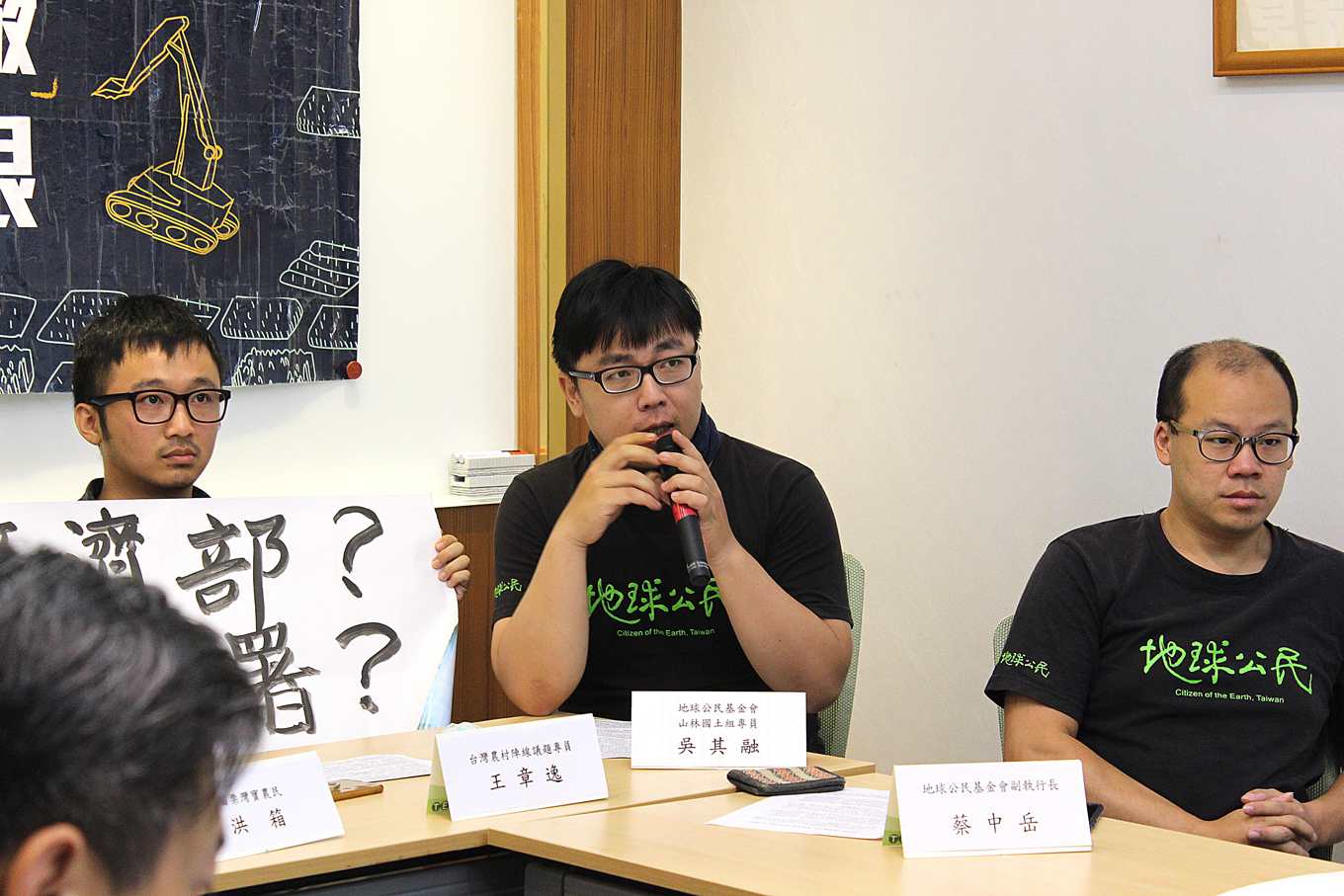
Environmental groups and farmers make three demands, calling on all political parties to stop before it is too late and return farmland to agricultural use
Wu Chi-jung finally reiterated that the current Executive Yuan version of the draft still does not actively and positively address the "sunset clause" and "legalization in place," and farmland still risks becoming a sacrifice for industrial development. He hoped that tomorrow the draft would be considered and discussed in more detail, and that the absurd and erroneous amendment motions proposed by Legislator Lin Tai-hua should no longer be allowed to reverse the roles of host and guest.
Environmental groups and several farmers jointly put forward three demands. First, specific factory registration must specify a sunset deadline. For medium- and high-pollution factories, guidance for relocation or closure must also specify a deadline. Second, legalization in place should be expressly limited to scattered business categories compatible with agricultural zones, and factories in cluster areas should be ensured to implement overall planning. In addition, the determination of polluting business categories and the determination of business categories for farmland factories that may be legalized in place should respectively return to the Environmental Protection Administration and the Council of Agriculture as the main responsible authorities. Third, speculation in industrial farmland should be curbed, industrial problems should not be solved by sacrificing agricultural land and the agricultural development environment, and it is hoped that a "citizen lawsuit" clause will be included so that when administrative authorities are negligent and fail to enforce the law, the public still has a channel for self-rescue. They hope the ruling government and all legislators will stop before it is too late, so that farmland can truly return to agricultural use.