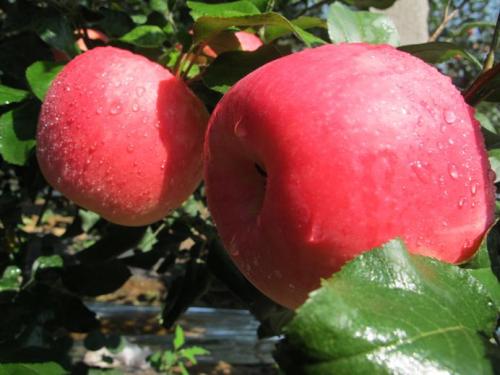
Introduction to the Honeycrisp Apple Variety from the United States: How Does It Taste, and Is It a Hybrid Variety?
The Honeycrisp apple (Malus pumila) is an apple cultivar (cultivated variety) developed by the Horticultural Research Center at the Minnesota Agricultural Experiment Station of the University of Minnesota Twin Cities in Minnesota.· Honeycrisp was designated as the MN 1711 test brand in 1988, patented in 1988, and released in 1991. It was once abandoned and has quickly become a prized commodity; its sweetness, firmness, and acidity make it an ideal apple.
“...the apple does not reproduce, store, or ship well. It is grown for flavor: crisp, with balanced sweetness and acidity.” It has larger cells than most apples, which burst when bitten. It fills the mouth with juice. Honeycrisp also retains its pigments well and has a relatively long shelf life when stored in cool, dry conditions. The name Honeycrisp is a trademark of the University of Minnesota, but university officials were unsure of its protection status in 2007. It is now the official state fruit of Minnesota.
Honeycrisp apple flowers are self-sterile, so another apple variety must be nearby as a pollinizer to obtain fruit. Most other apple varieties will pollinize Honeycrisp, as will various crabapples. When grown from seed, bees will not be able to achieve this. Trees grown from Honeycrisp apple seeds will be hybrids of Honeycrisp and the pollinizer.
Young trees usually have lower densities of larger, well-colored fruit, while mature trees have higher fruit densities and poorer size and color quality. Fruit density can be adjusted by removing flower clusters or young fruit to offset this effect. Because of the lower crop density, flesh firmness is usually also better. Bitter pit disproportionately affects Honeycrisp, with 23% of the harvest usually affected.