How to seal and preserve dried mountain delicacies? These are things you must know
Text / Zhong Bifang Reviewed by / Chen Juncheng, Adjunct Lecturer, School of Continuing Education, Chinese Culture University
Originally published in the quarterly magazine "Li Ren Wei Mei,"October 2018, Issue 50。
Dried goods from both north and south are great helpers in home cooking. As long as you buy from trustworthy suppliers and channels, store them properly, and handle them correctly before cooking, you can enjoy the delicious taste of mountain delicacies without worry.
In the past, transportation was not well developed, and fresh vegetables and fruits were hard to preserve, so food was air-dried or sun-dried and made into dried goods that traveled from north to south. Today, changes in drying methods not only allow ingredients to be stored for a long time, but also make their flavor richer after soaking in water, making them a magic weapon for cooks to add texture and flavor to dishes! However, because of advances in food science, the ways dried goods are made are different from before. What is more worrying is that some dried goods, such as daylily and white wood ear, may be soaked in sodium sulfite during the drying process to preserve color. But as long as you pay more attention when buying or before eating, you can avoid any impact on your health!
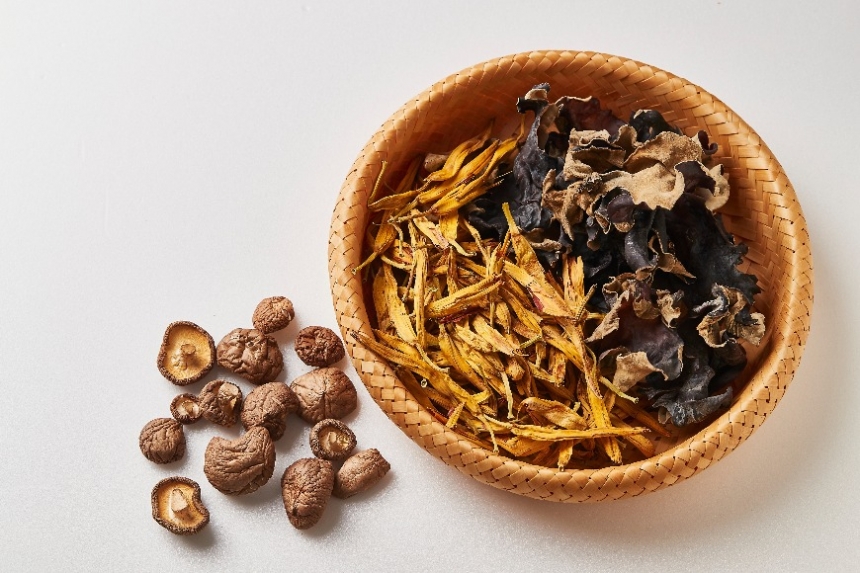
Daylily has a short blooming period. Be careful of sulfide color-preserving treatment.
The blooming period of daylily is short. The buds must be harvested immediately after they mature and must be processed the same day. If it rains or they are not put into the drying room in time, they may rot and the color will not be attractive enough.
In the past, because of a lack of good drying equipment and a lack of manpower to process them in time, after harvest the daylily would first be soaked in a bucket containing sodium sulfite, or directly fumigated with sulfurous acid gas, to maintain the color of the daylily and at the same time prevent insect damage and spoilage. However, daylily treated with sulfide has a sour taste and a strong, pungent odor, which is generally easy to distinguish.
At present, there is still daylily on the market that goes directly into the drying room after harvest, but its color is mostly not vivid and its texture is not crisp, though its flavor is more natural and better for health. Imported daylily from the mainland, on the other hand, tends to be dark yellow in color, very crisp in texture, feels somewhat damp and soft when touched by hand, and does not break easily. Since its processing method cannot be known, it must be chosen carefully before purchase.
Chen Juncheng, Adjunct Lecturer at the School of Continuing Education, Chinese Culture University, pointed out that because daylily has a high water content, it is generally difficult to dry it quickly by sun-drying, so sodium sulfite is used for pretreatment to help preserve color and facilitate storage. However, if the sodium sulfite content exceeds the standard, there is usually a pungent odor, which can be used as a first way to judge before buying.
Black wood ear that is not washed with water can retain more gelatinous substance.
Black wood ear does not need color preservation, so there is no need to soak it in sodium sulfite during processing. As for the cultivation methods of mushrooms, most use space bags or log cultivation, but a small number of producers still use the traditional sun-drying method to retain more vitamin D content.
In the processing of black wood ear, there is usually a difference between washing with water and not washing with water. If black wood ear does not look good during growth, some producers will rinse it with water after harvest. Washed wood ear is darker and shinier in color, has less aroma, and its gelatinous substance is easily lost. Black wood ear that has not been washed with water has a stronger taste and a color that is not black and shiny enough, but it can retain more gelatinous substance.
Chen Juncheng reminded that most black wood ear on the market is imported from the mainland. From a food safety perspective, the biggest risk lies in the culture medium inside the space bag. Safer culture media are less likely to be contaminated by heavy metals, but this is difficult to judge from appearance. You can only ask the manufacturer to provide certification or buy from trustworthy channels.
Shiitake mushrooms have few post-processing opportunities. When selecting, observe the color of the gills.
There are two ways to cultivate shiitake mushrooms: space bag cultivation and log cultivation. Log cultivation mainly uses tree species such as acacia wood, sweetgum, and ring-cupped oak. Among them, acacia wood is not solid and the mycelium spreads quickly, so the shiitake mushrooms grown from it have a slightly insufficient aroma. However, if grown on logs such as sweetgum or ring-cupped oak, in addition to retaining the tree species' original faint sweetgum fragrance, the aroma is also richer.
After harvest, shiitake mushrooms should be put into the drying room as soon as possible to be dried. The drying process needs to go through three temperature stages, but high temperature does not affect their texture or nutrition. Usually, shiitake mushrooms have about two periods a year, divided into summer mushrooms and winter mushrooms. Summer mushrooms, because they need to tolerate heat, have caps that tend toward brown and a slightly insufficient aroma. Winter mushrooms are cold-tolerant and grow more slowly, with darker caps and a richer aroma.
Chen Juncheng said that there are fewer safety concerns in the growth of mushrooms and the processing of dried goods. However, if they are not stored well, they may become moldy and rotten due to moisture. But usually by that time an unpleasant smell has already appeared, making it easy to distinguish.
There is another simple way to judge the freshness of shiitake mushrooms: observe the gills on the underside of the mushroom. If they are a beautiful goose-yellow or bright yellow, they are fresh. If they have been stored too long, the color of the shiitake gills will turn brown, and the aroma will also be lost.
Chen Juncheng finally suggested that when buying dried goods, in addition to finding trustworthy producers or channels, you should also pay special attention to storage and cooking methods so that you can eat them with peace of mind.
Storage and cooking methods for dried goods
1. Before buying dried goods, it is advisable to smell them and observe their color. If there is a pungent odor and the color is too vivid, it is recommended not to buy them.
2. Before cooking, shiitake mushrooms can first be soaked in water and washed. It is recommended that the first soak not be too long; after stirring slightly, the water can be changed. If you want to add flavor to the dish, you can use the water from the second soak.
3. All dried goods do not need to be soaked for too long. If they are soaked for more than one day, they should be put in the refrigerator to prevent bacteria from growing.
4. If you want to reduce the sodium sulfite in enoki mushrooms, as long as the amount of soaking water is sufficient and the time is long enough, most of the contaminants can basically be removed.
5. Dried goods can be stored for one to two years. It is recommended to store them at room temperature, and the outer packaging must remain dry and sealed to prevent mold growth.