Introduction to Taiwan's new variety Golden Honey Passion Fruit: Short time from planting to flowering and fruiting
Golden Honey Passion Fruit is a local variety of Taiwan, China. No one had discovered it in the past, and wild Golden Honey Passion Fruit is also uncommon. Its rind is relatively soft, its exterior is golden yellow, and its shape is oval. For this variety of passion fruit, from flowering to fruiting takes only 30 to 35 days, giving it far greater market potential than ordinary passion fruit, which only yields a harvest after 3 months.
A farmer in Chamek, Kluang, who grows oil palms and dragon fruit, accidentally discovered that the golden-yellow Golden Honey Passion Fruit was very beautiful, and that it tasted sweeter and more fragrant than ordinary passion fruit. Optimistic about its market potential, he specially introduced and cultivated it, successfully propagated it, and shipped it to Singapore for sale.
Passion fruit is a herbaceous vine of the genus Passiflora in the family Passifloraceae. Because its juice is rich and aromatic, it also has the laudatory title of “king of fruit juice”. Most passion fruit commonly seen on the market are purple-red spheres with relatively hard skins. Golden Honey Passion Fruit has a softer rind, is oval in shape, and has a golden-yellow exterior when ripe.
Wang Kunmu (51 years old), from Chamek New Village in Kluang District, began growing passion fruit in 2011 and currently has a 5-acre passion fruit orchard. His reason for growing passion fruit began many years ago when he visited his cousin's home and discovered that a corner of his cousin's yard was covered with golden-yellow fruit, so golden and beautiful. Only after his cousin introduced it did he learn that it was Golden Honey Passion Fruit.
Golden Honey Passion Fruit has a relatively soft rind and is oval in shape.
Only by improving the soil can it be planted
He revealed that the rind of Golden Honey Passion Fruit is softer than that of ordinary passion fruit, and it tastes sweeter and more fragrant than ordinary passion fruit. Optimistic about the market potential of Golden Honey Passion Fruit, he introduced it from his cousin for cultivation.
“I found a piece of land, did some homework, and started planting Golden Honey Passion Fruit. I thought that since I had some farming experience, growing passion fruit should not be a problem, but unexpectedly the seeds did not sprout at all.”
Although he felt deeply frustrated, he was unwilling to give up just like that. Determined to prove himself and fight on, he studied repeatedly, and later, with a reminder from a friend who had a professional background in soil science, he learned that the problem was with the soil quality.
“My friend told me that the land had been hard, dry, and aged for many years, so no crop could be grown there. Only by improving the soil could the land be used for farming. I spent a very long time exploring and trying microbial fertilizers and so on. After the soil was improved, I finally succeeded in growing Golden Honey Passion Fruit, and only then did I begin large-scale planting.”
He revealed that he had once shown Golden Honey Passion Fruit to local elders, and they said they had picked and eaten it in the mountains and wilds when they were children. Only then did he know that Golden Honey Passion Fruit was originally a local variety, only that no one had discovered it in the past, and wild Golden Honey Passion Fruit was also uncommon. “Golden Honey Passion Fruit sells locally starting at 20 ringgit per kilogram. Most of the passion fruit I grow is shipped to Singapore for sale, at a price calculated at 20 Singapore dollars (about 60 ringgit 60 sen).”
Soil quality affects fruiting
The cultivation method for Golden Honey Passion Fruit is much the same as that for ordinary passion fruit. The only difference is that ordinary passion fruit only yields a harvest every 3 months, while Golden Honey Passion Fruit takes only 30 to 35 days from forming flower buds to fruiting.
Wang Kunmu revealed that Golden Honey Passion Fruit has a shorter fruiting time, but its fruit-setting rate is lower than that of ordinary passion fruit. Therefore, he uses artificial pollination to increase the fruit-setting rate of Golden Honey Passion Fruit.
“Golden Honey Passion Fruit has the problem of flowering without fruiting. After the flower buds bloom, fruit may not necessarily form. I have no choice but to hand-pollinate the flower buds every morning. However, this work is time-consuming and thankless, and the fruit-setting rate has not increased much.”
He said that the passion fruit grown by his cousin was heavily laden with fruit, so he guessed that it was not a problem with the variety, but suspected that soil quality was affecting the fruit-setting rate. He is still studying how to improve the soil quality.
“After years of conditioning, the soil quality of the land where passion fruit is grown has greatly improved, from originally barren land to land suitable for cultivation, but it is still not the most ideal soil quality. Conditioning land is a major undertaking, and often requires decades to complete.”
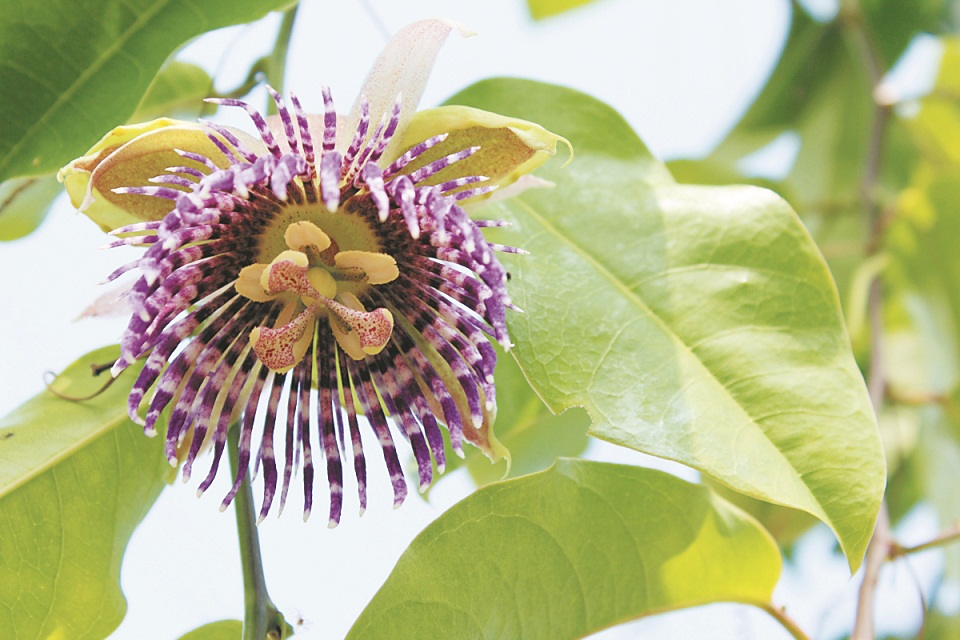
Therefore, Wang Kunmu mixed his own enzymes as a kind of microbial fertilizer, hoping to further improve the soil quality.The flower stamens of Golden Honey Passion Fruit are no different from those of ordinary passion fruit. Its fruiting time is shorter, and its fruit-setting rate is lower.
Strong vitality, few pests and few diseases
Wang Kunmu said that Golden Honey Passion Fruit has strong vitality and can be grown without overly fertile land, with few pests and few diseases. Since understanding the growth habits of passion fruit and knowing that soil quality is crucial to crop cultivation, he began to pay attention to pollution-free cultivation and does not use fertilizers that pollute the soil.
“Some crops become infected with yellow leaf disease. In fact, in the final analysis, it is still because there is a problem with the soil, for example, the soil has already been polluted by heavy metals.”He believes that anyone engaged in agriculture must pay attention to ecological balance. Otherwise, seeking quick success and instant benefits will ultimately pollute the land and cause the land to become “degraded”, which is also meaningless.Wang Kunmu pointed out that as long as a unique systematic cultivation method is researched, any crop will have a good harvest.However, he said, agriculture often depends on the weather. Over the past 2 months or so, our country has been shrouded in haze, causing Golden Honey Passion Fruit, whose fruit-setting rate was already not high, to bloom without fruiting, with no harvest at all.He revealed that the Golden Honey Passion Fruit he grows has passed verification by the Singapore Agri-Food and Veterinary Authority, proving it to be a product free of environmental pollution hazards.