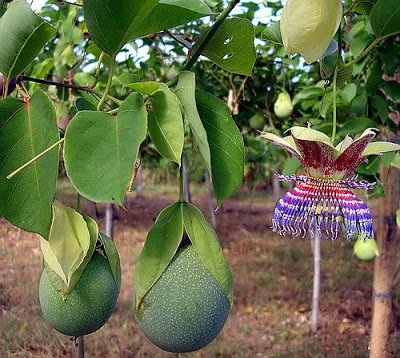
An introduction to the characteristics of Taiwan green-skinned lychee-flavored passion fruit and giant granadilla
In recent years, the most popular "lychee-flavored passion fruit" abroad really tastes and smells remarkably like lychee when eaten, and it is very well received. Its leaves are even more unusual: most passion fruits have three-part palmate compound leaves, but the lychee-flavored passion fruit exists in a single-leaf form, which is rather strange. It is especially productive in Taiwan; in summer, an old plant can casually bear a thousand passion fruits at a time, which is quite spectacular. The flavor is richly sweet, so it has been a fairly popular new variety of passion fruit in recent years.
Giant granadilla (giant passion fruit), scientific name Passiflora quadrangularis, English name Giant Granadilla, family Passifloraceae. Also known as giant granadilla, giant clock fruit, giant passion fruit, passion melon, giant passion fruit, and winged-stem passionflower, it is an evergreen climbing vine native to tropical America. The stem is climbing, the young branches are four-angled and wing-like, with tendrils in a spring shape. Leaves alternate, ovate or ovate-elliptic, apex acute, margin entire. Flowers axillary, corolla pale purplish red, fragrant, blooming from summer to autumn. Fruit spherical.
The giant granadilla is the largest variety among passion fruits; the fruit can weigh up to 2 kg, is thick and fleshy, and has few seeds. Like passion fruit, it can be eaten, but its flavor is milder than ordinary passion fruit, with both sweetness and acidity lower. It can be made into juice, and the unripe fruit can also be cooked as a vegetable. The giant granadilla not only has huge fruit, but its flowers are also strangely shaped and brightly colored, so it can be enjoyed both for flowers and fruit. Its stems and leaves spread strongly, making it suitable for trellis fences, green walls, or shade arbors.
Propagation can be done by sowing, cuttings, or grafting, with spring and autumn being the suitable periods. The growing medium is best as fertile sandy loam, and drainage and sunlight need to be good. Fertilize once every 2-3 months, and potash fertilizer should be ample. Prune and train the branches in winter; avoid heavy or severe pruning. It likes high temperatures and has few pests and diseases.
The fruit of the giant granadilla is the giant of passion fruits, usually about the size of a cantaloupe. Besides the aril, the inner pericarp can also be eaten, just like a cantaloupe, but its flavor is milder, with both sweetness and acidity low, and the flavor is poorer. It can also be cooked like a vegetable when the fruit is not yet fully ripe. In Taiwan, it can grow from the plains up to mountainous areas at about 900 m above sea level, and it can flower and fruit year-round. Because it has self-incompatibility, artificial pollination is needed to promote fruit set.