Pingtung banana farmers secure another big Taiwan banana order to Japan through quality management, not political orders
Taiwan banana exports to Japan break through their difficulties. In addition to the order for 10,000 metric tons over 3 years obtained at the Tokyo Food Exhibition in March this year, good news came again today: Arai Trading Co., Ltd. of Japan (hereinafter "Arai Trading"), through matching by the Agriculture and Food Agency, signed a 500-metric-ton export contract with Yilong Agricultural Products Co., Ltd. (hereinafter "Yilong Agricultural Products") today (the 10th), at a price of 25 yuan per kilogram for green bananas (after selection).
The Japanese side believes that Taiwan bananas have improved greatly in post-harvest cold chain and washing technologies, and that their taste and aroma far surpass Philippine bananas, so they remain popular in the market despite the higher price. In addition to the first purchase of 500 metric tons this year, they hope the volume can steadily double in the next two years, with a total of 5,000 metric tons expected over 4 years.
According to statistics from the Agriculture and Food Agency, in ROC year 107 (2018), Taiwan's total banana production was 356,590 metric tons, while exports were only 1,872 metric tons (of which 1,766 metric tons were exported to Japan), with exported bananas accounting for only 0.5% of the national total. Yu Chih-jung, general manager of Yilong Agricultural Products and a banana farmer, said that Japan's banana market has large demand, about 1 million metric tons per year, while Taiwan currently accounts for less than 0.2%, leaving much room for growth in the future. As long as Taiwan can capture 1% of the Japanese market, it would greatly help stabilize domestic banana prices.
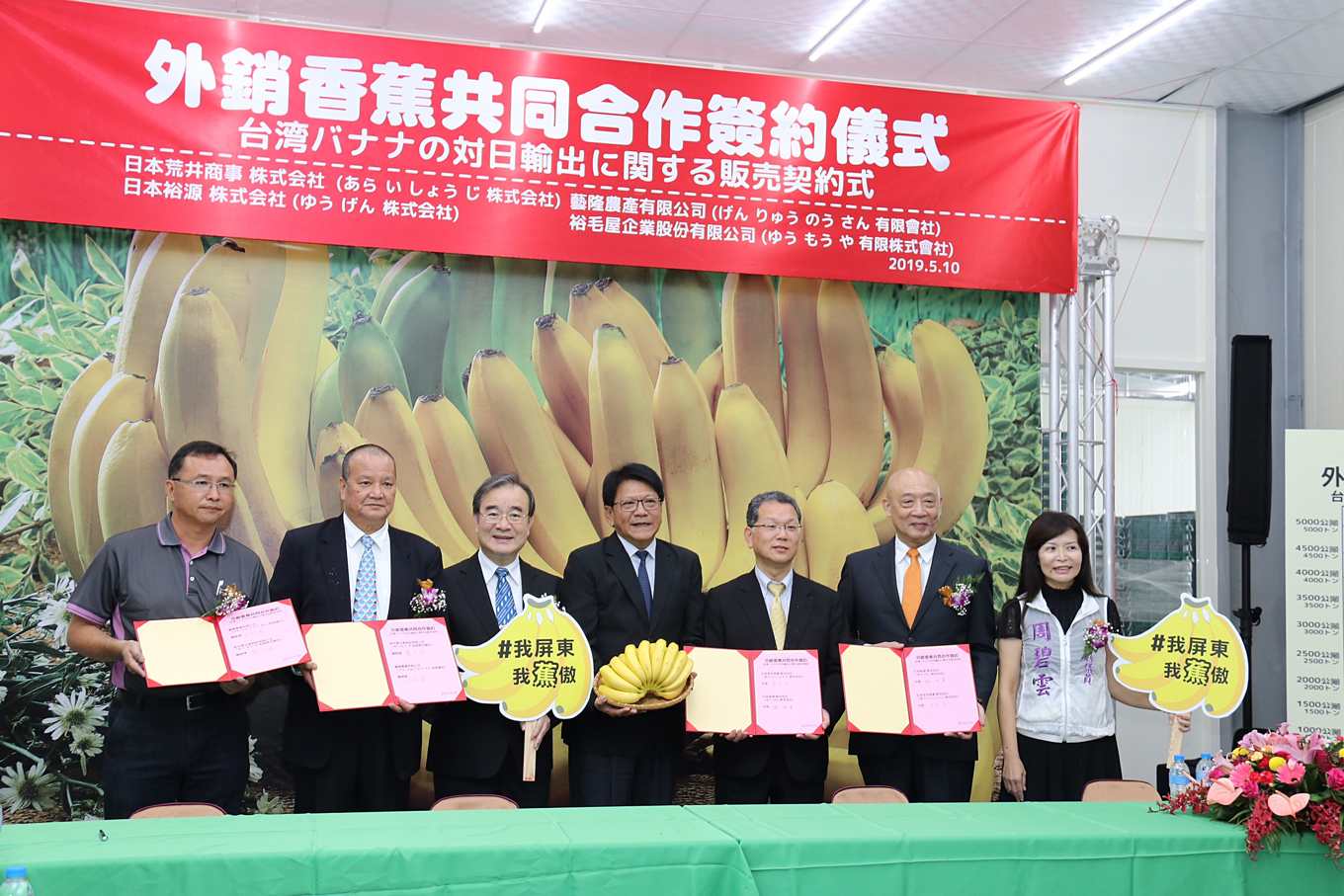
Banana exports to Japan got off to a strong start this year, repeatedly achieving excellent results
Taiwan bananas take a full year to mature, exactly twice as long as Philippine bananas, producing delicate flesh and excellent taste and aroma. However, whenever domestic prices are good, stable supply for export cannot be maintained, and post-harvest cold chain collection and other handling are not sufficiently complete, causing Taiwan banana exports to decline steadily, from 19,433 metric tons exported in ROC year 97 (2008) to only 1,872 metric tons in ROC year 107 (2018), less than one tenth of that. (See the detailed chart at the end of the article.)
Last year (ROC year 107 / 2018), banana prices were low due to a bumper harvest, and banana exports drew much attention. In March this year, the Council of Agriculture led a delegation to the Tokyo Food Exhibition and signed export contracts with two trading companies for 3,000 metric tons each over 3 years and 1,000 metric tons over one year. Council of Agriculture Minister Chen Chi-chung even assured the Japanese side that an agricultural product export platform would be established to ensure stable supply and to assist production areas in upgrading specifications from collection, washing, grading and packaging to cold chain logistics.
According to statistics from the Agriculture and Food Agency, export volume had reached 1,360 metric tons as of May 9 this year, an increase of 67% compared with the same period last year (the total amount of bananas exported to Japan in ROC year 107 / 2018 was 1,766 metric tons). Yu Chih-jung said that this year the total banana export volume to Japan had originally been estimated at 400 metric tons, and with the Arai Trading order, business has grown to 900 metric tons.
Yu Chih-jung: The Japanese side recognizes post-harvest cold chain collection and handling, and the order price is good
Yu Chih-jung, who secured the Japanese order today, is simultaneously a banana farmer, head of a production and marketing group, and general manager of an agricultural products company, handling everything from production to back-end collection in one coordinated operation. Yu Chih-jung said that in the past the Japanese side lacked confidence in Taiwan's post-harvest handling of bananas, and to avoid hot weather affecting quality, banana purchases mostly ended before July. In recent years, production areas have strengthened cold chain collection and other management measures, so that bananas supplied even after July can still ensure quality, building a good reputation and gradually opening the market.
Chen Li-yi, section chief of the Crop Production Division of the Agriculture and Food Agency, said that Arai Trading was purchasing Taiwan bananas for the first time. On one hand, Philippine banana acreage has shrunk in recent years due to yellow leaf disease, and on the other hand Taiwan bananas have a longer growing period and better aroma and flavor than Philippine bananas. Therefore, Arai Trading made inquiries through Japan's Yuyuan Trading Company (the parent company of Taiwan's Yumaowu Enterprise), and the Agriculture and Food Agency finally matched them with Pingtung banana farmer Yu Chih-jung, who has long been engaged in banana transportation and marketing.
Yu Chih-jung said that after Arai Trading came to Taiwan, it actually inspected the supply orchards and collection sites and confirmed that the plumpness of the bananas, the cold chain equipment and space at the collection sites, and other conditions all met requirements, and then requested a contract. In the first year, 500 metric tons will be supplied first, after which the amount will double year by year, with an estimated 5,000 metric tons to be supplied by ROC year 111 (2022). The price per kilogram for selected green bananas is 25 yuan, which is quite good.
How to ensure stable supply? Yu Chih-jung: guide by timing
Behind receiving the order are years of devoted effort. Last year, Yu Chih-jung discovered that drastic weather changes were shortening banana ripening time, so he immediately expanded his existing 150 ping of refrigerated space to 450 ping, raising weekly collection and transport volume from 200 metric tons to 300 metric tons, in order to face possible short-term surges caused by climate change and avoid affecting banana quality.
Yu Chih-jung said that Taiwan's banana export business had been neglected for many years, and today's achievements come from regaining trust through long-term transactions. In addition to strengthening post-harvest handling, whether contract farmers can supply stably is also a major test.
"If domestic prices are good, farmers will not deliver for export," Yu Chih-jung pointed out the past predicament of exports, but he said optimistically, "I come from a farming background, so I can understand this. We need to guide them (farmers) in turn, inducing 10% or 20% of their original 100% production to be delivered to me for export. I am one of the banana farmers. Apart from guiding by timing, there is no other way."