Take small actions to safeguard food safety, let's all do it together
Recently, the Taiwan GMO-free Alliance has received many messages saying: people want to participate in opposing the draft notice to add glyphosate (Roundup) pesticide residue tolerance limits, but they don't know how to start writing out their anger and worry! So we have specially written a simplified version of an opinion statement letter for the public to use, and it can be completed in just a few simple steps.
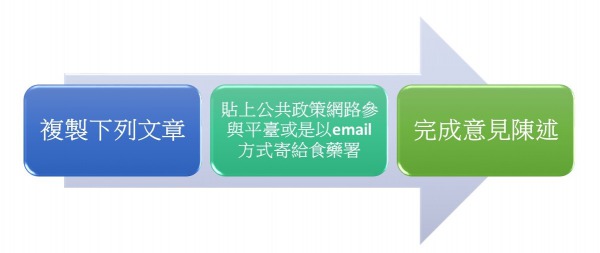
Email of the Food and Drug Administration, Ministry of Health and Welfare: [email protected]
Public Policy Network Participation Platform -Join: https://join.gov.tw/…/…/546eab8c-b0e2-4dbb-855b-f76222af7932 (To leave a comment as a guest, you need to first fill in simple information)
Oppose relaxing the glyphosate residue tolerance standard
I firmly oppose adding glyphosate residue tolerance standards for barley, millet, durum wheat, rapeseed, sorghum, triticale, rye, proso millet, oats and buckwheat,from the original not permitted to be detected to10ppm. The reasons are as follows:
1. The legal amendment is based only on written documents submitted by the applicant Monsanto, which is too hasty.
According to information published by the Food and Drug Administration, this amendment originates from an import tolerance application filed by "Monsanto Far East Limited, Hong Kong, China," and the basis for the revision refers to the written materials submitted by the company. However, just last year, the California Superior Court in the United States had just found that Monsanto concealed experimental data on glyphosate's cancer risk, and ruled that it must pay high compensation to the victims.
The Food and Drug Administration deciding to relax the standard based only on written documents submitted by Monsanto is truly too hasty.
2. No careful assessment of glyphosate's cancer risk
The Food and Drug Administration, citing the assessment results of the United States Environmental Protection Agency and the European Food Safety Authority as the reason, determined that glyphosate has no cancer concern. However, the International Agency for Research on Cancer (IARC) under the World Health Organization had already classified glyphosate as a Group 2A substance that may pose a cancer risk to humans as early as 2015. At the same time, in recent years academic studies have successively pointed out that glyphosate is genotoxic, and even at extremely low concentrations, long-term human exposure to it can affect health.
The Food and Drug Administration should comprehensively consider information from all sides and carefully reassess glyphosate's cancer risk.
3. There should be no opening of the door for imported coarse grains with glyphosate residues
This addition of barley, sorghum, millet and buckwheat items: although farmers in Taiwan, China do grow them, there is absolutely no need or request to raise their glyphosate residue tolerance limits.
The beneficiaries of this legal amendment are clearly imported coarse grains with residues of the herbicide glyphosate.
Based on the above three points, we strongly demand that the Food and Drug Administration revoke this regulatory amendment and protect the dietary safety of all citizens.