Amendments to the Factory Management and Guidance Act criticized for burying farmland; environmental groups threaten protests if not revised
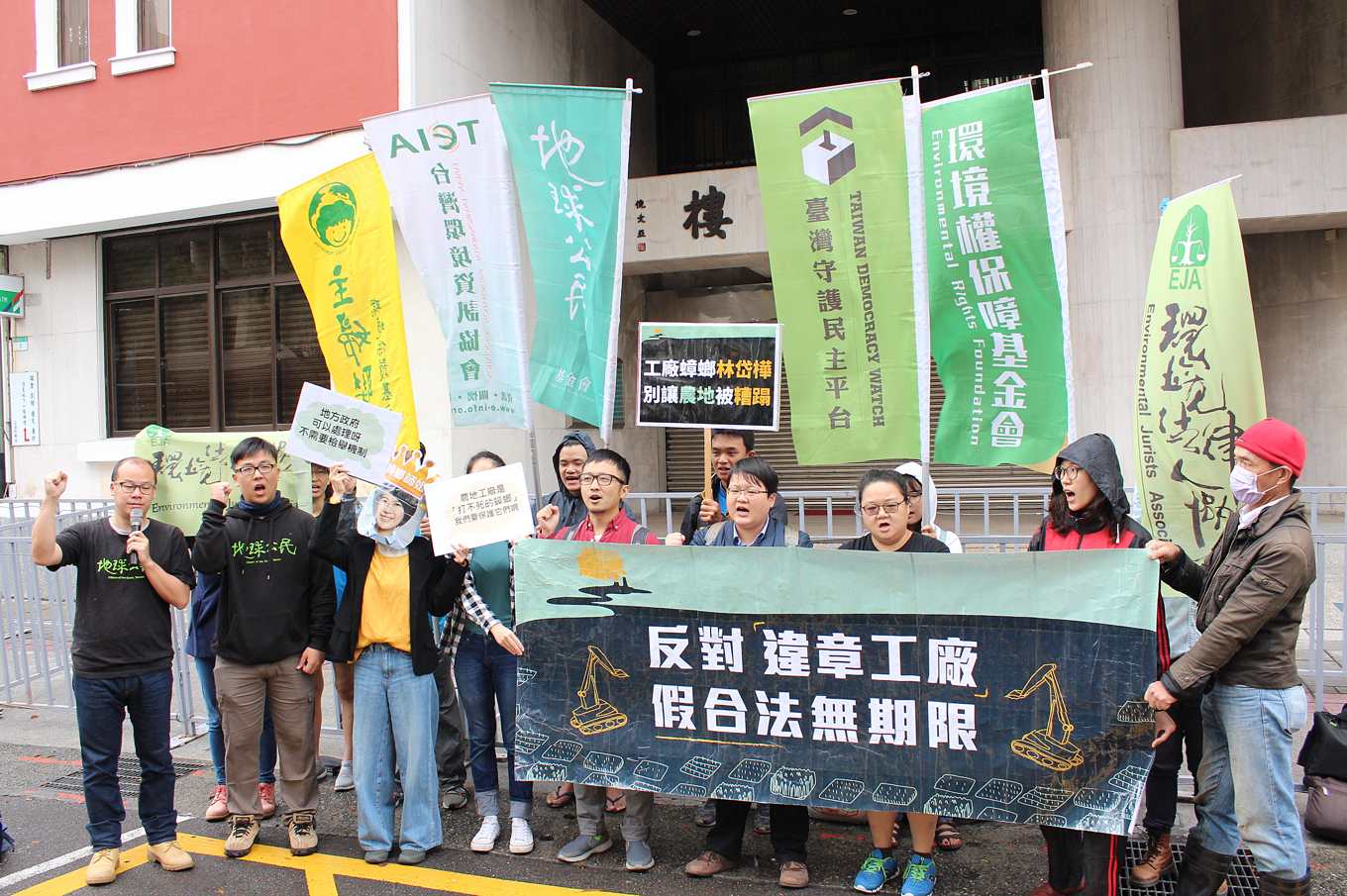
The draft amendment to the Factory Management and Guidance Act, originally intended to correct the chaos of illegal factories on farmland, not only failed to solve the problem after being reviewed by the Economics Committee yesterday (the 6th), but instead became an "agriculture-destroying hegemonic clause" overriding other laws. In addition to the absence of a sunset clause for illegal factories on farmland, legislator Lin Tai-hua even proposed multiple "water-release" provisions in accompanying resolutions. Today (the 7th), multiple environmental groups named Lin Tai-hua for "destroying agriculture and dooming the nation" and disregarding the value of farmland, and put forward multiple reform demands. If the ruling party insists on the current version, they do not rule out launching large-scale protests. (See attachment at the end)
Including the Citizens of the Earth Foundation, Taiwan Rural Front, Homemakers United Foundation Environmental Protection Foundation, Environmental Rights Protection Foundation, and Environmental Jurists Association, they called on all party caucuses to positively address four major points in the upcoming party negotiations: the Factory Management and Guidance Act should explicitly stipulate the expiration deadline for "specific factory registration" as well as the handling deadlines for counseling medium- and high-pollution factories to relocate or close; include a "citizen suit" clause so the public has a channel for self-rescue; legalization in place should be explicitly limited to sporadic business categories compatible with agricultural zones, and polluting business categories should return to the Environmental Protection Administration and Council of Agriculture for primary determination.
Complaints alone are ineffective; environmental groups: an enforceable "citizen suit" must be explicitly included
Regarding the environmental groups' proposal to include "citizen suits" in the Factory Management and Guidance Act, yesterday's draft review meeting did not directly pass it, but instead reserved it for cross-party negotiations, sparking strong dissatisfaction among environmental groups.
Wu Chi-jung, a specialist at the Citizens of the Earth Foundation, explained that the foundation receives petition letters from residents across the country on average every three to five days, complaining about newly built illegal factories around their residences and illegal factory matters, which shows that the situation of illegal factories on farmland is very serious. After receiving complaint letters, the foundation forwards official documents to local governments, but they all "sink like a stone into the sea." Wu Chi-jung criticized: if the existing complaint mechanism were effective, where would the 130,000 illegal factories on farmland come from?
Lin Tzu-lin explained that the "citizen suit" proposed by environmental groups is a combination of "complaint" and "lawsuit." If citizens discover illegal factories, through the citizen notification procedure, they ask the local government competent authority to handle it (this is the "citizen notification" in a citizen suit, and the mechanism is the same as a complaint). If the local government competent authority does not actively act, citizens can then file an administrative lawsuit in the administrative court. After the court determines through judgment that the competent authority indeed failed to act and violated the law, it can require the competent authority to carry out action and handle the illegal factory (this is the "litigation" stage in a citizen suit).
The Citizens of the Earth Foundation produced a video explaining that complaints alone are ineffective, and illegal local construction is springing up like bamboo shoots after rain:
Tu Yu-wen, chief executive of the Environmental Rights Protection Foundation, added that provisions related to citizen notification and litigation are very common in environmental pollution regulations. The complaint mechanism is handled through administrative agencies. In Taiwan's past, because laws and regulations could not actually be implemented and various administrative agencies faced personal-pressure issues, the so-called complaint mechanism has been ineffective domestically. A more proactive citizen suit must be enacted into law, rather than saying that because there is a complaint system, citizen suits are unnecessary. She said, "This is reversing cause and effect."
Wu Chi-jung said that even if the bill moves in a direction "leaning toward factory interests," retaining "citizen suits" is a right that cannot be ignored and should be included in the bill for active protection; it is also the last line of defense for protecting farmland.
Environmental groups: The draft Factory Management and Guidance Act amounts to a "farmland burial law"
Wang Chang-yi, issues specialist at Taiwan Rural Front, also said that the Factory Management and Guidance Act should take agriculture into consideration as a premise, thereby creating a win-win situation for farmland and industrial development. As for yesterday's review result, it seems that no matter what the public demands, factories can remain on farmland generation after generation without a sunset deadline. He criticized, "It would not be an exaggeration to call it a farmland burial handling act."
Wang Chang-yi said that during the review process, not only did legalization in place become a consensus, but several accompanying resolutions proposed by Legislator Lin Tai-hua greatly relaxed restrictions on factories on farmland. For example, relaxing the restriction that there should be a 1.5-meter isolation green belt between factories and farmland, raising the factory building coverage ratio from 60% to 70%, and raising the factory floor area ratio from 240% to 300%. This means factories can be built larger and larger and get closer and closer to farmland, and the risk of factory pollution to farmland will rise accordingly.
Wei Yang, advocacy specialist at the Homemakers United Foundation Environmental Protection Foundation, said that the Factory Management and Guidance Act requires the government to establish an effective and detailed system to counsel factories in transformation and relocation. Regarding the accompanying resolutions proposed by Lin Tai-hua with economic considerations as the priority, he fiercely criticized: can farmland sustainability and food security therefore be ignored?
The "safety risk" of illegal factory sheet-metal buildings should be listed for control
In addition to the farmland issue, Chu Chih-yu, secretary-general of the Firefighters' Rights Promotion Association, raised a "safety perspective," explaining that in past experience, illegal factories on farmland are often sheet-metal buildings. Once a fire breaks out, at temperatures exceeding 600°C, the sheet metal not only risks collapse, but because it is adjacent to farmland, the wastewater after firefighting is also directly discharged into irrigation ditches. He said illegal factories should be clearly inventoried, a database should be established, and they should be properly listed for control. This is not only protection for farmland, but also protection for factories and firefighters.
Tsai Pei-hui: The Factory Management and Guidance Act should adhere to three major premises including a sunset clause
Democratic Progressive Party Legislator Tsai Pei-hui said that immediate reporting and demolition of factories, maintaining strict control over farmland, and requiring registration certificates to have an expiration deadline are the three major premises for amending the Factory Management and Guidance Act. At the implementation level, more detailed regulations are needed so that local governments can carry them out.
Regarding yesterday's meeting result, she said that regarding the absurd accompanying resolutions by certain committee members, the Council of Agriculture and Ministry of Economic Affairs must strictly guard the gate and must not let them pass. She added that in Article 8 of her accompanying resolution, she proposed that "the competent authority should regulate the sunset provisions for specific factory registration and periodically review the incorporation into management of unregistered factories and the acquisition of specific factory registration certificates," and she also agreed that the bill should include "citizen suits."
Environmental groups demand that ruling and opposition caucuses face the issue, do not rule out launching protest actions
At the end of the press conference, environmental groups said that in addition to jointly reviewing the accompanying resolutions proposed by Legislator Lin Tai-hua, they also affirmed committee chairman Lai Jui-lung, who tried to stop doubtful proposals during the review process, and legislators Tsai Pei-hui, Hung Tzu-yung, Hsu Yung-ming, Chen Man-li, Chiu Yi-ying, and Chen Ting-fei, who actively raised objections.
But environmental groups stressed that Lin Tai-hua's "slippery slope" proposals cannot become a smoke screen and excuse to rationalize the Executive Yuan version of the Factory Management and Guidance Act, which is full of doubts. If the ruling and opposition parties do not engage in dialogue with environmental groups and the public, they do not rule out launching larger-scale protest actions.
Attachment 1: Motion to Amend the Factory Management and Guidance Act
Attachment 2: Accompanying Resolutions to the Factory Management and Guidance Act