Illegal factories to occupy farmland forever, the Factory Management and Guidance Act amendment nullifies all laws
The draft amendment to the Factory Management and Guidance Act (hereafter the Factory Guidance Act), regarded as an evil law for farmland occupation, was sent to the Economics Committee today (the 6th) for article-by-article review for the first time. In addition to confirming that the "specific factory registration certificate" will have no sunset clause, meaning that as long as a temporary registration certificate is held, operations can continue indefinitely, it further loosens factory application restrictions: whereas previously no factories could be established on grade-one prime farmland, the amended provisions confirm that this restriction is also removed. (For background on this news, please click here)
The draft also stipulates that the Factory Guidance Act is not subject to the Regional Plan Act, the National Land Use Planning Act, the Urban Planning Act, the Building Act, the Agricultural Development Act and other regulations. Legislator Lin Tai-hua further proposed multiple supplementary resolutions, including that illegal factories on farmland may be freely bought and sold, and that the feedback payment for land use conversion need only be 5 percent. Although no consensus was reached at today's meeting, deliberations will continue through cross-party negotiation.
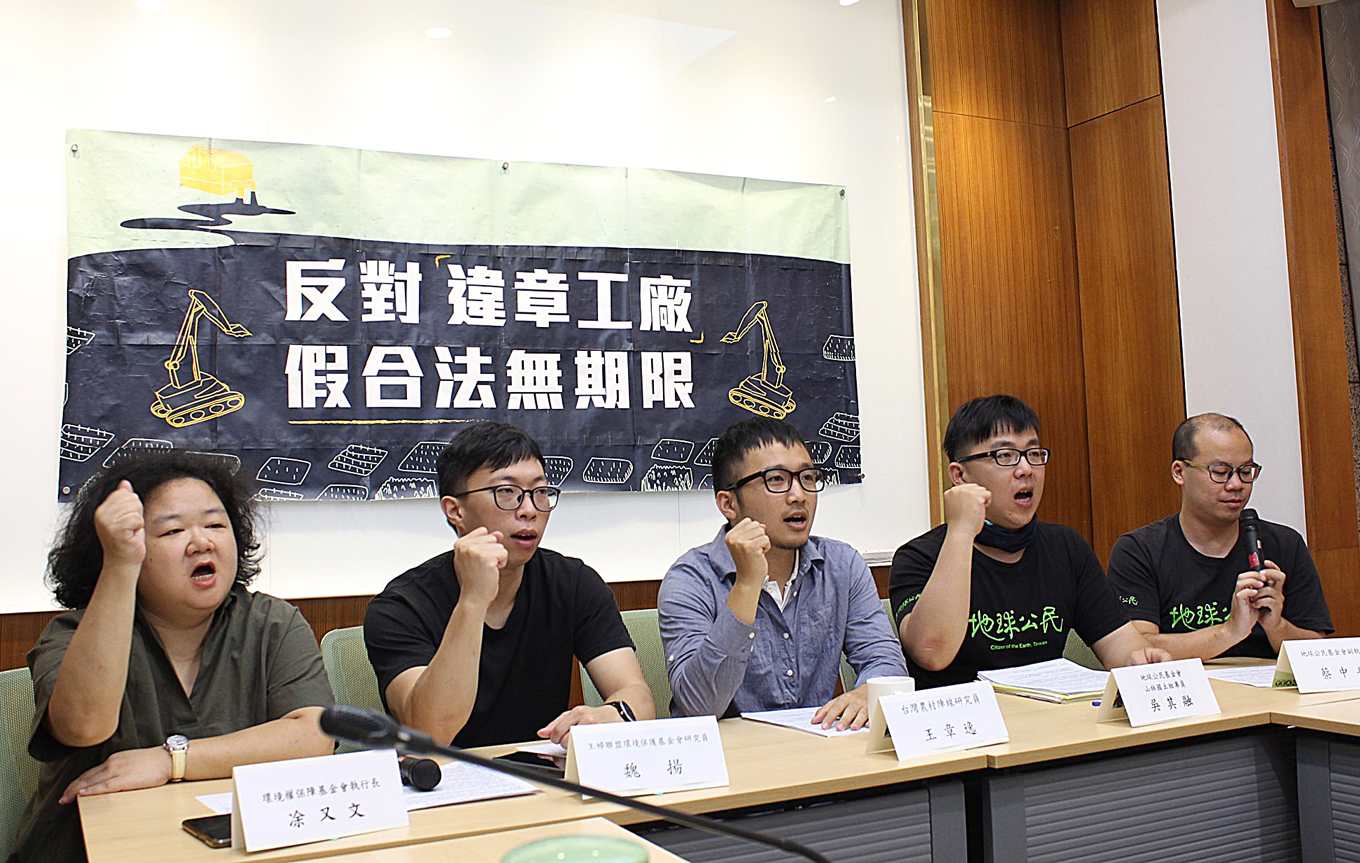
In response to today's review results, environmental groups expressed strong protest. Wu Chi-jung, a specialist at the Citizens of the Earth Foundation, sharply criticized, "This simply nullifies many regulations permanently," depriving the government of room to guide operators toward substantive improvements.
The Factory Guidance Act sent for review does not move forward but only loosens restrictions further
The Factory Guidance Act was sent to the Economics Committee for review. Article 28-5 (no sunset clause for the "specific factory registration certificate") and Article 28-8 (not subject to the Regional Plan Act, the National Land Use Planning Act, the Urban Planning Act, the Building Act, the Agricultural Development Act and other regulations), which environmental groups had originally questioned, both formally passed, giving illegal factories on farmland permanent residency rights.
In addition, Legislator Lin Tai-hua proposed many supplementary resolutions, which were formally passed by the committee today, including that in order to "guide the legalization of farmland factories," the restriction in the "Non-Urban Land Use Control Regulations" that "grade-one prime farmland cannot be applied for use as land for other undertakings" should also be relaxed, meaning that factories on prime farmland would have the opportunity to be legalized on site. This supplementary resolution was passed at the meeting, requesting the Ministry of Economic Affairs, together with the Ministry of the Interior and the Council of Agriculture, to complete the relevant legal amendments within two weeks (before 2019.05.17).
More loosening supplementary resolutions require cross-party negotiation; environmental groups say they are pessimistic
Lin also proposed other supplementary resolutions, but no consensus was reached at the meeting, and they still require cross-party negotiation, including: no need to create an "isolation green belt" within 1.5 meters around a factory, which amounts to relaxing the distance restriction between factories and farmland and bringing factories and farmland closer together. However, this supplementary resolution has not yet gained consensus at the meeting.
Regarding Article 28-9, Lin proposed cancelling paragraphs 1, 2, 3 and 6 (Note 1), meaning that illegal factories on farmland could be bought and sold in the future. Lin also proposed, in Article 28-10 (Note 2), regarding the land use conversion feedback payment, a proposal to pay 5 percent. However, these two points did not gain consensus at the meeting and will undergo further cross-party negotiation.
Although this amendment still requires cross-party negotiation and has not yet been finalized, the Citizens of the Earth Foundation holds a pessimistic attitude toward the direction of the amendment, because the opportunity for article-by-article discussion and review has ended at this stage, and it believes that the overall situation will move in a bad direction afterward.
Legislators propose "information disclosure" and "rolling review"; environmental groups: meaningless
Compared with other loosening proposals, the Economics Committee today also passed a proposal by Legislator Lai Jui-lung to add the principle of "information disclosure" to Article 28-3, requiring publication of the list of newly added and existing unregistered factories within the jurisdiction. In addition, Legislator Tsai Pei-hui proposed at the meeting a supplementary resolution for a "rolling inspection" every three years to supervise factory improvements, which was finally amended and passed at the committee meeting to extend it to a rolling inspection every five years.
Wu Chi-jung, a specialist at the Citizens of the Earth Foundation, said that "rolling review" is meaningless. If no deadline is expressly set, the incentive for factories is simply insufficient; and the loosened conditions proposed by Lin Tai-hua only make factories more inclined to stay on farmland waiting to become legal.
Regarding the proposal that "factories become commodities for sale," Tsai Chung-yueh, deputy chief executive of the Citizens of the Earth Foundation, said bluntly, "If I don't want to run the factory anymore, either I just leave it idle, or I sell it. In that case, who would still want to legalize?" He sharply criticized this as completely contrary to the spirit of the Factory Guidance Act, which is to "manage" and "guide" toward legalization.
Citizens of the Earth Foundation: permanently nullifies many regulations
Wu Chi-jung sharply criticized that the draft amendment would allow illegal factories established before May 20, 2016, to extend indefinitely as long as they obtain specific factory registration, without needing to move toward legalization through land category conversion. In addition, under the effect of Article 28-8, they would not be subject to the Regional Plan Act, the National Land Use Planning Act, the Urban Planning Act, the Building Act, the Agricultural Development Act and other regulations.
In addition, under Article 28-10, paragraph 2, subparagraph 2 (Note 3), as long as the operator provides a land use legalization plan, land category conversion can proceed. He sharply criticized, "This simply nullifies many regulations permanently," depriving the government of room to guide operators toward substantive improvements.
Tsai Chung-yueh, deputy chief executive of the Citizens of the Earth Foundation, explained that some illegal factories are scattered among farm fields, while some are slightly larger clustered factories. Scattered factories, because they directly affect agricultural activity, should not be legalized on site; clustered factories should be guided toward legalization, but should relocate to industrial land. Wu added that these bills make it very easy for factories to "legalize on site" rather than "relocate to legally permitted land."
Environmental groups: remediation of illegal factories is far off, allowing farmland and factories to mix unchecked
Wang Chang-yi, issues specialist at the Taiwan Rural Front, approached the issue from the perspective of land. He said that the most criticized aspect of farmland factories is their scattered distribution, which makes pollution difficult to control and increases the risk of industrial wastewater contaminating farmland. The Factory Guidance Act has been in force for nearly twenty years, and this draft amendment offers no remediation of illegal factories, only the "legalization on site" clause in Article 28-10. Once the amendment passes, it will clearly mean allowing the phenomenon of farmland and factories mixing unchecked.
Wei Yang, advocacy specialist at the Homemakers United Foundation Environmental Protection Foundation, said that President Tsai Ing-wen once put forward the "Five Links of Food Safety" policy, among which "strengthening source management" to prevent environmental pollutants from entering the food supply chain is the first link of this policy. If this draft passes, there will be a major gap in source control.
Wei Yang said that the government should centralize the management of farmland factories, and give priority to guiding medium- and high-pollution factories to relocate or shut down, and expressly set a 5-year sunset deadline. They absolutely must not be legalized on site, allowing unresolved food safety bombs to remain planted in farmland.
Pollution categories decided by the Ministry of Economic Affairs; tires, asphalt concrete, and metal casting are all low pollution?
Tu Yu-wen, chief executive of the Environmental Rights Protection Foundation, explained the loophole in the draft regarding the determination of "pollution categories": as long as environmental protection, soil and water conservation, water conservancy and fire safety regulations are met, temporary legality can be obtained, and later a "land use legalization plan" can be submitted and, once approved, legalization on site can be obtained. "However, currently the decision-making power lies only with the Ministry of Economic Affairs, with no involvement of the Environmental Protection Administration or the Council of Agriculture in making the relevant determinations."
The determination of "low pollution" or "medium- and high pollution" is also delineated by the Ministry of Economic Affairs according to industry category. If an industry does not fall under "medium- and high pollution," it is classified as "low pollution." However, many industries classified as low pollution, such as tire manufacturing, asphalt concrete, and related metal casting industries, in substance carry medium- and high pollution risks. She believes that determinations of whether there is pollution on farmland and the degree of pollution require the participation of agricultural administration and environmental protection units together, and cannot be decided by the Ministry of Economic Affairs alone.
Environmental groups: passage of the draft would be a "farmland tragedy"
After the Economics Committee, Wu Chi-jung said, "Apart from the information disclosure in Article 28-3, basically none of our demands have been responded to." He said that if the Democratic Progressive Party really lets the proposals put forward by Legislator Lin Tai-hua pass through negotiation, making farmland a tool and investment target that can be freely bought and sold, "it will probably become a farmland tragedy." Tsai Chung-yueh also said that apart from information disclosure, basically all past demands have been "slapped in the face."
In addition, the "citizen lawsuit" provision in Article 28-13 has also been retained for cross-party negotiation. Today's committee produced something even worse than the original Executive Yuan draft, and they called for not allowing the proposals and supplementary resolutions put forward by Legislator Lin Tai-hua to pass through negotiation.
Tsai Chung-yueh also explained that the current Factory Guidance Act does not lack guidance; it is precisely because of erroneous policy-making that 90 percent of factories have made no improvements, and the draft amendment now proposed will only further reduce the incentive for factories to move toward rationalization and legalization. He also added that because factories are commonly scattered among residents' farmland, the Factory Guidance Act must require information disclosure and must include a public litigation mechanism so that the public can supervise on its own.
The Citizens of the Earth Foundation, Taiwan Rural Front, Homemakers United Foundation Environmental Protection Foundation, Environmental Rights Protection Foundation and other environmental groups jointly put forward four demands today (the 6th). The "specific factory registration" should expressly set a sunset deadline, and medium- and high-pollution factories should be guided to relocate or shut down with a five-year sunset; the Factory Management and Guidance Act should incorporate "information disclosure" and "citizen lawsuit" clauses so that the public has channels for self-rescue; the Factory Management and Guidance Act should incorporate priority clauses for relocation guidance and centralized management; the determination of polluting industry categories and of industry categories that may be legalized on site on farmland should be primarily determined by the Environmental Protection Administration and the Council of Agriculture. They demand that the government face the problem of farmland and factories mixing unchecked and formulate a long-term policy that fundamentally solves the problem.
Su declares "work with peace of mind to boost the economy, temporary-registration illegal factories to be legalized on site under conditions"; environmental groups criticize major loosening and oppose to the end