Food safety education helps children learn from daily life and grow up healthy in body and mind
Revisiting "True Food Education" mother Wang Qiaozhen, whose oldest child is now in the first year of junior high school. She recalls: "Children bring us so many challenges we never anticipated... when cooking, 1 comes over wanting to help, and the other 2 follow along too, so you have to figure out how to keep them all occupied." In fact, when children first step into the kitchen, it is mostly for fun. However, there are so many tools of all sizes in the kitchen, and Qiaozhen takes the opportunity to teach her children how to protect themselves so they do not get hurt; and even if they do get hurt, how to handle it. Looking back on these years of cooking together with her children, it has evolved from a childhood game into training for housework and life skills.
"The older sister is the oldest, so she can be taught to use a knife; the younger sister is next, and cracking eggs is just right for her; as for the younger brother, who was only in the middle class of kindergarten at the time, the job of washing vegetables was given to him..." This seemingly simple division of work actually involves safety considerations. Having divided kitchen tasks and cooperated together from an early age, the children quietly learn how to cooperate with others while receiving Qiaozhen's work guidance, and they are also able to break things down into steps and carry them out one by one. They also learn even more important things such as logical thinking, communication, and leadership. The power of life education should not be underestimated.
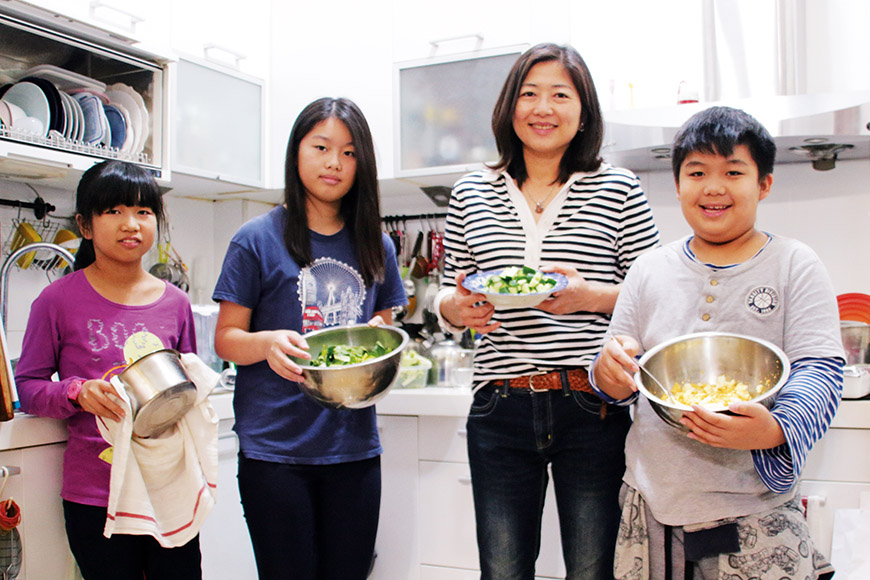 Wang Qiaozhen recalls the journey of cooking with her children. At first it was an unintentional planting, but years later it unexpectedly bloomed and bore fruit, growing into a beautiful surprise.
Putting it another way, nutrition education that accompanies growing up
Because the children have followed their mother since childhood, housework, kitchen tasks, and daily life are all before their eyes. If opportunities for incidental teaching are often given, children can quietly build a considerable and solid foundation of values. Take the concept of food additives: by constantly explaining that candy contains many colorings and additives that are bad for the human body, the children, even if they get candy at school, do not dare to eat it casually and always obediently bring it home and voluntarily hand it over; also, getting balanced nutrition from food, such as which foods contain which rich vitamins, minerals, or fiber, Qiaozhen never tires of saying again and again.
Qiaozhen mentions that with the popularity of food and agriculture education in recent years, children have a considerable understanding of food nutrition. It is just that as children begin to enter puberty, hormonal changes make her involuntarily want to rebel. "When they were little, they ate whatever they were told to eat, but now it is different... so I change my approach and tell the children, for example: Older sister! You are starting to get acne on your face now. If you often eat fried chicken cutlets and junk food from outside, you will take in too much trans fat, and it will also make you gain weight. On top of that, you often stay up late, which will increase free radicals. This will not only damage the cells' ability to repair themselves, but your skin will also get worse, and the acne will not heal easily." For the sake of beauty, adolescents seem to become more easily persuaded.
Extending environmental education through cooking
Qiaozhen recalls that in the cooperative's early days, the vegetables often had many insects. At first, the children were so scared when they saw the insects that they did not dare to touch them. At times like that, she told the children that because the cooperative's vegetables have no pesticides, the bugs eat them; then from the issue of cabbage worms and pesticides, she talked about how supermarkets also claim their vegetables are pesticide-free, so why do their vegetables look so beautiful while the cooperative's vegetables look so ugly? Then she talked about the relatively safer reduced-pesticide approach, why we should buy vegetables from small farmers, and even serious issues such as land justice. Through food, she could begin talking with her children about all of this.
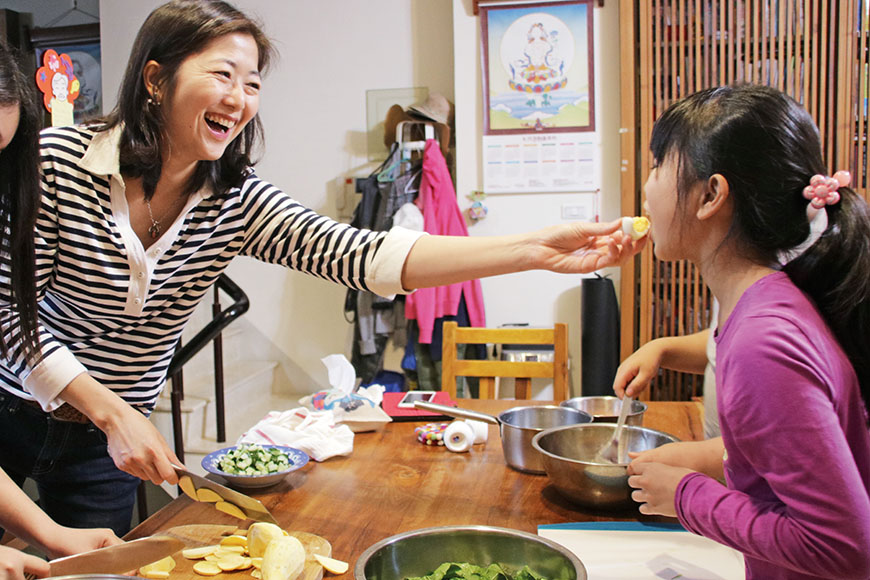 For Qiaozhen, extending from cooking to skill development, the deep-rooted concept of sharing household chores, and the rooting of values are all important aspects of life education.
"Cooking is not just cooking," Qiaozhen says. She has seen many parents spare no expense in sending their children to cooking classes, but she believes that if the children cannot connect cooking with life after returning home, then the cooking class is just a very fun activity that ends when it ends. After all, cooking is still a part of life. If it is cut off from life, then a very important meaningful connection is also cut off. What exactly do you want your children to learn from cooking? This is something parents should think deeply about.