Batch-by-batch border sampling data on imported soybeans that the Food and Drug Administration once provided to legislators (provided by Guo Huaren)
Scholar: The US Congress has proposed a bill demanding stricter standards; our relaxation is an unwise move Guo Huaren reiterated the contradictions in setting residue tolerance levels, "Why do the standards for edamame and soybeans differ so much?" Edamame is grown domestically, with a glyphosate tolerance of 0.2 ppm; soybeans are mainly imported, with a tolerance of 10 ppm - a 50-fold difference. Yet we eat far more soybeans than edamame. If the edamame standard were applied, more than 80% of these imported soybeans would exceed the limit.
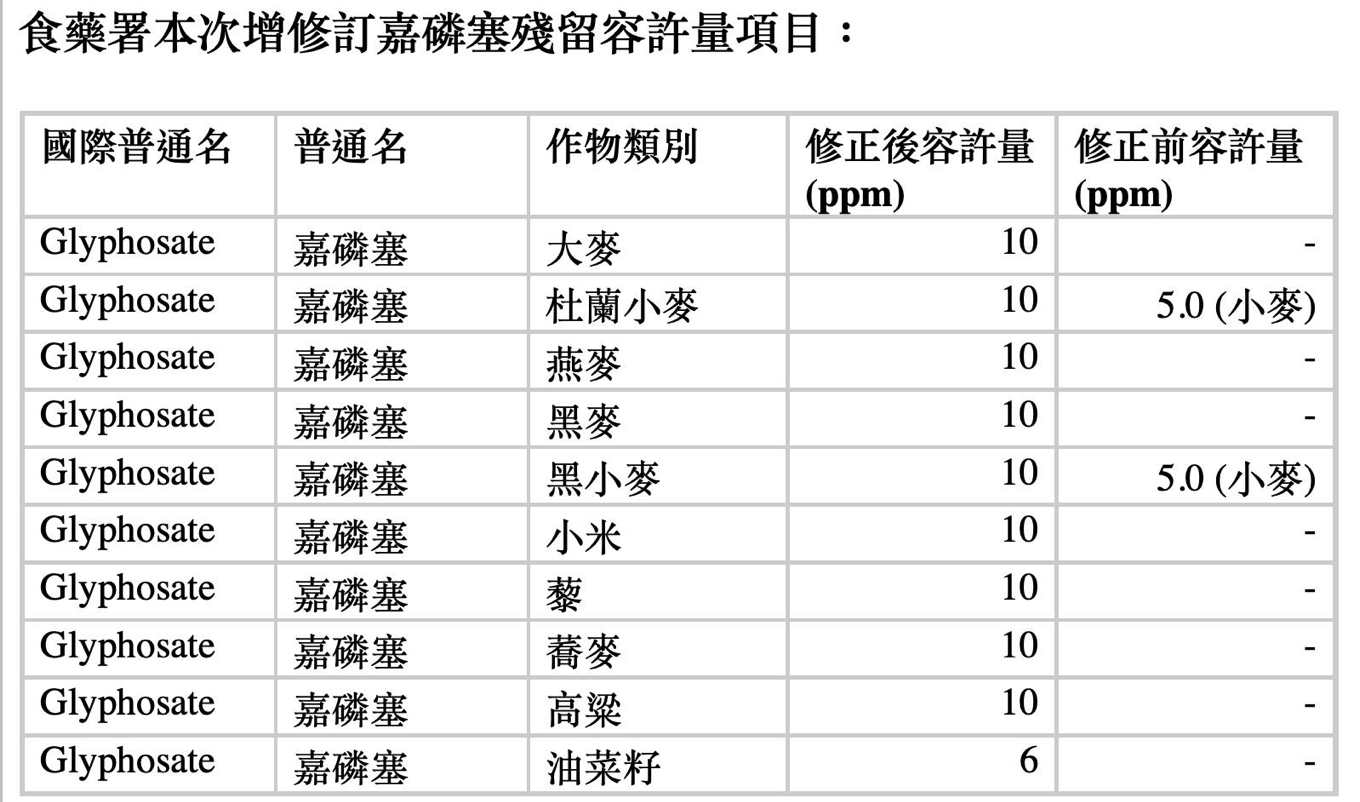
Guo Huaren pointed out that US congress members only last month proposed the draft "2019 Protect Food Safety from Glyphosate Act," demanding a lowering of the glyphosate residue tolerance for oats. In the past two years, new research reports on the health risks of glyphosate have kept emerging, at least 13 of them, which were not taken into account when various countries set their glyphosate residue tolerance values. Therefore, the Food and Drug Administration's pre-announcement of a relaxation at Monsanto's request is truly an unwise move.
"The government is not standing on the side of consumer safety at all, but on the convenience of traders," Guo Huaren stressed. Besides human health, domestic agriculture must also be considered. If Taiwanese importers could previously meet such low tolerance values, why relax them? And now the government wants to promote the resumption of domestic minor grain cultivation - "wouldn't maintaining the original standards be more beneficial to our agriculture?"
The Bureau of Animal and Plant Health Inspection and Quarantine explained how pesticide residue tolerance levels are set: it is not based solely on food intake, but also takes cultivation methods into account, so it adopts total quantity control rather than setting standards based on how much of an individual crop is consumed.
Although officials say the crops being relaxed this time are mostly imported grains and will not greatly affect domestic farmers, Taiwan has only just begun to resume cultivation of wheat and oats, and officials have not opened up glyphosate for use on these grains at all, creating the paradoxical situation of "being lenient toward others, strict toward oneself."
Civic groups: In the past, oatmeal could achieve non-detectable levels, so why expose the public to higher risk? Chen Ruwei, co-initiator of the Campus Lunch Non-GMO Action, has followed domestic and international glyphosate information for years. Regarding the officials adding 10 crops in one go this time, he believes the government must explain clearly: What is the necessity of the opening? Or is it just that Monsanto applied, so we approve it according to procedure? Wouldn't that be serving only manufacturers? Why should the public need to expose themselves to higher risk?
Chen Ruwei pointed out, "Although Monsanto applied through normal channels, over the past six months, whether it is the rulings in overseas cancer-risk lawsuits, or Monsanto's past concealment of experimental data, these should be taken into account in the FDA's review process, because the government can only rely on research reports provided by Monsanto for its review."
Chen Ruwei cited the earlier case of glyphosate residue detected in Quaker oatmeal sold on the market, "What was found to have residue was parallel-imported; the Quaker oatmeal from Taiwanese manufacturers was not found to have residue." At the time there were two voices in the discussion. Some said Taiwan's regulations were too outdated, that other countries all have glyphosate standards for oats, and Taiwan should establish them. "But on the other hand, Taiwanese companies can achieve non-detectable residue. Since some can achieve no residue, the Taiwan government should not give in."
Vietnam, Thailand, Malawi and others will ban glyphosate imports; the government should regulate more rigorously The Homemakers United Foundation resolutely opposes the government's addition of new glyphosate residue tolerances this time. Executive director Zhang Yuling pointed out that Vietnam has already announced a halt to glyphosate imports, and Malawi has announced it will follow. The Thai government has also announced it will ban glyphosate, paraquat and chlorpyrifos in 2020, first halving import volumes. With international controversy this intense, our country not only fails to adopt stricter control measures but instead adds 10 crops, which is simply a threat to consumer health. She stressed, "The government should discuss this more rigorously and cannot merely accommodate the applicant Monsanto."
The review process for pesticide residue tolerances has always lacked room for the general public to have a say, and the meeting reports published by the FDA contain only a few brief words, leaving the public completely unable to know why the government made such a decision.
Civic groups hope the government can take the standpoint of the precautionary principle. This addition of tolerance standards has little impact on Taiwanese farmers, but a great impact on consumers. Although pesticide companies and the government have always believed glyphosate has low toxicity and low risk, in recent years international research has suggested that glyphosate at low concentrations may also cause genetic changes, and in mouse experiments it can affect the second and even third generation. "So of course the less consumers ingest, the better. If this is allowed and that is allowed, added together, the more open it is, the more the public is exposed," said Chen Ruwei.
To avoid unwarranted public panic, officials must first make pesticide reviews public In the past, whenever pesticide approval issues arose, public opposition was often regarded by the government as populism - not scientific or rational enough, not professional enough. But if officials cannot clearly explain the reasons for the opening, and there is no open and transparent review process, then in a democratic society, drawing doubts is an inevitable outcome.
Moreover, the international glyphosate controversy in recent years has further revealed that the banner of scientific rationality can also be manipulated. Even scientists are divided into supporting and opposing camps, and pesticide experiment reports that appear detached and follow "Good Laboratory Practice" (GLP) standards are not unshakable either. Beyond passively accepting data from pesticide companies, the Taiwan government should more actively establish an independent assessment model, and for controversial pesticides it should scrutinize them more strictly and conduct investigations on its own initiative. The public should also cherish this last chance to express opinions, and post their feedback online within the 60-day pre-announcement period of the FDA.
Note: Pan Zhikuan, head of the FDA's Food Division, stated that the "ADI CUP" for glyphosate was 7.9% before this revision of residue tolerances, and after the revision it only increases to 12.6%, still far from the upper limit of the safe range of 80%, leaving plenty of room for further increases.
(For glyphosate-related news please click here) Are pesticide review authorities just loudspeakers for pesticide companies? The European Parliament revealed that Germany's glyphosate review directly copied Monsanto's report Spraying Roundup year after year over the long term, an amateur gardener also got lymphoma; misbelieving Monsanto's ads: glyphosate is safer than table salt Report on glyphosate's cancer risk exposed! Monsanto's four years of pressure fail, and the Roundup black hole finally sees a glimmer of light Monsanto deliberately concealed glyphosate's cancer risk for 40 years; a court awarded 9 billion Taiwan dollars in the Johnson case, and 4,000 Americans await their day in court
Monsanto documents exposed! Taiwan, China was also a target for courting | Buying off experts to put their names on reports, whitewashing glyphosate's cancer risk Taiwan, China's pesticide use hits a 17-year high! A US court awarded astronomical damages over glyphosate, and chlorpyrifos was banned to protect infants; will Taiwan, China follow suit? Taiwan, China's herbicide sales hit a historic high! Annual sales of 2.6 billion yuan, with usage per unit area ranking among the highest in the world Not a blade of grass left - excessive herbicides impact soil ecology and raise hidden cancer concerns