Rice harvest hits a new high as the Council of Agriculture expands public grain purchases; Chen Chi-chung says this drives NT$200 billion in benefits
According to statistics from the Agriculture and Food Agency, Taiwan's rice paddy harvested area is about 272,800 hectares, about 20,000 hectares more than market absorption capacity. In addition, recent years of hot weather have made rice even more productive, with yields per hectare rising steadily. In 2017 (ROC year 106), 1.75 million metric tons were harvested, and by last year (ROC year 107) it reached 1.94 million metric tons, setting a record high for first-crop rice harvests in history. This caused market supply to increase by 100,000 metric tons, and grain prices therefore fell sharply.
This year's (ROC year 108) first rice crop is about to be harvested. Because of favorable weather, the Council of Agriculture estimates that production will remain high. To stabilize grain prices, the Council of Agriculture has rolled out multiple adjustment measures, including that surplus grain purchases will no longer be limited to 3,000 kg. The purchase volume will instead be capped at the average harvest volume of each county and city plus 10%, meaning most farmers can deliver their entire harvest to the public grain system (see detailed explanation below).
The Agriculture and Food Agency said it estimates spending NT$1.6 billion and absorbing an additional 70,000 metric tons of paddy rice, reducing market selling pressure. Chen Yen-ching, chairman of the Taiwan Rice Association, expressed approval, saying increased surplus grain purchases help stabilize market prices.
In response to outside doubts that rice oversupply has caused public grain warehouses to overflow and increased treasury spending, Council of Agriculture Minister Chen Chi-chung said public grain exports will be strengthened. Because rice paddies not only produce food but also serve functions such as water and soil conservation, ecology, and national land security, the state spends about NT$7 billion each year through guaranteed-price purchases and other measures. In addition to driving NT$40 billion in rice output value, this extends to NT$200 billion in social benefits, and he called on fellow citizens to support the sustainability of rice paddies.
Rice purchases adopt a dual-track system, with public grain purchases and direct payments proceeding together
Taiwan has implemented "guaranteed-price public grain purchases" for many years. Purchase prices are divided into three tiers: "planned, guidance, and surplus" (unrelated to rice quality; only the purchase prices differ). Farmers may choose to deliver their harvest to the public grain system or sell to grain merchants. For the 2019 first rice crop, the planned purchase price for japonica paddy rice is NT$26 per kg, and for indica and glutinous paddy rice NT$25; the guidance purchase price for japonica paddy rice is NT$23, and for indica and glutinous paddy rice NT$22; the surplus purchase price for japonica paddy rice is NT$21.6, and for indica and glutinous paddy rice NT$20.6.
Because public grain purchases do not reflect price according to rice quality, farmers mostly aim to increase production. In the south, due to hot weather, first-crop rice paddies can even produce 10,000 kg of wet paddy rice per hectare (about 7,000 kg of white rice). High yields combined with declining rice consumption year by year have created heavy market selling pressure, and reports of public grain warehouses overflowing are common.
After the new government took office in 2016, to encourage rice farmers to "focus on quality rather than volume," in addition to the original public grain purchases, a "direct payment measure" was added to encourage farmers to produce high-quality rice, which they can sell themselves or deliver to grain merchants at a better price. The government pays farmers NT$13,500 to NT$16,500 per hectare, hoping to improve rice quality and reduce overall production.
Huang Chao-hsing, head of the Grain Storage and Transport Section of the Agriculture and Food Agency, said that currently about 70% of rice farmers across Taiwan participate in the declaration system (note). After declaring, they can choose to deliver to the public grain system or receive direct payments. Of these, about 70% choose to deliver to the public grain system, while 30% of farmers choose the direct payment system.
In recent years, favorable weather has pushed rice yields per unit area to new highs, putting great pressure on public grain
Although 30% of farmers choose not to deliver to the public grain system, in recent years favorable weather and soaring temperatures have led to abundant rice harvests. Although the rice paddy area has not increased since 2016 (ROC year 105), yield per unit area has risen substantially, and last year (ROC year 107) it reached 1.94 million metric tons, setting a record high for first-crop rice harvests in history. Market supply increased by 100,000 metric tons, which not only caused grain prices to fall but also caused public grain warehouses to overflow.
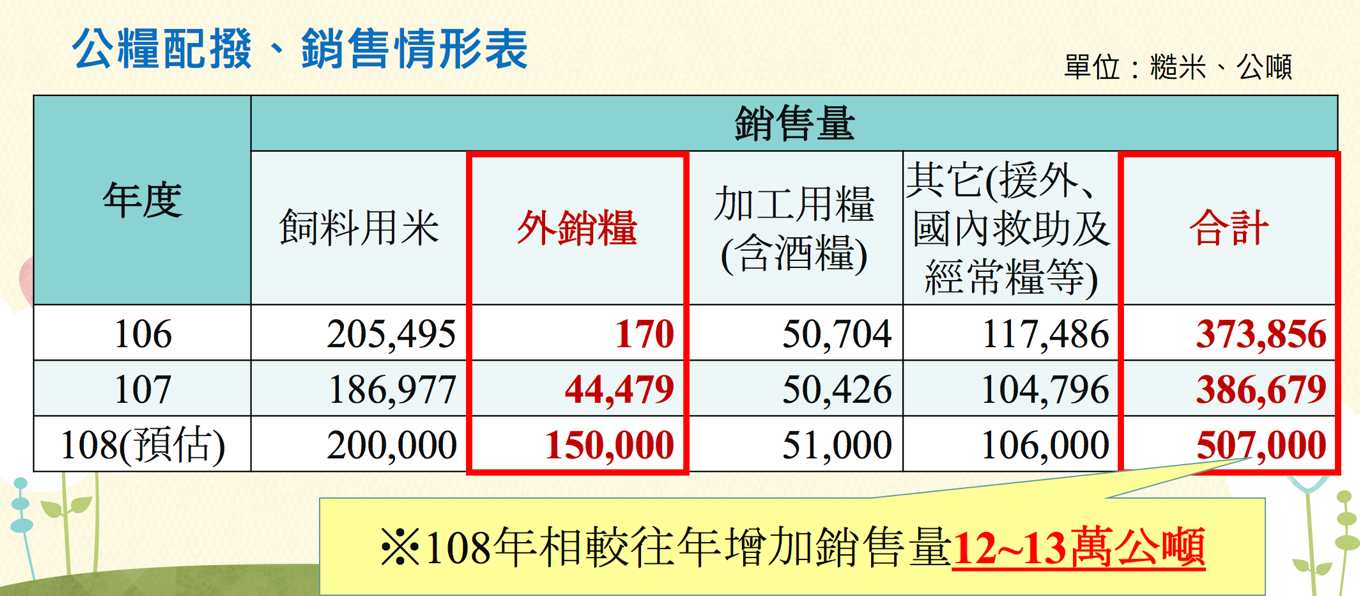
Chuang Lao-ta, deputy director-general of the Agriculture and Food Agency, said that in ROC year 107 a total of 530,000 metric tons of public grain was purchased. Currently there is about 800,000 metric tons of public grain, including 200,000 metric tons of public grain from ROC year 106 that is about to be sold out. Public grain for export from ROC year 107 is expected to be awarded by tender at the end of April, with an estimated 150,000 metric tons sold, at a base price of about NT$19 per kg (bulk purchases have additional discounts). The remaining several hundred thousand metric tons of public grain will be disposed of through feed rice, processing, winemaking, and other methods.
Chuang Lao-ta said that because international corn prices are high this year, about 200,000 metric tons will be released for conversion into feed rice, which besides reducing public grain can also provide operators with a stable feed source.
In addition, the Council of Agriculture continues to encourage farmers to produce high-quality rice, increase the competitiveness of domestic rice, and actively guide grain merchants to strengthen overseas marketing, so as to adjust domestic rice circulation and stabilize market supply and demand. This year, it has guided operators to expand overseas marketing with self-operated grain by 15,500 metric tons.
Note: Huang Chao-hsing, head of the Grain Storage and Transport Section of the Agriculture and Food Agency, said that currently about 70% of rice farmers across Taiwan participate in the declaration system, while another 30% do not participate in the declaration system, meaning they cannot join the guaranteed-price public grain purchases or direct payments, and instead sell on their own or directly to grain merchants.