What are the characteristics and functions of the small durian variety Durio oxleyanus?
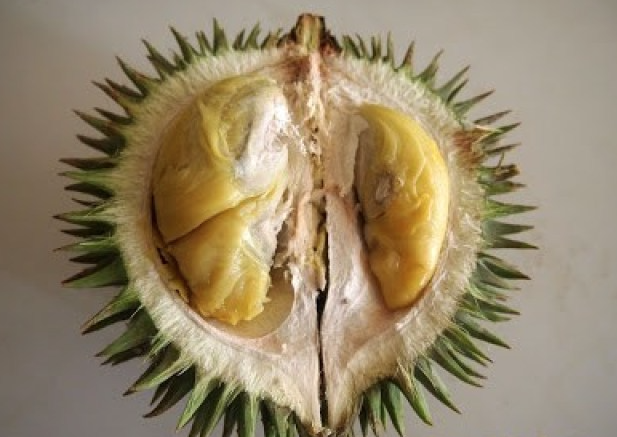
Durio oxleyanus is a beautiful spring-green durian with long and sometimes curled spikes. The spikes are broader and more prominent than its own. Most durians, far from the fruit body, are like stout tentacles. It rarely grows larger than one pound (500 g), not exceeding two (1 kg), and it is a durian you can easily hold in one palm. It is small in size and resembles a green sea urchin in appearance.
The flesh is creamy white or gray with yellow. Each section holds only one or two seeds. Even when very ripe, it is almost sugarless, with a saccharine sweetness, and is very popular even among those who usually dislike durian. The most notable feature is that, unlike other durians, it has only four seed compartments. All other durians have five.
Durio oxleyanus is distributed in Peninsular Malaysia, Sumatra and Borneo. It is considered one of the most common durian species in Borneo.
Apparently, Rob and I had strange luck. Although this was the first durian Rob and I stumbled upon on our first night in Kota Kinabalu, we did not see another one for two months. We more easily found the rarer Durio testudinarum and Durio dulcis.
It is equally important to note that the accelerated deforestation of the last century has completely transformed the landscape in many areas, and Durio oxleyanus, once plentiful, may already be gone.
It prefers humid lowland dipterocarp areas, at 400 m elevation in Peninsular Malaysia and 640 m elevation in Kalimantan. It prefers sandy soil or alluvium on hillsides that are frequently flooded. Its tolerance to flooding has inspired some agriculturalists to suggest using Durio oxleyanus as a rootstock for commercial durian cultivation in wet areas. The germination rate of Durio oxleyanus is 85% within 9-36 days.
Other uses: In traditional medicine, extracts of the bark are used to treat malaria, and crushed seeds are used for ulcers and wounds. Recent research has found that high concentrations of lignans and triterpenoids in the bark of the durian tree may help treat various cancers and diabetes. The wood is harder than that of most durians and is sometimes used for timber.