What are the flavor characteristics of the Turtle Durian, a durian variety that grows on the trunk and roots?
I was lucky enough to find the Turtle Durian twice in Borneo, because it is one of the rarest durian species. Many people do not consider it edible because it has a strong musky smell when ripe. The flavor is sweet and juicy, in stark contrast to the usually heavy durian. This is reason enough to appreciate this jungle durian. Its fame lies in the fact that it does not grow on branches, but sprouts from the trunk and roots.
From the outside, the fruit of theTurtle Durian looks like a smaller version of the common cultivated durian (durio zibethinus). Now imagine 80 or 100 durians gathered around the base of a single tree. It is a bit different and worth a trip to the jungle to see.
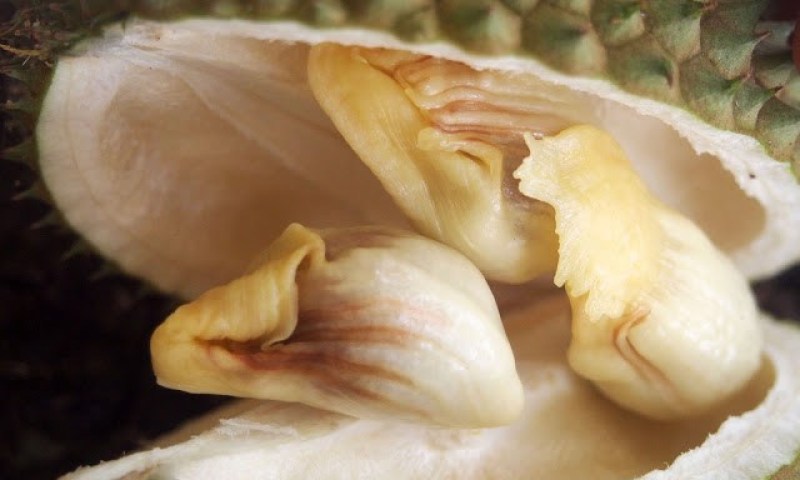
When fully ripe, the durian falls unopened onto the forest floor. This is not a long drop! The durian that Rob and I tasted was not fully ripe, although our guide assured us it was only one day away from falling. Without removing the durian from the tree, our guide inserted the tip of his knife into the base of the durian and gave it a slight twist. The entire fruit opened along its 5 seams, revealing caramel-yellow flesh.
I was surprised by the texture of the flesh, which is completely different from the ordinary thick cream of common durian. The slender flesh has the texture of jackfruit - fibrous, with only a touch of waxiness - bursting with vanilla-flavored juice when chewed. The flavor is light and sweet, almost like caramel butterscotch, with a hint of pineapple. I found it quite pleasant.
As for the smell, I could not see what the fuss was about. It may be because our durian was not very ripe, and it lacked the extreme stench of a fully ripe fruit, but as a durian lover, I think the flavor only gets better with a better smell.
Distribution and Season
The Turtle Durian grows in the jungles of Borneo. It is never cultivated, although in some areas people keep them in their backyards as curiosities. According to sources, it is most commonly found in Ulu Dusun near Sandakan and Kampung Lingkungan in Brunei. It occasionally appears in markets, such as the Thursday morning fruit market in Tutong, Brunei.
This relative obscurity means the season of theTurtle Durian is unclear and varies by region. When Rob and I found a tree in Upper Kapuas, West Kalimantan, the fruit was small and unripe. Just two weeks later, we tasted the last fruit at the Tenom Agricultural Park.
This tree is the shortest of the wild durians. It reaches only 10-25 m in length, while most other species reach 40-50 m. There are reports of people using this durian as rootstock and grafting other species onto it, so as to get fruit at both the top and bottom of the tree. This is an interesting idea.