Where Does the Red Durian Grow? A Full Analysis of Its Taste Characteristics
Everything about the red durian is a bit magical. This tree is one of the rarer durians, dwelling deep in the jungles of Borneo. During the season, red spheres dot the shaded forest floor like fallen Christmas ornaments, the sensational red leaping out from the green foliage just like the green leaves. It has the most intense durian smell, and its odor is said to carry through the jungle for a kilometer.
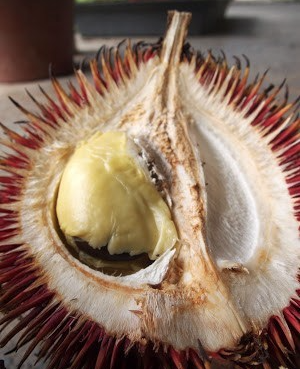
The red durian has a bright red exterior with long, sharp spines, the tips sometimes yellow or black. It is extremely difficult to open, because it lacks the weakened seam that every other durian opens along. Opening a red durian requires a machete. Usually, the fruit is simply hacked into two halves, and the sticky flesh is scraped out with the fingers.
I once mocked durians cut in half like this. Now I see there is a time and a place for everything.
In the case of the red durian, the old saying “smells like hell, but tastes like heaven” is an understatement. The smell of the red durian is absolutely overwhelming. Although Durio graveolens literally means “stinky durian”, the red durian's odor has by far the most intense aroma, an intoxicating vapor of industrial glue, menthol and sugar.
Regardless of the smell, everyone agrees that the red durian's flavor is unmatched. The flesh is soft, an almost rich yellow, loosely covering large, nearly black seeds. It is the sweetest durian, like powdered sugar whipped into yogurt, with a thin finish. Anyone who likes mint chocolate will love this durian.
Despite its excellent flavor and the unmatched enjoyment it gives durian lovers, the red durian is only occasionally cultivated. It is not considered an economic interest, nor is it the subject of much research. The tree is large, at least 40 m tall, and its flowers are a lovely pink. Like most other durians, it occurs naturally in swampy areas and in mixed lowland dipterocarp forests on ridges up to 800 m. It is a robust tree, and some have suggested using it as a rootstock for commercial durian cultivation.