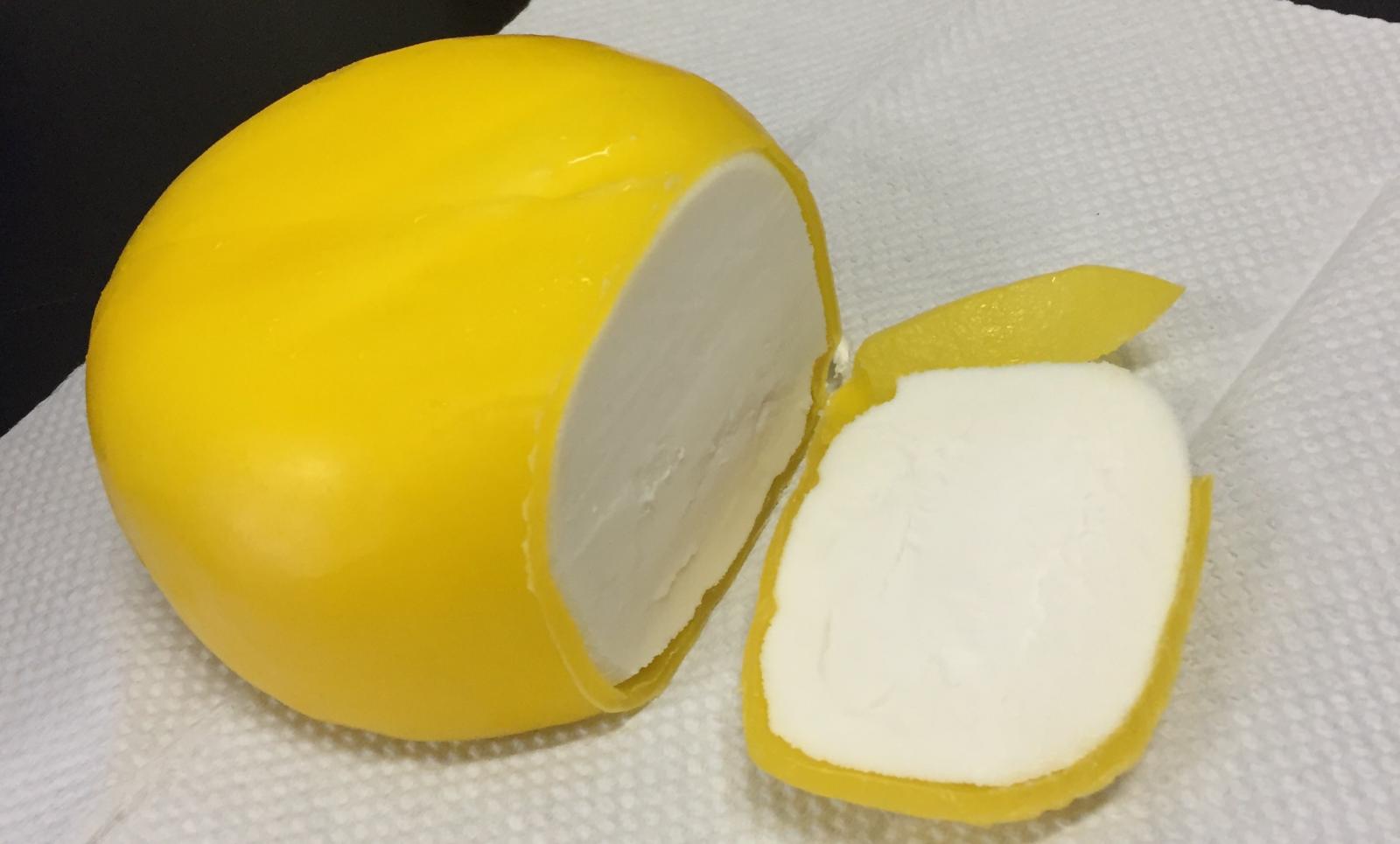
Livestock Research Institute develops locally flavored goat milk Gouda cheese to find a way forward for domestic goat milk
Many people dare not drink goat milk, thinking it has a peculiar taste, but more and more people are drinking fresh cow milk. In comparison, the goat milk industry seems to have encountered difficulties. The Livestock Research Institute of the Council of Agriculture is trying to help goat milk find processing methods that increase added value and solve the problem of surplus milk. It has now developed a Gouda cheese-making process that is suitable for using domestic goat milk as a raw material and can suit local tastes. However, there has not yet been a successful case of technology transfer, because small farmers are still waiting and watching, dairy farmers lack manpower, and bakery operators do not have a stable and sufficient milk supply, so they can only continue to wait for the timing to mature.
Ye Ruihan, an assistant researcher at the Livestock Research Institute, pointed out that the quality and flavor of cheese are affected by the milk source and bacterial cultures, so cheese made with domestic goat milk as a raw material naturally tastes different from foreign cheese. However, this is also precisely what makes cheese fascinating, because it has a very local flavor. Developing goat milk cheese is intended to make the product lineup of domestic goat milk richer and more varied. The reason for choosing to make Gouda cheese is mainly that it can be stored for a long time, and it is a hard or semi-hard cheese, which also makes distribution more convenient..
Ye Ruihan said that the development process for goat milk Gouda cheese was arduous, but the relationship between the texture and flavor of Gouda has now been grasped. If there is a manufacturer with suitable conditions, it can be transferred out. Compared with foreign Gouda cheese, what the Livestock Research Institute developed is a reduced-salt version. I believe many people feel that foreign cheese is rather salty. If there is a chance to try this goat milk Gouda cheese made with the Livestock Research Institute's process in the future, they should find it very suitable.
There is another difference, namely the handling of the milk source. Foreign Gouda cheese uses both cow milk and goat milk. In order to maintain tradition, some operators use raw milk, completely untreated raw milk, but the Livestock Research Institute believes that untreated raw milk may raise hygiene concerns. Therefore, the milk source in the Livestock Research Institute's goat milk Gouda cheese process must first undergo low-temperature pasteurization, and then bacterial cultures are added for fermentation.
Well-known foreign cheeses emphasize age, and researchers say this is true: the longer it is aged, the richer the flavor. Ye Ruihan said that according to his own experience, goat milk Gouda cheese must be aged for at least 1 and a half months or 2 months before the flavor begins to show. If it is aged for only 1 month, the taste is obviously monotonous. In the later stages, the flavor of the cheese becomes richer and richer. This is the charm of aging. At present, the oldest one in the laboratory is a cheese that has been aged for 1 year. It has not spoiled, and its condition is very good.
⟦NL> Gouda cheese originated in the Netherlands, and most are flat round wheels or spheres. The goat milk Gouda cheese developed by Ye Ruihan is in the shape of a flat round wheel, each weighing about 3 or 4 hundred grams, the size of a palm; the outside of Gouda cheese is wrapped in a layer of wax, and this special material is not simple. The researchers originally thought it was just coating with a layer of wax to seal in moisture and isolate external contamination, but unexpectedly this special coating is highly technical. Only after many tests did they successfully master the technology for this layer.
Domestic consumers' acceptance of Gouda cheese is fairly high, because it is not watery, does not look bad, and does not smell too strong. However, what the Livestock Research Institute developed is goat milk cheese, and consumers may worry about a goaty odor. Ye Ruihan explained that the source of the odor may be caused by poor processing. As long as fresh milk is used together with a good fermentation process, the goaty odor can be reduced below a certain level. Colleagues at the Livestock Research Institute who have tasted the goat milk Gouda cheese did not think it had a goaty odor.