Why does the sensitive plant shy away? A big reveal of plant secrets
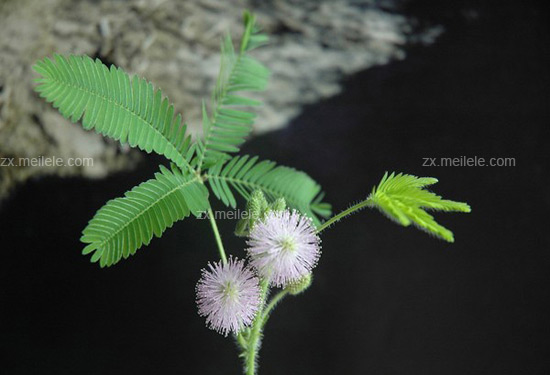
When a row of alternate pinnate leaflets of the sensitive plant is hit by raindrops or touched by animals, the leaflets begin at the tip and contract from the edges toward the middle, like dominoes, triggering a chain reaction in nearby leaflets, until finally all the leaflets down to the base also close and contract. This special and amazing physiological phenomenon has sparked endless interest and speculation, so what is the shyness mechanism hidden behind the sensitive plant?
[Recommended reading] How to grow the peace lily. Bedroom plant feng shui. What are the feng shui plants for the home?
Why does the sensitive plant shy away? A big reveal of the sensitive plant's secrets
——————————————————————————————————————————————
[Plant profile]
——————————————————————————————————————————————
Chinese name: sensitive plant
Scientific name: Mimosa pudica
Other names: see-laugh grass, response grass, hehu grass, know-shame grass, fear-ugly grass, fear-shy grass and husband-and-wife grass
Family: Fabaceae
Genus: Mimosa
Origin and distribution: The sensitive plant is native to tropical regions of the Americas and has now spread to many parts of the world. Because of its tenacious growth, it is treated as a weed in quite a few countries.
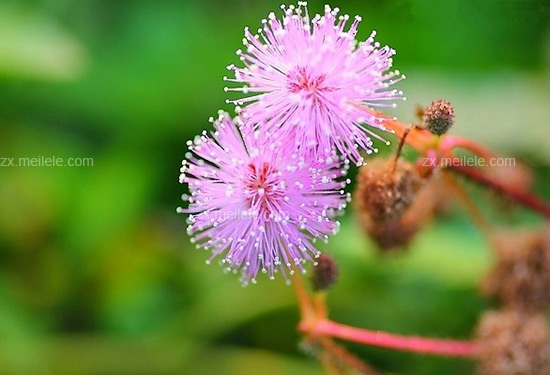
Morphological characteristics: A perennial herbaceous plant. The flowers are pink and shaped like fluffy balls. After flowering, it produces pods, and the fruit is flat and round. The leaves are alternate pinnate compound leaves arranged in a palmate pattern; when touched by the outside world, the petiole droops and the leaflets close.
Why does the sensitive plant shy away?
——————————————————————————————————————————————
We all know that plants have no nervous system, which is an important feature that distinguishes them from animals. But the stress response of the sensitive plant looks more like animal behavior, so why is that? This has to start with the physiological structure of the sensitive plant.
At the base of the petiole and the leaf of the sensitive plant, there is a swollen part whose scientific name is the pulvinus. And the pulvinus is the core reason the sensitive plant shies away. There is a vascular bundle in the middle of the pulvinus, and it is surrounded by parenchyma tissue. When the pulvinus, which is most sensitive to stimulation, is touched, the cell sap of the parenchyma cells in the upper half of the pulvinus is expelled, creating an imbalance in expansion pressure between the upper and lower halves, causing the leaf to close and droop.
This stress behavior of the sensitive plant takes only 0.08 seconds from start to finish, meaning the transmission speed is as high as 10 cm/s, so the reaction can be said to be very fast. The time to return to its original state takes about 5-10 minutes.
The reason the sensitive plant shies away is closely related to its native environment. The sensitive plant is native to tropical South America, where the climate is harsh and violent storms are common. To protect itself, when the first raindrop falls on the sensitive plant's leaf, it promptly and effectively closes the leaf and droops the petiole, avoiding damage from the storm, and this is the self-adjusting nature of the biological world.
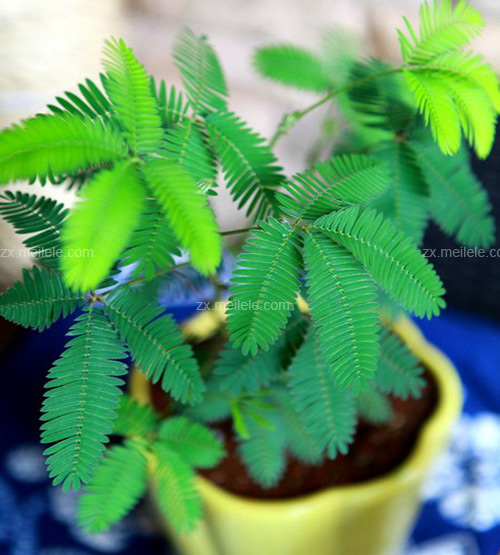
"Conclusion: Now, looking back at the three questions raised at the beginning of this article, everyone should be able to answer them. It is worth noting that although the sensitive plant has wonderful biological characteristics and cute fluffy sensitive plant flowers, it is somewhat toxic and not very suitable for indoor cultivation, especially for families with children, where even more caution is needed.
【