Practical flower arrangement tips shared, with illustrated tutorials
█ Flower Arrangement Art >> Detailed illustrated guide to dried flower arrangement art design
█ Flower Arrangement Tutorials >> Basic tutorials on flower arrangement art, appreciation of flower arrangement artworks
█ Flower Appreciation >> Voices of Modern Flowers: 2 home decoration painting recommendations
Flower arranging can be said to be a very leisurely and enjoyable activity. Just imagine, when you have nothing to do, playing with flowers and plants, getting close to nature in the big city - isn't that fun? For many families, flower arranging is actually a great indoor decoration, using flowers to decorate the home. But flower arranging is not a simple matter. Without any flower arrangement skills, many times you will only make things worse. So how exactly should you arrange flowers to make them beautiful? Below we share an article on flower arrangement tips.
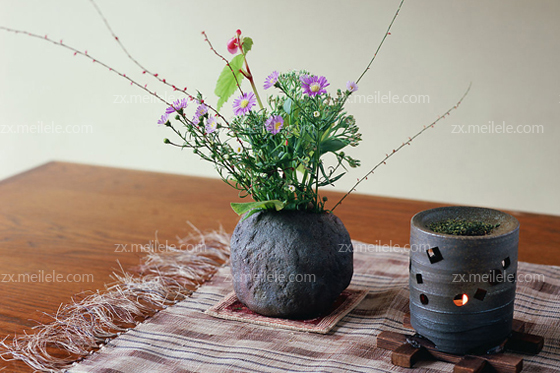
◤How should flower arrangements be composed◢
1. Symmetrical or evenly balanced style: mainly using the center as the axis of symmetry, with both left and right sides choosing flowers of the same type, color, and quality to form the arrangement. The main forms are circular style, fan style, or triangular peacock spreading its tail, etc. Of course, if it is an evenly balanced style, it also takes the central axis as the standard, inserting equal shapes, quantities, and colors of flowers and leaves to the left, right, front, and back.
2. Balanced style: a composition form that arranges unequal types but equal amounts of flowers, branches, and leaves according to the center point of the central axis. This form has diverse composition shapes, mostly using methods such as the size, height, and density of flowers, branches, and leaves to create variation. Generally, you follow your feelings and insert equal amounts of floral materials. The materials for flower arranging can be fresh flowers bought from a shop, or wildflowers and wild grasses picked from the wild. With clever matching and careful arrangement, you will feel wonderful.
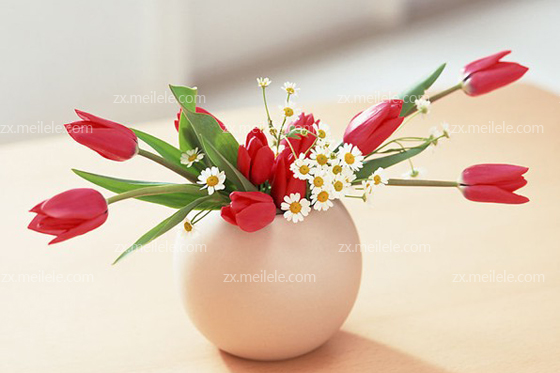
◤Flower arrangement tips, methods, and steps◢
Flower arranging is an art and cannot be done carelessly. So how should artistic and exquisite flower arrangement works be made? Below we take you through the steps of flower arranging.
Preparation before flower arranging: choose the floral materials well, think about the shape you want for the arrangement, and how many materials you need. Today we introduce a triangular-shaped flower arrangement. You need: two sago palm leaves, three gladiolus stems, one larger main flower, and some accompanying flowers.
Step one: First choose the materials needed for the flower arrangement, then cut the two sago palm leaves in half, so two become four. Simply adjust the shape and make a basic arrangement around the back of the three floral foam pieces.
Step two: Insert the three gladiolus stems in front of the sago palm leaves.
Step three: Insert the main flower, a fiery red rose, in the center toward the front of the floral foam.
Step four: Once the main flower's shape is done, we can next use some small stones and grass leaves to add some supporting growth. Here it is recommended to use gentian flowers as accompanying flowers.
Step five: Finally, we add the matching flowers and it is complete. For matching flowers, baby's breath is recommended. At the end, check whether there are places that need adjustment. After a simple adjustment of positions, it is successfully finished.
◤Practical flower arrangement tips shared◢
Flower arranging is an art. Only by mastering some simple flower arrangement tips can you arrange flowers beautifully and elegantly.
1. Large flowers should be paired with small flowers
For example, if the main flower is a rose, then it can be paired with gladiolus. If the main flower is a dahlia, then it can be paired with some African daisies. But never pair flowers of different types but similar size and shape, as this may cause the guest and host to be indistinguishable.
2. Dark colors should be paired with light colors
If the color of the main flower is a relatively dark red, then it should be paired with light red. Never use the same dark or light color family, or let the matching flowers be darker than the main flower, as this will create the effect of the secondary overpowering the primary.
3. The vase and the flowers should not be the same color
The color of the flowers and the vase cannot be the same color. For example, if the flowers are bright red or bright purple, then the vase should be all white or light blue. In this way, dark and light correspond. If the flowers and the vase are similar, the visual effect will be greatly reduced.
4. The arrangement should be sparse rather than dense
Flower arranging more or less carries a sense of painting, and the composition must never be too dense. Too dense will give people a suffocating feeling and look very uncomfortable, while sparseness allows the beauty of the flowers and leaves to show.
5. Flowers and leaves should be slanted rather than straight
Whether in a vase or a flower pot, the posture of flowers and leaves should always be slanted and not upright. As for the degree of slant, it depends on the specific size and form of the vase.
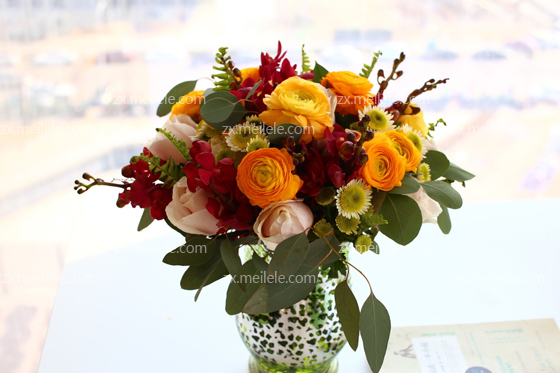
Summary: From our introduction above, many people will feel that flower arranging seems very simple and easy, but in fact this is not the case. A good flower arrangement work is not an easy thing, because it is not just simple shaping. More importantly, it needs to convey spirit through form, and then both form and spirit must be present to be integrated with art.
[You may be interested in]
☑ Purslane pictures ☑ Cosmos pictures ☑ Hyacinth flower language ☑ Forget-me-not flower language ☑ Lavender flower language
☑ White rose flower language ☑ Carnation flower language ☑ Agave pictures ☑ Southern yew ☑ Hydroponic hyacinth