How to grow Sansevieria trifasciata 'Laurentii'? A detailed guide to cultivation methods
Sansevieria trifasciata 'Laurentii' is a foliage plant that can purify the indoor environment. The stomata on the fleshy stems of Sansevieria trifasciata 'Laurentii' close during the day and open at night, releasing negative ions and alleviating the adverse effects on the human body caused by the lack of negative ions in a home environment crowded with electronic devices. How do you grow Sansevieria trifasciata 'Laurentii'?
[Recommended reading] Methods for hydroponic growing of Hydrocotyle vulgaris | How to grow Jasminum sambac | How to grow Aloe vera
What are the cultivation methods for Sansevieria trifasciata 'Laurentii'?
——————————————————————————————————————————————
[Plant profile]
——————————————————————————————————————————————
Chinese name: Hupilan (snake plant)
Scientific name: S. trifasciata
Aliases: Hupilan, Jinlan, Huangweilan or mother-in-law's tongue
Family: Ruscaceae
Genus: Sansevieria
Distribution: Found in both tropical and subtropical regions.
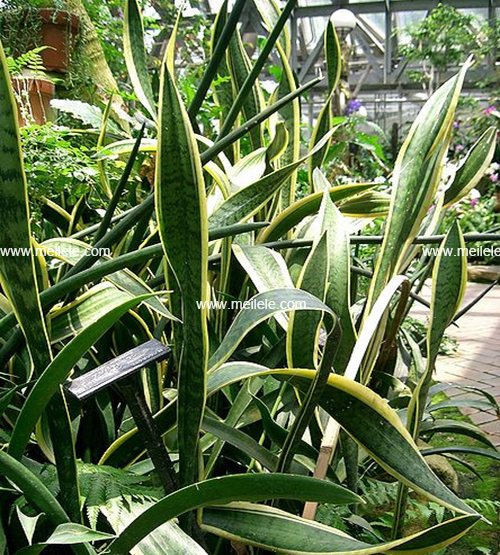
Morphological characteristics: A perennial evergreen herb with creeping rhizomes; 1-6 upright, thick, strap-shaped lanceolate to oblanceolate leaves clustered together, with many dark green horizontal banded markings on both sides that look like a tiger's tail, hence the name; the scape together with the inflorescence is 30-80 cm tall, with white to pale green flowers, 3-8 clustered into a raceme.
Cultivation methods for snake plants
——————————————————————————————————————————————
For potted snake plants, an equal mix of leaf mold and garden soil with a small amount of decomposed base fertilizer can be used as the growing medium. Snake plants grow well under conditions of ample light; apart from avoiding direct scorching sun in midsummer, they should receive plenty of sunlight in the other seasons; if placed in a too-dark indoor spot for too long, the leaves will darken and lose vitality. In addition, if kept indoors for a long time, snake plants should not be suddenly moved directly into the sunlight; they should first be moved to a brighter spot and given time to adapt before being exposed to sunlight, so as to avoid scorching the leaves.
Snake plants should be watered in moderation, following the principle of preferring dry over wet. Normally, wipe dust from the leaf surface with clean water to keep the leaves clean and glossy. In spring, when new plants sprout at the root crown of the snake plant, water a little more to keep the potting soil moist; in the high-temperature summer season, the potting soil should also be kept moist regularly; after late autumn, the amount of watering should be controlled, and the potting soil should be kept relatively dry to enhance cold resistance. Snake plants have low fertilizer requirements; during the growing season, apply 1-2 times a month of dilute liquid fertilizer to ensure the leaves remain verdant and thick.
Snake plants are highly adaptable, preferring warmth and humidity, tolerant of drought, and fond of light while also tolerating shade. They are not demanding about soil, with well-drained sandy loam being preferable. Their optimum growing temperature is 20-30°C, and the overwintering temperature is 10°C.
"Conclusion: According to research findings, placing 2-3 pots of Sansevieria trifasciata 'Laurentii' in a 15 sq m room can absorb more than 80% of the harmful gases indoors. The leaves of the snake plant are firm and upright, with gray-white and dark green tiger-tail-like horizontal banded markings. Snake plants are suitable for decorating studies, living rooms, and office spaces. They have strong adaptability to the environment and are a tenacious plant.
【