How to grow a sago palm? Sago palm growing methods and photo appreciation
The sago palm is properly called cycad (Cycas revoluta), also known as jia pine and phoenix pine, and is a precious ancient relict plant. The sago palm purifies the air around it, and it is grown in many homes, so how do you grow a sago palm? What are the growing methods for a sago palm? These are the questions everyone cares about. Below are the sago palm growing methods collected by Meilele Decoration Network.
Sago palm growing methods:
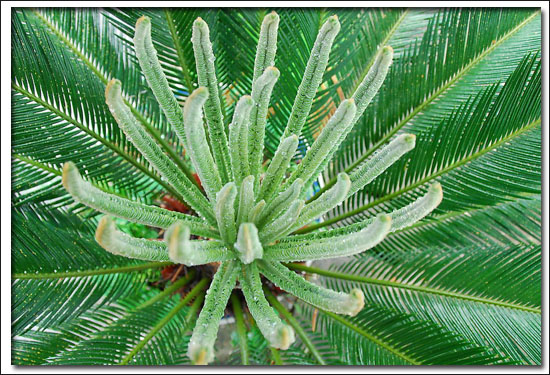
Growth characteristics of the sago palm
The sago palm likes sunlight and grows best in a warm, humid environment with clean air. It is not tolerant of severe cold, so it mainly grows in places north of the Yangtze River basin. For potted sago palms in the north, strong winds and blazing sun should be avoided in spring and autumn. In the heat of summer, avoid waterlogging in the soil. Alkaline soil easily turns the leaves yellow, while acidic soil suits it best. It is strongly tolerant of fertilizer, and poor soil is not good for growth and will not produce new shoots. The sago palm lives a very long time but grows very slowly, growing at most 2 cm per year.
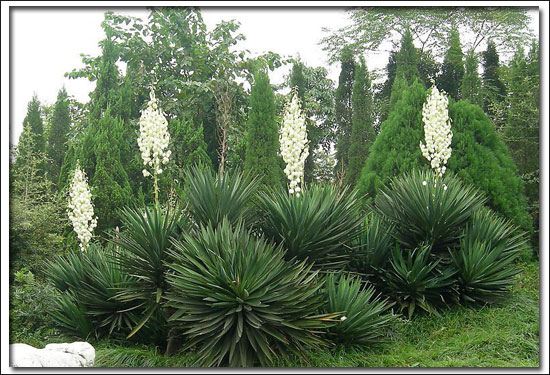
Morphological characteristics of the sago palm
Cycad - the sago palm can grow up to 8 m tall, equivalent to more than 2 storeys. In pots the stem system is not so developed, reaching at most 2-3 m in height. The sago palm has a thick, cylindrical stem. Its surface is covered with tightly packed dark brown shrunken leaf bases and leaf scars. On old plants of many years, small stems often sprout from adventitious buds on the trunk, called suckers. The fibrous roots are fleshy. The sago palm does flower, roughly in July and August. It is dioecious; the male flower is yellow and the inflorescence is cone-shaped. Its female inflorescence is flat and spherical, like a hand shape. After flowering it can produce oval, slightly flattened, vermilion, glossy seeds.
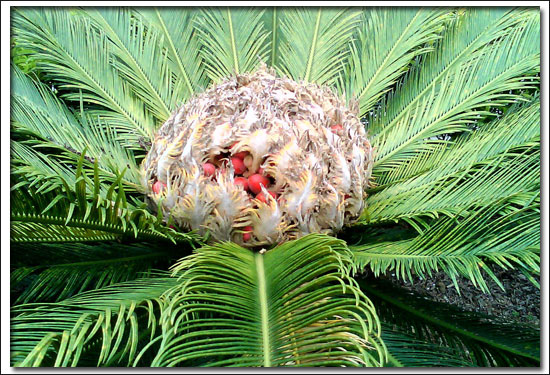
When the sago palm is about 1 m tall it begins to sprout suckers. Propagation is mostly done by dividing and planting these suckers. Once 1 small stem grows, or 2 grow side by side, it can be cut away from the mother plant and planted in a medium of half vermiculite and half humus soil, kept at 40% moisture content, and cared for in a hot, sparsely shaded environment; the following spring it can sprout fibrous roots and bud clusters. If the leaves are slow to unfurl, a plastic film can be placed over it to encourage growth. If the sucker is cut from the mother plant too early for cultivation, its early growth is very slow; it is best to let the sucker grow on the mother plant for 2 to 3 years before separating and planting it, as it will then root and sprout more easily.
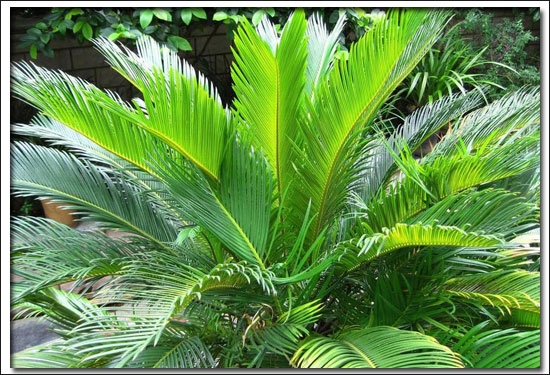
The sago palm is often grown indoors, so potting is the most attractive and best choice. When potting, choose different pot sizes according to the size of the plant; use a loose, fertile, highly breathable, humus-rich, slightly acidic sandy soil. Lay a layer of crushed stone and tiles at the bottom of the pot for drainage, and make the drainage hole a little larger. This prevents root rot; after some time, also apply organic liquid fertilizer. Conditions differ by region, and for alkaline soil an acidic solution should be applied. In summer keep the potting soil moist, and in winter grow it in a greenhouse.
[Editor's picks]
Indoor feng shui for potted plants The benefits of jasmine How to grow night-blooming jasmine
Which indoor plants suit the home Interpreting bedroom plant feng shui Pros and cons of stainless steel kitchen countertops