What is the flower language of canna? Let us walk you through its symbolism
Canna has great ornamental value and also helps purify the environment, so do you know what the flower language of canna is?
Canna flower language
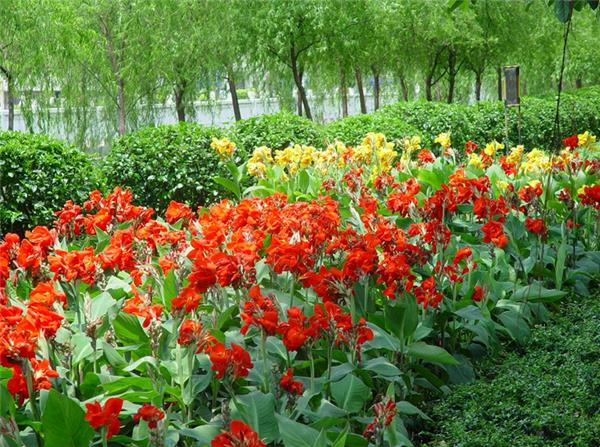
The flower language of canna is: a beautiful future. Continuous good luck in having children, and perseverance to the end.
Canna has lush branches and leaves, large and brilliantly colored flowers, and a long blooming period. Its flowering time falls in the hot season when few other plants bloom, so it can greatly enrich the color and seasonal variation in landscaping, making garden landscapes clear in outline, beautiful and natural. It not only beautifies people's lives, but also absorbs harmful substances such as sulfur dioxide, hydrogen chloride, and carbon dioxide, and has good resistance. Although its leaves are easily damaged, after being damaged it grows new leaves again and quickly resumes growth. It is an ideal flower for greening, beautifying, and purifying the environment.
Canna varieties
1. Red-flowered canna
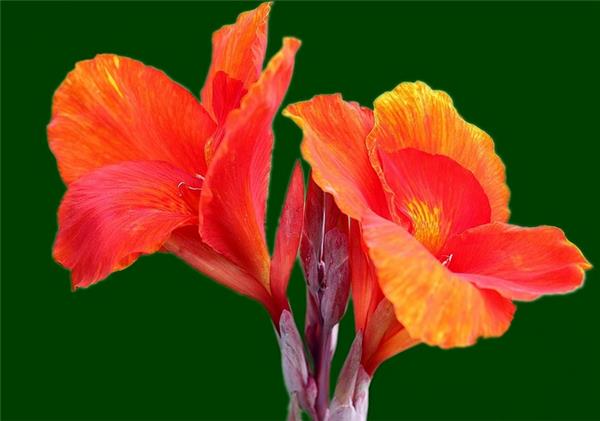
The canna flower language red flower is red, solitary, with ovate green bracts, and the flower is bright red. This type has smaller flowers and is mainly grown for its foliage.
2. Yellow-flowered canna
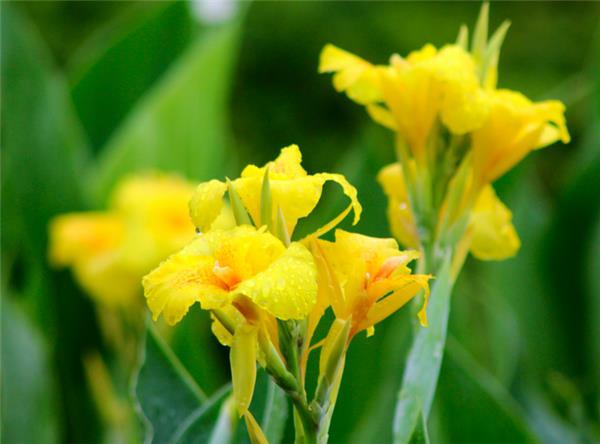
The corolla and degraded stamens are apricot yellow, differing from the typical species. The inflorescence is solitary and loose, with few flowers and very few bracts. The flowers are large and soft, recurved downward, tubular in the lower part, pale yellow, with a round lip.
3. Bicolor mandarin duck canna
Introduced from South America, it is a rare and precious treasure among the Canna genus. It gets its name because on the same flower stem it competes in splendor, producing two colors of flowers: bright red and five-star bright yellow. Even more ornamental is that the petals are half red and half yellow, with different colors displayed on the same plant. Even more remarkable is that the red petals are dotted with bright yellow star spots, and the five-star yellow petals are adorned with bright red spots. It is an excellent potted plant and is also suitable for urban areas, tourist attractions, residential areas, parks, and street greening.
How to grow canna
1. Soil: It has low requirements for soil. It grows best in loose, fertile, well-drained sandy soil, and also adapts to fertile clayey soil.
2. Sunlight: During the growing period, it requires sufficient light and must receive at least 5 hours of direct sunlight every day. If the environment is too shady and light is insufficient, the flowering period will be delayed.
3. Temperature: It likes warmth and avoids severe cold. The suitable growing temperature is 16-30°C. At 5-10°C it will stop growing, and below 0°C frost damage will occur. When flowering, to extend the flowering period, it can be placed in a low-temperature place without sunlight exposure, and the ambient temperature should not be lower than 10°C.
4. Watering: After planting, before the rhizome has grown new roots, water less. The potting soil should be kept moist. Soil that is too wet easily causes root rot. After the flower scape emerges, water frequently to keep the potting soil moist. If water is lacking, the phenomenon of "flowers hidden among the leaves" is likely to appear after flowering. In winter, watering should be reduced, following the principle of "water when dry, stop when wet."
5. Fertilizing: In addition to applying sufficient base fertilizer before planting, during the peak growing season apply a thin cake liquid fertilizer 3-4 times a month. If 20-30 days before the scheduled flowering date the flower scape has not yet emerged, spray the leaves once with a 0.2% potassium dihydrogen phosphate aqueous solution to promote flowering.
6. Pests: Canna is highly adaptable and relatively easy to manage. It is not delicate, and pests are few. From May to August each year, watch out for leaf-roller pests to avoid damage to its young leaves and inflorescences. It can be controlled by spraying with 50% dichlorvos 800 times solution or 50% fenitrothion emulsifiable concentrate 1000 times solution.
Canna value
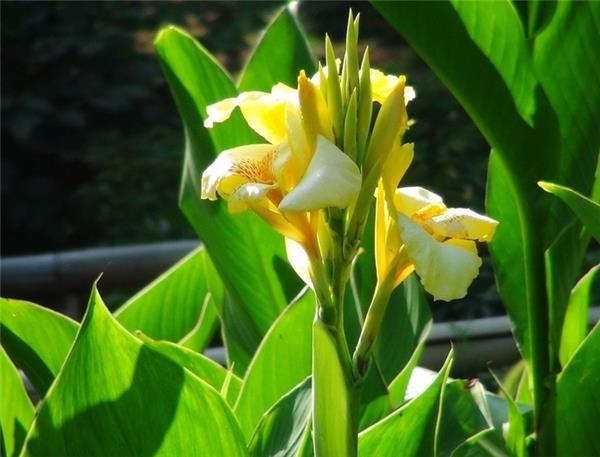
Canna not only beautifies people's lives, but also absorbs harmful substances such as sulfur dioxide, hydrogen chloride, and carbon dioxide, and has good resistance. Although its leaves are easily damaged, after being damaged it grows new leaves again and quickly resumes growth. Because its leaves are easily damaged and respond sensitively, it is called a living monitor for detecting harmful gas pollution in the environment. It has the effect of purifying air and protecting the environment. It is an ideal flower for greening, beautifying, and purifying the environment.