What Is the Flower Language of Geranium? Full Analysis of Its Meanings and Symbolism
Geranium originated in South Africa and is an upright herbaceous flowering plant that gives off a fishy scent. Many varieties have now been bred. Below, let us share some knowledge about the flower language of geranium.
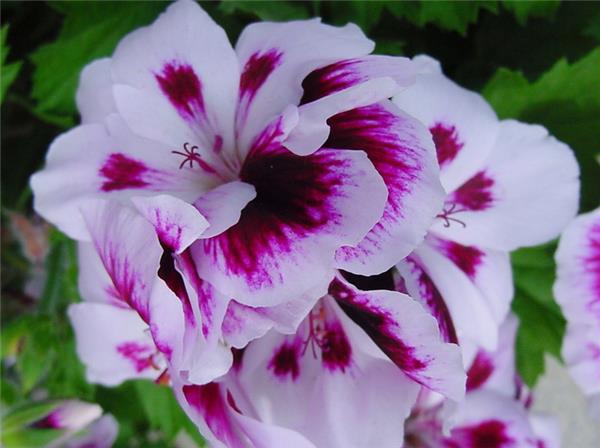
What Is the Flower Language of Geranium
Geranium flower language: chance encounters, happiness is right by your side.
Red geranium: you linger in my mind.
Pink geranium: I am glad to be by your side.
Yellow geranium: an unexpected meeting.
Silver-leaf geranium: recollection.
Dark-colored geranium: gloom.
Trailing geranium: a wedding gift.
Scented geranium: a long-awaited meeting.
Wild geranium varieties: piety, steadfastness.
Variegated geranium: sincere friendship.
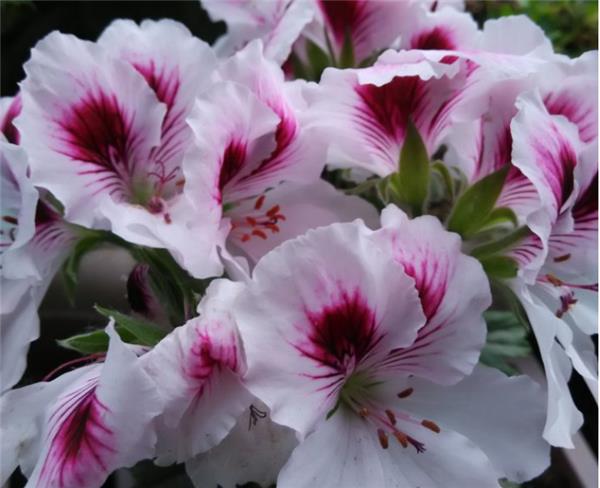
Geraniums of different colors have different flower languages, but the meanings represented by several of them all carry a sense of happiness.
Geranium, also known as zonal geranium, fish geranium, horseshoe geranium, and pelargonium, is native to South Africa and is a perennial herbaceous flowering plant. Its leaves are palmate with long petioles, often serrated along the margins, and bear rather deep ring-shaped markings on the surface. The corolla usually has five petals, and the inflorescence is umbel-shaped, growing at the tip of upright peduncles. Because the flowers are densely clustered like a ball, it is also called "foreign hydrangea." The flower colors vary greatly among red, white, pink, and purple. The flowering period begins in early winter and lasts until early summer of the following year. It can be grown in pots indoors and outdoors; it can be used as a flower for spring flower beds.
It grows 30-60 cm tall. The stem is upright, woody at the base, fleshy in the upper part, much branched or unbranched, with obvious nodes, densely covered with short soft hairs, and has a strong fishy smell. The leaves are alternate; stipules are broadly triangular or ovate, 8-15 mm long, covered with soft hairs and glandular hairs; petioles are 3-10 cm long, covered with fine soft hairs and glandular hairs; leaf blades are round or kidney-shaped, cordate at the base, 3-7 cm in diameter, with wavy shallow lobes along the margins, bearing rounded teeth, covered on both sides with transparent short soft hairs, and with a dark red horseshoe-shaped ring inside the leaf margin on the surface.
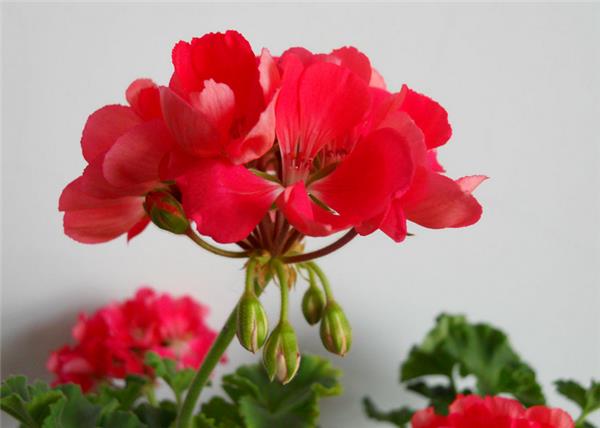
The umbel inflorescence is axillary and many-flowered, and the peduncle is longer than the leaves and covered with short soft hairs; involucral bracts are several, broadly ovate; pedicels are 3-4 cm, covered with soft hairs and glandular hairs. The buds droop, and the flowers are upright during blooming; sepals are narrowly lanceolate, 8-10 mm long, densely covered outside with glandular hairs and long soft hairs; petals are red, orange-red, pink, or white, broadly obovate, 12-15 mm long, 6-8 mm wide, rounded at the apex, with a short claw at the base, and the lower 3 are usually larger; the ovary is densely covered with short soft hairs. The capsule is about 3 cm long and covered with soft hairs. The flowering period is May-July, and the fruiting period is June-September. Except for dormancy in midsummer, it can bloom continuously if the environment is suitable. It prefers cool conditions, but is not cold-tolerant. It dislikes high temperatures, prefers full sunlight, and likes fertile loam with good drainage; it is not tolerant of waterlogging, tends to grow leggy when humidity is too high, and is slightly drought-tolerant. The optimum growth temperature is about 15°C during the day, and not lower than 5°C at night. In summer it becomes dormant or semi-dormant, so it should be placed in partial shade and watering should be controlled.
Common varieties include True Love, with single red flowers. Fantasia, a large-flowered type, with semi-double red flowers. Bubble Gum, a bicolor type, with deep red flowers and a pink center. Purple Ball 2·Pebal, with semi-double purple-red flowers. Tango Purple, a large-flowered type, with pure purple flowers. Meloda, a large-flowered type, with semi-double bright red flowers. Jana, a large-flowered, bicolor type, with deep pink flowers and a magenta center. Samba, a large-flowered type, with deep red flowers. Arawa, with semi-double pale orange-red flowers. Grape Designer, with semi-double purple-red flowers and a white eye. Lost White, with pure white flowers.