When does the silk tree flower bloom? Blooming period and flower language
The silk tree has a graceful tree shape, beautiful flowers and a pleasant fragrance, and many people like to grow it, so do you know when the silk tree flower blooms?
When does the silk tree flower bloom
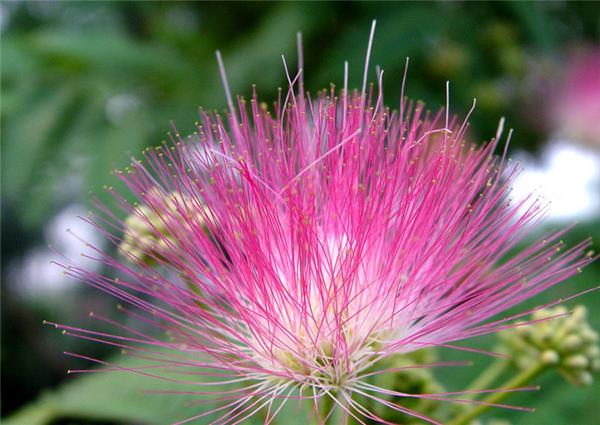
The silk tree flower blooms from June to July, and right now is when it blooms most abundantly. After the silk tree begins to bloom, the main axis of its inflorescence can continue to extend upward, constantly producing bracts and flower buds, just like a monopodial branch, so it is also called a monopodial inflorescence. The opening order of the flowers is that the flowers at the base of the flower axis open first, then progress upward in sequence, opening one after another. If the inflorescence axis is shortened and the flowers are densely packed in one plane or sphere, the opening order is that they start from the edge first and then open in sequence toward the center.
The silk tree flower is very beautiful, mostly red or pink, occasionally white, and its shape looks like a fan, fuzzy and very similar to a dandelion.
The flower language of the silk tree flower
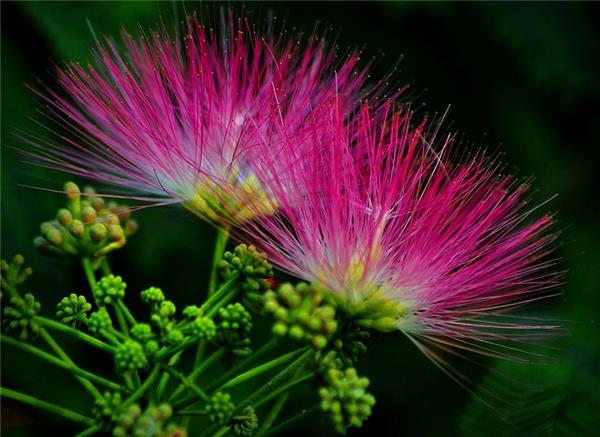
The flowers of the silk tree are like fine hairs growing on the buds, especially beautiful, with the fine hairs red and the buds alternating white and green. The silk tree flower symbolizes everlasting love, being paired together, and is a symbol of harmonious marriage. There is also a similarly named plant, the golden wattle.
Every September, golden-yellow golden wattle blooms everywhere in Australia, with fragrance spreading in all directions. The golden wattle has also been designated as the national flower of Australia.
The legend of the silk tree flower
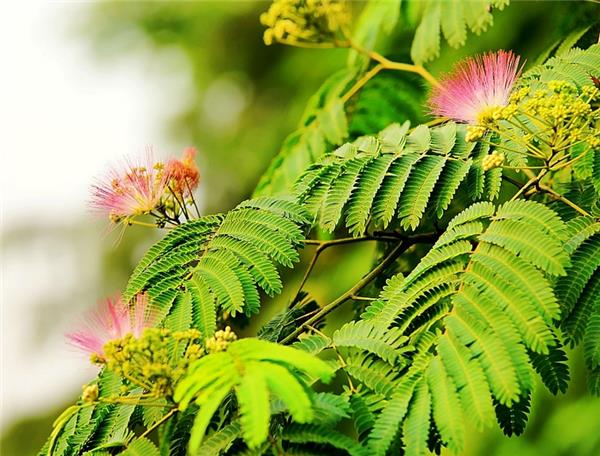
In ancient times, the silk tree flower was called the bitter love flower, but it did not bloom. How did the bitter love flower become the silk tree flower? It begins with a scholar. The scholar studied hard for ten years and prepared to go to the capital to take the imperial examination. When he was about to leave, his wife Fenshan pointed to the bitter love tree in front of the window and instructed the scholar: My husband, on this journey you will surely pass the examination with high honors, only the capital is full of distracting flowers that dazzle the eyes, so do not forget the road home.
How to grow the silk tree flower
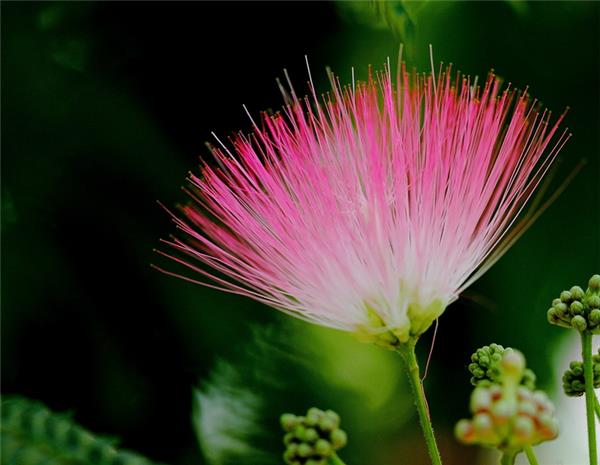
Soil: The silk tree flower is not strict about soil, but fertile, moist, well-drained sandy loam and limestone loam are best.
Sunlight: The silk tree flower is a light-loving tree species and is slightly shade-tolerant, so during the growing period pay attention to providing sufficient sunlight, but when the sunlight is too strong in summer also pay attention to shading.
Watering: The silk tree flower is tolerant of dryness and not tolerant of waterlogging, so do not water too much during care, so as to avoid waterlogging and damage to the root system.
Temperature: The silk tree flower likes a warm environment, but its cold resistance is very strong, and in southern regions it does not need to be moved into a greenhouse in winter.
Fertilizing: The silk tree flower can be managed extensively and does not have very high requirements for water and fertilizer; even in poor areas it may grow very vigorously. But note that it does not like noise or dust, so when growing it you need to keep a good check on this.
Pests and diseases: The silk tree flower is mainly harmed by canker disease and the like, so when disease occurs it needs to be treated by spraying pesticides. Generally you can spray Bijunsha 800-1000 times dilution, Penkejun 2000-3000 times dilution, 50% Tuijunte 800 times dilution, etc. The main pests include psyllids and longhorn beetles, etc., and you can spray 80% dichlorvos, etc. For psyllids, you can use 25% Pushiling 1500-2000 times dilution.
Pruning: The silk tree flower has weak sprouting ability, sparse branches and is not tolerant of pruning, so do not prune casually during the growing process.