What are the uses of the sensitive plant (Mimosa pudica)? This article gives you a detailed analysis
If the leaves of the sensitive plant are touched by hand, watered, or hit by a typhoon, they curl up, as if bowing to people. It is a very courteous plant, and today we are going to introduce the uses of the sensitive plant.

Uses of the sensitive plant
1. The sensitive plant can forecast the weather.
The sensitive plant is a wonderful plant that can foretell changes between sunny and rainy weather. If you touch it with your hand and its leaves close very quickly, but open slowly, this indicates that the weather will clear up; if when you touch the sensitive plant its leaves contract slowly and droop slowly, or even close slightly and then open again, this indicates that the weather will turn from sunny to overcast or that it is about to rain.
The reason the speed at which the sensitive plant's leaves open and close can foretell whether the weather will be overcast or clear is mainly that at the base of the sensitive plant's leaf there is a small drum-shaped thin-walled cell tissue, the pulvinus, and the pulvinus is filled with water. When you touch a leaf of the sensitive plant, as soon as the leaf vibrates, the water in the cells of the lower part of the pulvinus immediately flows upward and to both sides, so the lower part of the pulvinus deflates while the upper part swells, and the petiole droops and the leaf closes. Therefore, the closing and opening of the leaves is caused by the turgor pressure of the pulvinus. And the turgor pressure effect of the pulvinus is closely related to the humidity in the air. When the air humidity is very low, the turgor pressure effect of the pulvinus is obvious, and the leaves close and open quickly; when the air humidity is very high, the leaves open and close slowly. Therefore, the speed at which the sensitive plant's leaves open and close indirectly reflects the level of humidity in the air and can serve as a reference for weather forecasting.
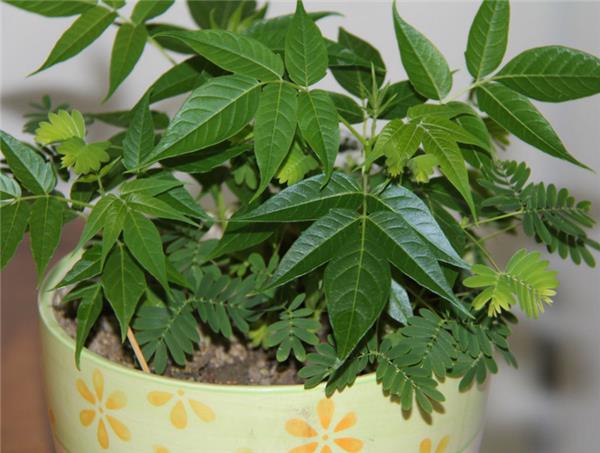
2. It can also predict earthquakes.
The sensitive plant can predict earthquakes. According to Turkish seismologist Ercan, a few hours before a strong earthquake occurs, the leaves of the sensitive plant, which are sensitive to external touch, suddenly shrivel and then wither. In earthquake-prone Japan, scientists have found through research that under normal conditions, the leaves of the sensitive plant open during the day and close at night. If the leaves of the sensitive plant show the abnormal phenomenon of closing during the day and opening at night, this is a precursor to an earthquake. For example: at 7 a.m. on January 11, 1938, the sensitive plant began to open, but by 10 a.m. the leaves suddenly all closed, and indeed a strong earthquake occurred on the 13th. In 1976, members of the Japan Earthquake Club observed the abnormal closing phenomenon of the sensitive plant's leaves many times, and earthquakes subsequently occurred each time.
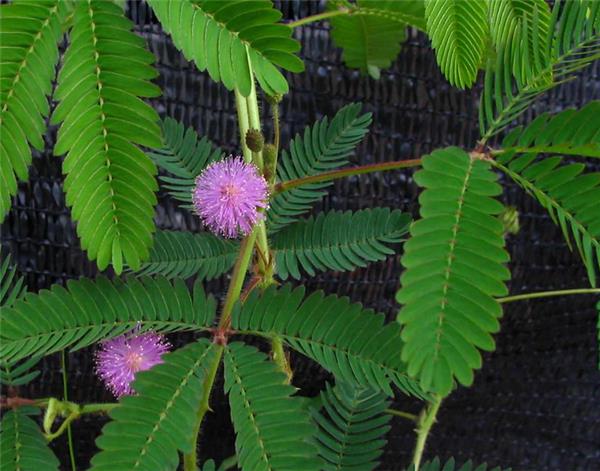
3. The sensitive plant has a special ornamental value.
The sensitive plant has a loose plant shape, and its feathery leaves are slender and elegant; its leaves close as soon as they are touched; the sensitive plant has many and delicate flowers, charming and lovely, giving people an impression of delicate elegance. It can be planted in the ground at a courtyard corner, or grown in a pot on a windowsill or desk. When giving it as a flower gift, gently cover the potted plant with pink thin gauze and tie on a pink decorative ribbon bow. If it can be further decorated with pink mohair pompoms, it will be even more interesting.
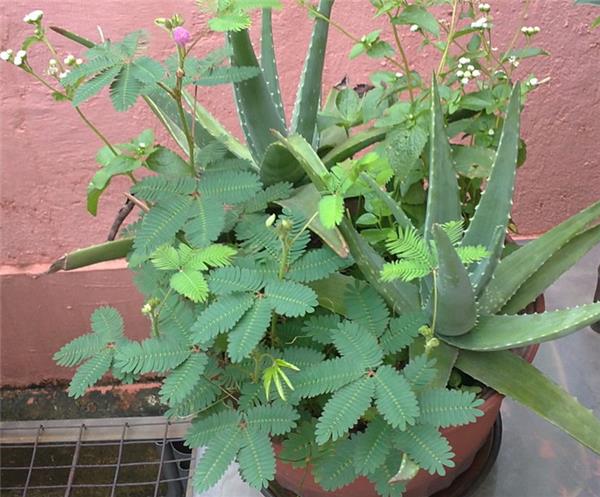
4. The medicinal value of the sensitive plant is also considerable.
The sensitive plant is also a medicine. Collect it in summer and autumn, remove all weeds, wash it clean, cut it into sections, and dry it in the sun or use it fresh. Soaking the root of the sensitive plant in liquor and taking it, or decocting it together with liquor, can treat rheumatic pain, neurasthenia, insomnia, and so on; stewing and eating it together with lean pork can treat hot swollen and painful eyes, hepatitis, and nephritis; the fresh leaves, when pounded into a paste, can be applied to treat swelling and pain and herpes zoster, and so on, and are quite effective in relieving pain and reducing swelling, clearing heat and promoting urination, resolving phlegm and relieving cough, calming the nerves and relieving pain, detoxifying, dissipating blood stasis, stopping bleeding, and astringing. It is used for colds, high fever in children, acute conjunctivitis, bronchitis, gastritis, enteritis, urinary tract stones, malaria, and neurasthenia; for external use it treats traumatic swelling and pain, sores and swelling with toxin, hemoptysis, and herpes zoster.