Reasons and Solutions for Yellowing Leaves on Large-Leaf Pothos
During the growing season, pothos should be watered every day and its leaves misted two to three times, and the temperature should be kept from getting too high or too low. Another point is that fertilizer must not be applied in excess, and it should not be placed in the sun for long periods, nor kept out of light for long periods. The cause you mention may be long-term lack of light combined with too little watering.
The leaves of the pothos you are growing have turned yellow, and newly grown ones turn black and die. Since you only water once a week, too much watering is probably not the problem. Could it be that you have kept it in a shaded spot indoors for too long? Although pothos is a shade-loving plant and dislikes direct sunlight, it likes scattered light. When grown indoors it can be placed beside a window, but direct sunlight must be avoided. Too strong sunlight will scorch the leaves of pothos, while too much shade will make the beautiful markings on the leaf surface disappear, affecting growth. Generally, receiving four hours of scattered light gives the best growth and development for pothos. Below is some information on "Pothos Care" for your reference.
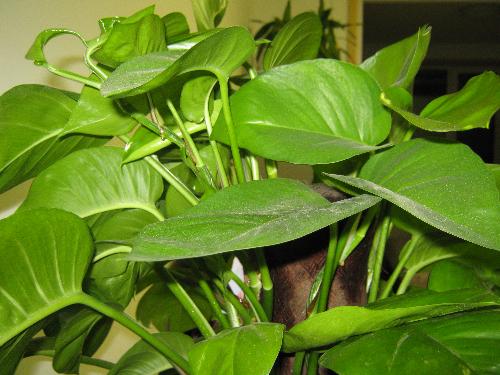
Pothos develops best when grown in loose, organic-rich, slightly acidic to neutral sandy loam. You can mix and compost 70% leaf mold, 20% red loam, and 10% rapeseed cake and bone meal. Repot once every three years. Pothos is a shade-loving plant; it dislikes direct sunlight, likes scattered light, and is fairly shade-tolerant. When grown indoors it can be placed beside a window, but direct sunlight must be avoided. Too strong sunlight will scorch the leaves of pothos, and too much shade will make the beautiful markings on the leaf surface disappear. Generally, receiving four hours of scattered light gives the best growth and development for pothos. Pothos likes relatively high air humidity and a moist environment. In midsummer, during the peak growth period of pothos, you can mist the aerial roots and leaf surfaces several times a day; this not only washes dust off the leaves, helping pothos breathe, but also keeps the leaves emerald green and fresh, lowers leaf surface temperature, increases the air humidity of the micro-environment, and helps the leaves grow better. Keep the potting soil at a moist level; when you notice the potting soil turn pale, water thoroughly.
In winter, when room temperature is lower, pothos is in a dormant state, so water less and simply keep the potting soil from drying out. The most suitable growing temperature for pothos is 20°C-28°C during the day and 15°C-18°C at night. In winter, as long as the indoor temperature does not fall below 10°C, pothos can safely overwinter; if the temperature falls below 5, it easily causes leaf drop and affects growth. For fertilizing pothos, nitrogen fertilizer is primary and potassium fertilizer secondary. Before the growing season of pothos arrives in spring, apply a 0.3% solution of ammonium sulfate or urea once about every 10 days, and apply a 0.5‰-1‰ urea solution once as a foliar feed. This not only meets the growth needs of pothos but also keeps the leaves green and glossy. Fertilizing should stop in winter. Pothos is usually propagated by cuttings and stem layering. Select a robust pothos vine, cut it into sections of two nodes, being careful not to damage the aerial roots, then insert it into plain sand or coal cinders to a depth of 1/3 of the cutting, water thoroughly, and place it in a shaded spot. Mist the leaf surface daily or cover with plastic film to retain moisture; as long as the environment is kept no lower than 20, the survival rate is above 90%.