What are the benefits and contraindications of honeysuckle?
Honeysuckle is a commonly grown bonsai plant used to beautify the home, and its ornamental effect is very attractive. Not only that, honeysuckle has been a good medicine for clearing heat and detoxifying since ancient times. Below is a detailed introduction to the benefits and contraindications of honeysuckle.
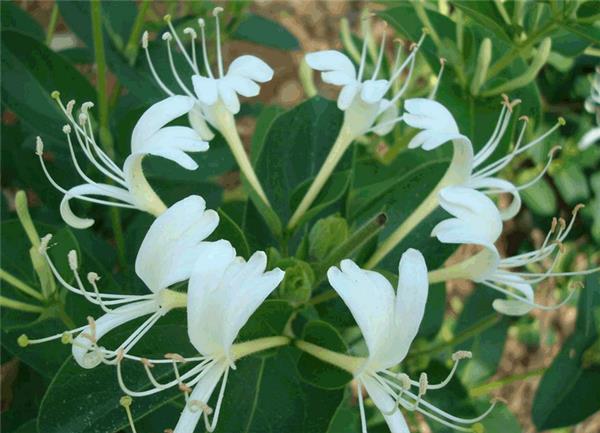
Benefits of honeysuckle
1. Used for externally contracted wind-heat or the early stage of warm disease. Honeysuckle is sweet and cold; it clears heat from the qi level and also clears heat from the blood level, and within its heat-clearing action it also has a mild effect of dispersing and venting, so it can treat external contraction of wind-heat or the early stage of warm disease when the exterior syndrome has not been resolved and internal heat is already abundant. In application, it is often combined with Forsythia suspensa (lianqiao), Arctium lappa (niubangzi), Mentha (bohe) and the like.
2. Used for sores, abscesses, swellings and toxins, and sore throat. Honeysuckle has a quite strong heat-clearing and detoxifying effect, and is a commonly used item in external medicine. It is generally used for sores, abscesses, swellings and toxins with redness, swelling, heat and pain. For syndromes identified by pattern differentiation as "yang syndromes," it is relatively suitable. It can be decocted with dandelion, Viola mandshurica (didingcao), Forsythia suspensa (lianqiao), Moutan cortex (danpi), Radix Paeoniae Rubra (chishao) and the like for oral intake, or fresh ones can be used alone, pounded into a paste and applied externally.
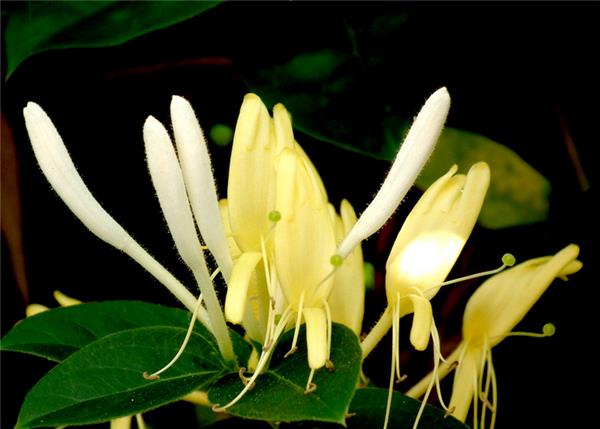
3. Used for diarrhea and bloody stool caused by heat toxin (stool mixed with mucus and blood). When heat toxin gathers in the intestinal tract and enters the blood level, then dysentery with bloody stool occurs. Honeysuckle can cool the blood and resolve heat toxin, so it can treat bloody dysentery and bloody stool. Clinically, charred honeysuckle is often used together with Scutellaria baicalensis (huangqin), Coptis chinensis (huanglian), white peony root (baishao), purslane (machixian) and the like.
4. Honeysuckle is sweet in flavor and cold in nature, with a fragrant odor. It can both clear and vent the exterior and resolve heat toxin in the blood level, and is especially a key medicine for treating yang-type sores and ulcers. Combined with Forsythia suspensa (lianqiao), Arctium lappa (niubangzi), Mentha (bohe) and Schizonepeta tenuifolia (jingjie), it vents the exterior and resolves heat; combined with fresh Rehmannia (shengdi), Scrophularia ningpoensis (xuanshen), Forsythia suspensa (lianqiao), bamboo leaf rolled heart (zhuye juanxin) and the like, it clears the nutrient level and drains heat; combined with Viola philippica (zihuadiding), wild chrysanthemum (yejuhua) and dandelion, it resolves toxin and treats sores; combined with Astragalus membranaceus (huangqi), Angelica sinensis (danggui) and licorice, it supports toxin expression and disperses abscesses; combined with Scutellaria baicalensis (huangqin), white peony root (baishao), licorice and the like, it clears heat and treats dysentery.
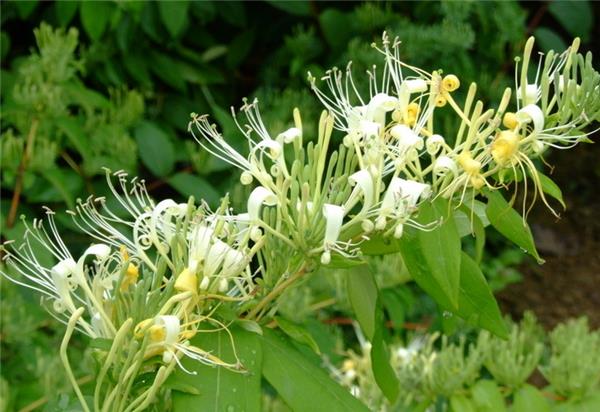
Contraindications of honeysuckle
First: absolutely avoid taking excessive amounts
Honeysuckle is cold in nature, and taking excessive amounts can easily cause discomfort in the gastrointestinal tract. Some people take a large amount of honeysuckle at one time in order to enhance its effects on the body; this brings no benefit to the body, only harm.
Second: taking it is forbidden during menstruation
Menstruation is the most special period for all women. During this stage, women must take good care of themselves and eat less of or have less contact with cold foods or objects. Honeysuckle is cold in nature, so it is best not to take it during menstruation to avoid adverse effects on the body.
Third: patients with spleen-stomach deficiency cold should take it with caution
Honeysuckle is cold in nature, so if the patient's body originally has a deficiency-cold constitution and is prone to weakness and frequent illness, then drinking honeysuckle infusion not only cannot condition and protect the body, but instead increases the burden the spleen and stomach must bear, which is very unfavorable for health.
Fourth: choice of season for taking it
Honeysuckle is not suitable for taking in all four seasons. Experts suggest that if you want the body to obtain the best health care, then the time for taking honeysuckle is best chosen in summer. Because summer weather is hot, the body is very prone to heatstroke and thirst, and at this time taking honeysuckle can very well produce fluids, quench thirst, clear heat and detoxify.
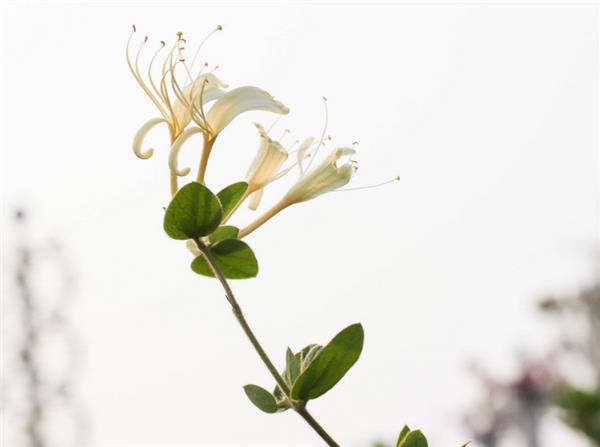
Fifth: do not take honeysuckle infusion overnight
Veteran Chinese medicine practitioners suggest that drinking honeysuckle infusion is actually the same principle as brewing tea daily: just brew it two or three times, and after it has sat overnight it is best not to take it, to avoid affecting health due to spoilage.
Sixth: honeysuckle is not suitable for cold drinks
Special attention should be paid to the fact that when brewing honeysuckle in water for daily drinking, it is best not to drink it cold, because this can easily cause diarrhea. If you want to take honeysuckle correctly, then you can brew it with boiling water and take it while hot, so that the medicinal effects and nutritional value of honeysuckle can be better brought out.
Seventh: honeysuckle infusion cannot be drunk every day
Only start taking honeysuckle when your body shows signs such as internal heat. Each time, choose about 10 grams and brew it with boiling water. It is best not to drink it every day; otherwise the burden and harm to the spleen and stomach are relatively great.
Eighth: patients with hepatitis B should not take it long term
Veteran Chinese medicine practitioners tell us that patients with hepatitis B cannot drink honeysuckle infusion long term; otherwise it can easily cause gastrointestinal discomfort, such as diarrhea, borborygmus or poor appetite.
Ninth: others
Honeysuckle is usually more suitable for patients whose constitution shows internal heat. If a patient has relatively deficiency-cold spleen and stomach and is prone to diarrhea, stomachache, abdominal coldness, or cold hands and feet in daily life, it is best to drink less; otherwise it is unfavorable for health.
Otherwise it can easily cause gastrointestinal discomfort, such as diarrhea, borborygmus or poor appetite.Ninth: others
Honeysuckle is usually more suitable for patients whose constitution shows internal heat. If a patient has relatively deficiency-cold spleen and stomach and is prone to diarrhea, stomachache, abdominal coldness, or cold hands and feet in daily life, it is best to drink less; otherwise it is unfavorable for health.