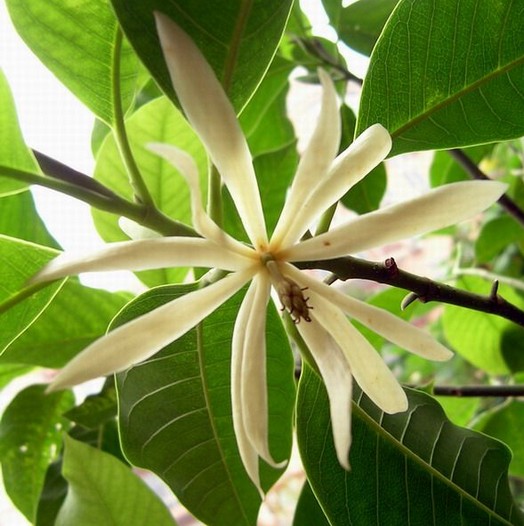
How to grow Michelia alba (white orchid)? Remember these four precautions
Precauction one: It likes acidic soil
When choosing potting soil for Michelia alba, two points need attention. First, because Michelia alba has fleshy roots, it is better suited to a soil environment with good aeration. Second, because Michelia alba is a southern flower, it likes acidic soil. But soil in the north is alkaline, so when preparing the growing soil, an appropriate amount of ferrous sulfate or sulfur powder should be mixed in to reduce the soil's alkalinity.
Precauction two: It likes a well-ventilated, humid environment
When cultivating Michelia alba in northern regions, watering is crucial. The essence of Michelia alba liking a moist environment is that air humidity is high but soil moisture content must not be too high. Water in the north is relatively alkaline, and long-term use easily makes the soil alkaline, so it is best to use rainwater, snow water or ferrous sulfate water. But rainwater and snow water are not easy to store. Usually, when watering with tap water, watering once with ferrous sulfate water at regular intervals (about every 10 days) will also prevent the plant from getting chlorosis.
Precauction three: It likes sunlight but fears being scorched
Michelia alba is not strict about light, but too strong or insufficient light is unfavorable to plant growth. Too strong light easily scorches the leaves, while insufficient light makes it difficult to form flower buds, and even if there are flowers, they are not fragrant. In spring, after the Mid-Autumn Festival and in winter, it should be placed in a sunny spot to receive light. In summer and early autumn, it should be placed in semi-shade, blocking 50% of the light, so that it receives sunlight before 9 a.m. and after 6 p.m., avoiding direct exposure to strong midday sunlight.
Precauction four: If drainage is poor, root rot easily occurs
Michelia alba has fleshy roots. Too much or too little water in the pot is unfavorable to root growth, and it is especially afraid of waterlogging, which easily causes the roots to turn black and rot. During the rainy season, the pot should be tipped on its side, and attention should be paid to preventing waterlogging. If yellow leaves or leaves turning red caused by root rot are found, watering should be strictly reduced, and watering can even wait until the leaves become soft and droop. The water used for watering should be stored first so that it matches the air temperature.
Precauction five: Remove pests promptly
Common diseases of Michelia alba include anthracnose, leaf spot and chlorosis, and the main pests include red spider mites, scale insects and aphids. In daily care, in addition to strengthening water and fertilizer management and improving the plant's disease resistance, attention should also be paid to ventilation. If pests occur, when their numbers are small they can be removed by hand; when their numbers are large, a 1000-fold dilution of 40% dicofol can be sprayed to kill red spider mites, and a 1000-fold dilution of 40% omethoate emulsifiable concentrate can be sprayed to kill scale insects and aphids. Anthracnose and leaf spot can be controlled with broad-spectrum fungicides such as chlorothalonil and carbendazim. Chlorosis can be controlled by spraying the leaves with 1/800 ferrous sulfate water.