How to grow Alocasia macrorrhizos ( giant taro)? A detailed guide to cultivation methods and precautions
Cultivation methods for Alocasia macrorrhizos:
1. Temperature: It likes warmth, and grows rapidly when the temperature is above 25°C. The most suitable temperature for growth is 25-30°C. It has a certain degree of cold resistance; as long as the overwintering temperature is maintained above 2°C, it is fine.
2. Light: It likes partial shade and cannot tolerate exposure to strong sunlight. From May to September, shading should be provided, blocking about 50% of the sunlight. Then during the remaining time, we should let Alocasia macrorrhizos enjoy ample sunlight. It cannot tolerate excessive shade, otherwise we will see that the leaf stalks are very likely to become thin and elongated; not only will the plant's shape be unattractive, but it will also break easily.
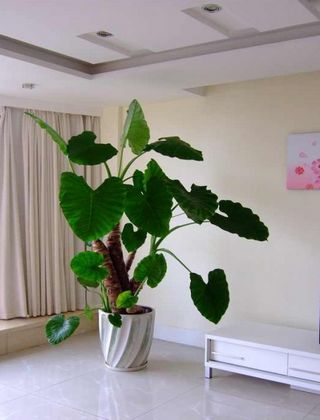
3. Watering: Because its leaves are huge, it consumes a lot of water, so it is afraid of drought. It likes a slightly moist soil environment, and during the growing period, watering should follow the principle of "alternating dry and wet while leaning toward moist." We should water it sufficiently; even if we water a little more, it does not matter. What needs special attention is that on hot, sunny summer days, we must place even more importance on replenishing water to meet the plant's water requirements. Because the leaf surface of Alocasia macrorrhizos is relatively large, the leaf tips of Alocasia macrorrhizos often release water droplets in the morning, becoming a peculiar phenomenon, which is why it is called " dripping Guanyin." The requirement for growing Alocasia macrorrhizos is that we try to keep the potting soil moist at ordinary times, to ensure that the plant can absorb sufficient water, use the plant's root pressure to transport water to the leaf tips and release it; when the potting soil is dry, there will be no water to drip. Controlling water in winter is also very important; just keep the potting soil slightly moist, and it is enough if the leaves do not droop softly; if the potting soil is too wet, it easily causes root rot in the plant.
4. Environmental humidity: It likes a humid environment and avoids dry air. During the growing season, when it is sunny and dry, water should often be sprayed on the branches, leaves and surroundings to maintain a relatively high air humidity.
5. Fertilizing; it likes fertilizer. Because its growth volume is large, nutrients need to be supplemented in time so that the stems can grow thick and strong, and the leaves can be huge, dark green and glossy; when it lacks fertilizer, we will clearly see that its leaves become smaller and their color turns yellow. During the growing period, a nitrogen-based fertilizer should be applied once about every 10 days. After the beginning of autumn, stop applying nitrogen fertilizer and apply 2-30: phosphorus and potassium fertilizer. Stop fertilizing in winter.
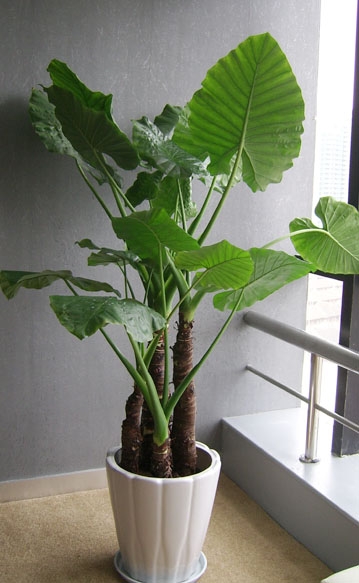
6. Pruning: Yellow leaves should be cut off at any time. Because the leaf stalks are long, when moving, placing and caring for it, avoid breaking the leaf stalks. If they are broken, they should be cut off promptly.
7. Repotting: It needs to be repotted once every 1-2 years. It does not have high requirements for soil, but likes fertile, loose and well-drained sandy loam. For the growing medium, we can use materials such as leaf mold, garden soil, peat soil, and river sand. If sufficient base fertilizer is applied, the leaves can grow large and thick. Because the leaves of Alocasia macrorrhizos are relatively large but few in number, and the leaf stalks are long, when moving the plant and caring for it, try to avoid damaging the leaves; otherwise, it may reduce its ornamental value.
8. Propagation: sowing, cuttings, division, etc.
(1) Sowing: Wild plants often bear seeds. Sow in spring. The suitable temperature for germination is 25-28°C, and germination occurs 20-25 days after sowing.
(2) Cuttings: Carry out in April. Cut thick stems into stem sections about 10 cm long with
several buds to use as cuttings. After drying slightly, insert them obliquely or lay them flat in the seedbed. When laying flat, the depth should be just enough to bury the stem section; the cuttings can also be inserted directly into pots. After insertion, keep the medium moist and the ambient temperature at 25-2TC, and roots can form and they can survive after 4-5 weeks.
(3) Division: Potted plants easily produce many small plantlets at the base. In April, in combination with
repotting, carry out division. After separating the small plantlets from the mother plant, plant them separately. Division should be carried out when the temperature reaches 20C or higher. On the basis of keeping the medium moist, new buds can sprout in about 20 days.
Precautions for Alocasia macrorrhizos:
1. A friendly reminder: the white sap in the stems of Alocasia macrorrhizos is a toxic liquid, and the water it drips is also toxic. If you accidentally touch or ingest its sap, it is very likely to cause discomfort in the throat and mouth, and a burning pain will also be felt in the stomach. Therefore, people who grow Alocasia macrorrhizos are reminded to be especially careful, and special attention should be paid to preventing young children from accidentally eating it. However, Alocasia macrorrhizos is not a carcinogenic plant.
2. According to analysis by professionals, because Alocasia macrorrhizos is toxic, when the skin comes into contact with its sap, itching or a strong irritation reaction will occur. Contact of the eyes with the sap can cause severe conjunctivitis, and even blindness. If the stems and leaves are eaten by mistake, there will be symptoms of nausea and pain, and in severe cases there may also be suffocation, leading to death from cardiac paralysis. Therefore, contact with Alocasia macrorrhizos should be minimized as much as possible, and families with children had best not plant it.