How do you care for golden pothos? The simplest growing method taught to you
Today the editor will explain the simplest way to grow golden pothos, hoping it will help friends who want to grow golden pothos.
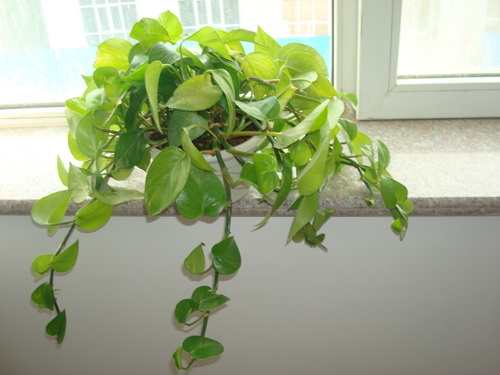
Pothos and golden pothos are regarded as two pearls among indoor foliage plants, and are much loved by people. Both are large vines in the Araceae family, climbing by means of aerial roots. The leaves are leathery, ovate to oblong, with a nearly heart-shaped base; the plant habit and leaf shape are similar, so people often confuse the two. Although they belong to the same family, they are in different genera: pothos belongs to the genus Epipremnum (pothos genus), and golden pothos belongs to the genus Scindapsus (Scindapsus genus), so golden pothos is not a variety of pothos. The most obvious difference lies in leaf color: pothos has glossy dark green leaves, while the tender green leaves of golden pothos are inlaid with many golden yellow and milky white streaks, brilliantly variegated, and the leaves gradually grow larger as the plant ages. Pothos is extremely shade tolerant and can be placed anywhere indoors; in a room without light, it can grow normally with lamp lighting. Golden pothos, on the other hand, prefers a lightly shaded environment and soft light. If the light is weak, the variegated stripes will fade and even gradually disappear, making it very unattractive. In addition, pothos is also more cold tolerant than golden pothos during the winter.
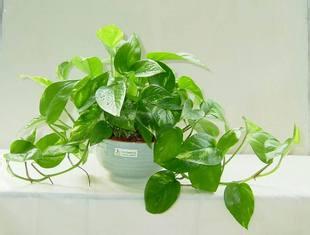
Pothos and golden pothos are native to the Solomon Islands and like warm, humid conditions and fresh air, with an optimum growing temperature of 25°C to 30°C, and a wintering temperature that must not be lower than 12°C. They require a culture soil rich in humus, loose and fertile, and slightly acidic; it can be made from peat soil, pine needle soil, leaf mold, river sand, and vermiculite. They are propagated by cuttings. Usually, the top shoot of an old stem that has grown past the moss pole can be cut off as a cutting, or a side branch that continues growing with a growing tip can be used for cuttings; after rooting, it can quickly develop into a new plant with large leaves and thick stems. If a stem section without a growing tip is used for cuttings, the new plant will be weak and become smaller and smaller. The cutting medium should be loose, and at around 25°C roots will quickly form and the plant can be potted up.
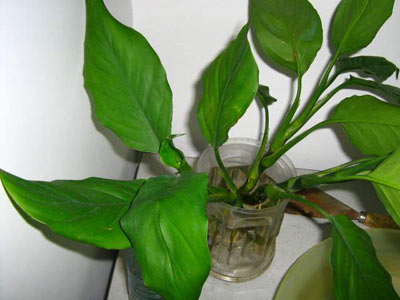
They are usually grown in a totem pole (coir-pole) style. The potting soil should be kept moist often, and it is best to drip irrigate slowly from the top of the pole. This not only moistens the potting soil, but also allows the sponge or coir on the pole to fully absorb water, which helps the twining aerial roots absorb water and at the same time increases air humidity. In summer, avoid drought; water should be plentiful, and the leaves should be sprayed with water often. In winter, prevent waterlogging; the potting soil should not stay wet for long. During the peak growing season, apply dilute liquid fertilizer 2 to 3 times as appropriate, and 1 to 2 times with a small amount of 500-fold diluted ferrous sulfate solution. Young plants should be repotted and the soil changed every year, while mature plants can be repotted once every 1 year. At ordinary times, keep changing the direction in which the pot is placed so that the green leaves receive light evenly and the plant keeps a symmetrical, full shape.
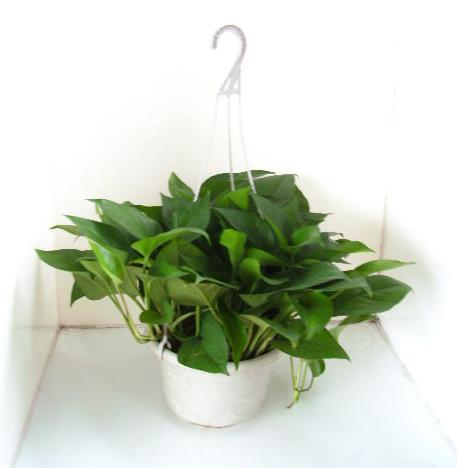
The above is an explanation of the simplest way to grow golden pothos. Do you understand it now? Hurry and try it yourself.