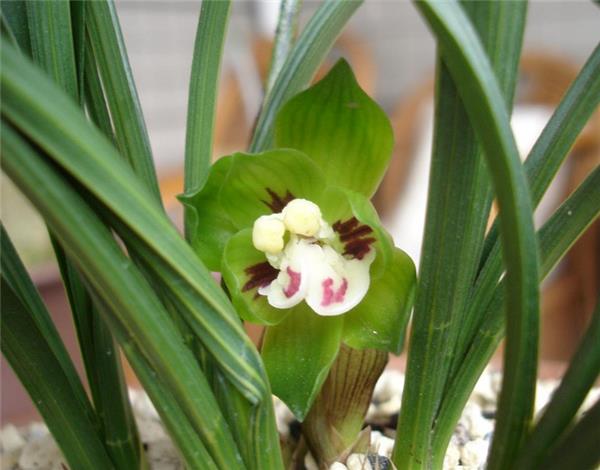
How to manage orchids during the flowering period? These methods you need to master
The orchid is a flower with a uniquely distinctive style and very high ornamental value. Orchid flowers are elegant in color, with tender green and yellow-green being the most common, but those with pure, unmarked petals are especially prized. Let us take a look together at the methods for managing orchids during the flowering period.
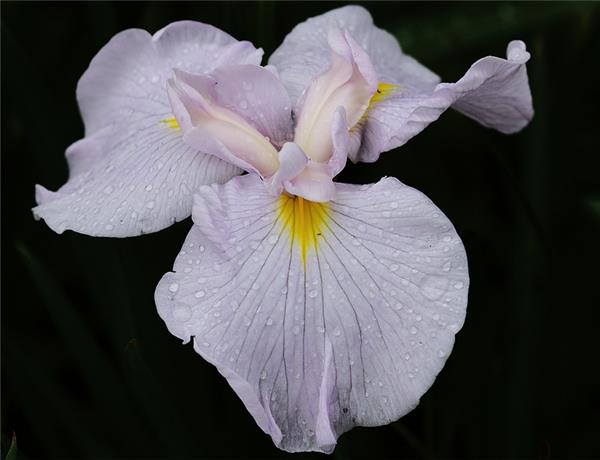
Orchid flowering period management methods
1. Once the flower buds emerge from the soil, never touch, squeeze or pinch them with your hands: beginners growing orchids, upon seeing new shoots emerge, cannot tell whether they are leaf buds or flower buds, and cannot resist reaching out to touch and pinch them. Little do they know that the newly emerged shoots are extremely delicate, and a squeeze or pinch of the hand will cause the outer bracts to "scorch," or even cause the flower buds to "become stunted." Therefore, you can only observe with your eyes, and must never squeeze or pinch with your hands.
2. After the flower buds have all emerged, thin the buds according to the number of orchid plants and their growth condition, removing the weak and keeping the strong: for example, for a pot of a famous variety of Cymbidium goeringii (spring orchid) with only 4 or 5 plants, keeping one flower bud is quite enough; 8 or 9 strong plants can keep 2 flower buds; more than ten plants can keep 3 without harm. The author has a pot of "Yipin" with 10 plants that produced 8 flower buds, of which 6 were thinned out and only 2 kept. That was to avoid consuming too many nutrients. The principle of bud thinning is "remove the weak and keep the strong" - if both the front clump (the pseudobulbs newly grown the previous year) and the back clump produce flower buds, it is better to keep the flower buds of the strong front clump and remove those of the back clump; if a single strong plant produces two flower buds, keep only one; flower buds produced by weak plants must be firmly removed and not retained; flower buds that emerge too late are also best removed; those crowded among the orchid leaves are not as good as those kept around the periphery of the plants.
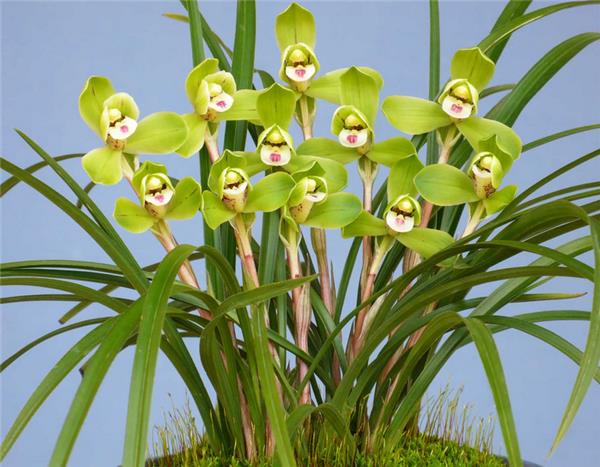
3. To prevent the flower buds from being damaged by frost, they must be brought indoors to overwinter in cold winter: place the orchid pots with flower buds in a sunny indoor spot so they can bask in warm sunlight. During the day, when the temperature rises a little, open the windows for ventilation and strengthen air circulation. When watering routinely, try to avoid water droplets intruding into the bracts, so as to prevent rot.
4. From the jointing stage to the opening of the petals, orchids should have their moisture level appropriately controlled: when the orchid begins to send up its stem, it needs a certain amount of water. If there is no moist environment in the pot, the flower stem will not grow tall and will shrink down to the pot surface, hidden by the leaves, harming its appearance. To make the flower scape grow tall, the pot must be kept moist and not too dry. But when it comes to the stage of the stamens emerging and the petals opening, the pot must be kept slightly dry. If the humidity in the pot is too high, although the flower scape may continue to grow taller, it often causes the side petals to "drop their shoulders," affecting the flower's appearance and quality. Therefore, before the petals open, water should be reduced. But this cannot be applied across the board. For some unusual varieties, such as Cymbidium goeringii 'Yu Hudie,' 'Liangxi Ruidie,' 'Wudie,' and so on, as well as Cymbidium faberi 'Duoyun,' 'Haiou,' 'Fengqiao,' 'Lixing Ruidie,' and so on, not only should they not be kept slightly dry, they should actually be kept even more moist, so that when the petals open they can better display the morphological characteristics of their unusual petals.
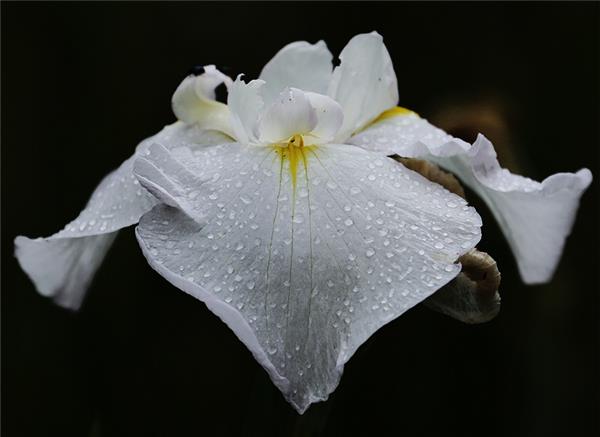
5. When the flower scape has risen and the tip of the stamen emerges from the bracts, light should then be controlled: placing them in a spot with diffused light is more suitable. If the light is too weak, the flower color will not be bright later; if they are left in direct sunlight (light too strong), after the petals open the petal color will turn yellowish, and they may even be easily scorched and "burned," harming the flower's appearance. This is especially true for pure-petaled orchids (suxin lan), whose tongue (labellum) turns slightly yellow under too strong light. Therefore, when orchids are opening their petals, they should avoid direct sunlight and be placed in a spot with diffused light.
6. Cut the flowers at the right time: the flowering period of orchids is generally just over ten days, and some last as long as about a month. Common orchids can be allowed to bloom freely, but for precious orchids, in order not to consume too many nutrients and affect the growth of new shoots, Cymbidium goeringii should be cut at the right time after the petals open, having bloomed for at most one week. For Cymbidium faberi, which has multiple flowers on one stem, 5 or 6 days after the flowers have opened fully from bottom to top, they should be cut promptly (except when needed for exhibitions, which is a different matter). Method of cutting flowers: for Cymbidium goeringii flowers, the flower can be pulled up together with the stem - pinch the flower stem with two fingers about one cun above the pot surface, and quickly pull upward, so that flower and stem come up together, leaving no residual stem; Cymbidium faberi flowers cannot be pulled up, so use scissors about 2 cun above the pot surface to cut the flower scape at a slant. For the cut flowers, use a match to scorch the end of the flower scape to "seal it," then keep them in a vase with water, and they can still be enjoyed for several days without wilting. There is also an even simpler method: use a clean glass bottle, pour out any accumulated water, put the cut flowers into the bottle, and cover it tightly. Because there is a certain amount of moisture in the bottle, the flowers remain as pretty as ever, and can be enjoyed for half a month without fading.