How to grow Peperomia? A detailed guide to Peperomia cultivation methods
"Xiao jia bi yu" (little household jasper) - "bi yu" was originally a person's name, and later "xiao jia bi yu" came to refer to a beautiful young girl from a humble family. In fact, bi yu, also known as dou ban lv (bean petal green) or jiao cao (pepper grass), is an evergreen perennial succulent herbaceous plant of the Piperaceae family. It is a particularly compact green plant suited for display in offices, on coffee tables, or on curio shelves. Because of its rather elegant color, it can add a touch of freshness to a room. Today, the editor will introduce the cultivation methods of Peperomia for the reference of interested friends!
Growth habits
Peperomia prefers a cool, semi-shaded environment, with its main growing period in spring and autumn, and is an "intermediate type" variety among succulents. It is drought-tolerant, not cold-tolerant, and dislikes high temperatures, humidity, and direct sun exposure. It fears deep shade and also fears waterlogged soil. During the growing period, it should be given sufficient light. If it is too shaded, the plant shape will become loose and not compact, the leaves will be thin and elongated, and the transparency of the "window" will be poor. If the light is too strong, the leaves will grow poorly and turn light reddish-brown, and sometimes intense direct sunlight will scorch the leaves, leaving unsightly marks. Plants grown in semi-shade have thick, plump leaves with high transparency!
Introduction to Peperomia cultivation methods
[Water]: It prefers moisture. During the growing period from May to September, water more frequently. In hot weather, spray or sprinkle water on the leaf surface to maintain relatively high air humidity and keep the leaf patterns clear and the leaf color emerald green.
[Fertilizer]: Apply fertilizer once a month until overwintering.
[Soil]: It requires loose, fertile, well-drained soil, which can be prepared by mixing river sand, mud surface material, and leaf mold.
[Temperature]: It prefers warmth. The suitable growing temperature is around 25°C, and the overwintering temperature should not be lower than 5°C.
[Light]: Avoid direct sunlight; it is best grown in semi-shade. Peperomia is an indoor ornamental plant, so of course it can be placed indoors.
[Pruning and propagation]: For newly propagated young seedlings, when the seedling height is about 10 cm, pinch off the growing tips to increase the number of branches. This makes the plant shape fuller and its ornamental value higher.
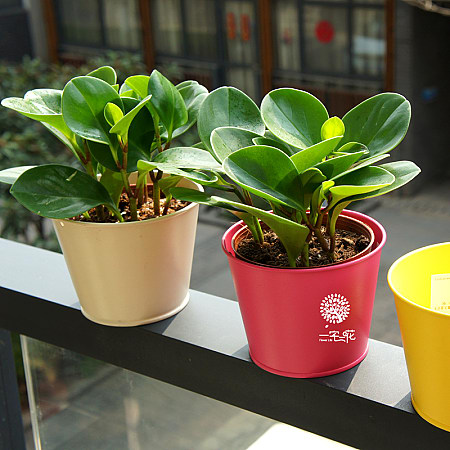
Pruning of large plants is generally determined by their growth condition. Cutting back leggy branches can provide cuttings, which root easily and can be inserted into clean river sand or vermiculite, or directly inserted into sandy soil. Propagation can also be done by leaf cuttings and division. The environmental temperature generally required for propagation is between 20-25°C. Leaf cuttings need to have a leaf stalk and should be inserted vertically or slightly slanting into river sand, with the insertion depth being 1/4-1/3 of the leaf stalk. Keep the substrate moist and the air humidity relatively high; roots and adventitious buds will form in 2-3 weeks. Once the small buds are slightly larger, they can be transplanted.
The above is the editor's introduction to Peperomia cultivation methods. I hope it is helpful to friends who like growing flowers and plants!