How to Grow Cyclamen from Seed? Detailed Planting Methods and Steps
There are many ways to propagate cyclamen, and growing from seed is one of the more common methods, but how do you grow cyclamen from seed?
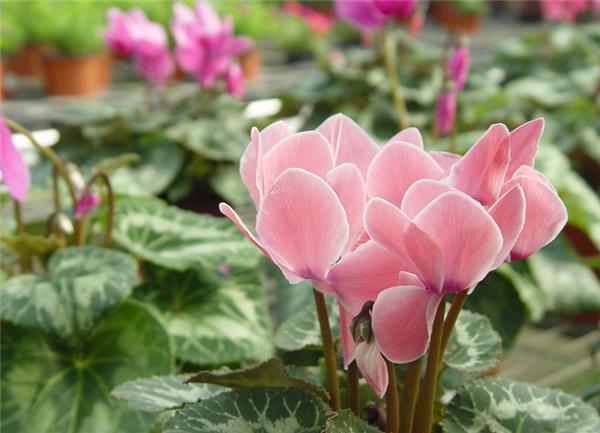
How to Grow Cyclamen from Seed
1. Sowing time: September to October is the best time for sowing.
2. Seed selection: Choose large, plump seeds.
3. Seed treatment: Cyclamen seeds are relatively large, with about 100 seeds per gram, and the usual germination rate is 85-95%, but germination is slow and uneven. To encourage early and uniform germination, seeds can be soaked and pre-sprouted before sowing. First soak the seeds in cold water for a full day and night, or in warm water at 30°C for 2-3 hours, then wash off the sticky substance on the seed surface, wrap them in a damp cloth to sprout, keeping the temperature at around 25°C for 1-2 days, and once the seeds show slight signs of sprouting, take them out and sow.
4. Sowing soil: Mix equal parts of loam, leaf mold and river sand.
5. Sowing method: Sow at a spacing of 1.5-2.0 cm in a shallow pot or shallow box, covering with 0.5-1.0 cm of soil. Water thoroughly using the bottom-soaking method, cover with glass, and place in a spot at 18-20°C; germination takes about 30-40 days. After germination, remove the glass promptly and place in a sunny and well-ventilated spot.
6. Pricking out: When the seedlings grow 1 true leaf, carry out the first pricking out, moving them into a shallow pot at a spacing of 3.5 cm, with a potting mix of leaf mold 5, loam 3 and river sand 2. When planting, the top of the small corm should be level with the soil surface. After planting, water thoroughly and provide appropriate shade. When the seedlings resume growth, gradually give them light, increase ventilation, do not let the potting soil dry out, keep the temperature at 15°C-18°C, and apply nitrogen fertilizer appropriately, taking care not to let fertilizer water splash onto the leaves, so as to avoid leaf rot. After fertilizing, sprinkle clean water once to keep the leaves clean.
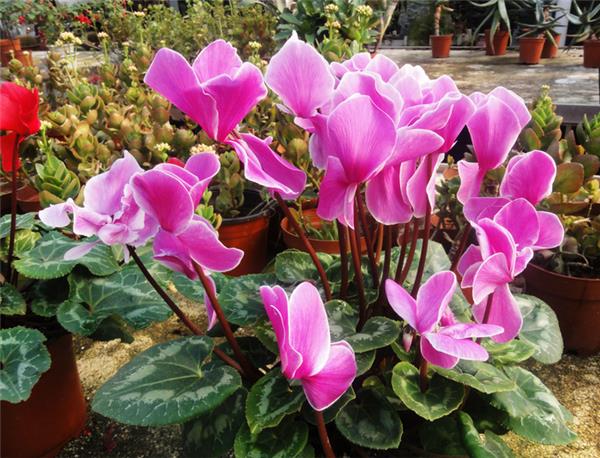
7. Transplanting: When the seedlings grow to 3-5 leaves, transplant them into 10 cm pots; at this point the potting soil ratio can be changed to leaf mold 3, loam 2 and river sand 1, with decomposed cake fertilizer and bone meal added as a base fertilizer. After March to April the temperature gradually rises, the plant produces more leaves and growth becomes more vigorous, and its demand for fertilizer and water also increases, so fertilizer and water management should be strengthened, the potting soil kept moist and ventilation increased, strong midday sun shaded out, the temperature kept as low as possible, and rain and waterlogging of the potting soil prevented, so as to avoid corm rot. It should be grown outdoors in a shade shed equipped with rain protection.
8. Final planting: In September, plant in 20 cm pots, with the corm allowed to protrude about 1/3 above the soil surface. The potting soil is leaf mold 3, loam 2 and river sand 1, but additional base fertilizer is needed. Topdressing should be mainly phosphorus and potassium fertilizer to promote flower bud differentiation. After flower buds appear in November, stop topdressing and give plenty of light; flowering begins in December and reaches full bloom by February of the following year, meaning it takes about 13-15 months from sowing to flowering.
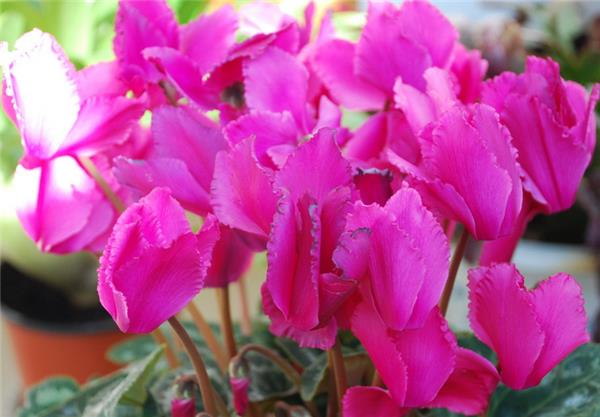
Indoor air quality is very important to our health, so air purifiers, adsorbents, humidifiers and other machines have appeared in our lives. In fact, green plants also have functions similar to these advanced devices, and cyclamen is just such a flower.
1. It has an air-purifying function. Cyclamen has a relatively strong ability to absorb sulfur dioxide and strong resistance, and it also has a certain ability to absorb some other harmful gases; it absorbs sulfur dioxide through its leaves and, through oxidation, converts it into non-toxic or low-toxicity substances such as sulfate. In addition, cyclamen can also absorb carbon dioxide while releasing oxygen, and can increase the negative ion content and raise the humidity of indoor air. Placing it in the home is more than appropriate.
2. It has a pleasant fragrance. Most cyclamens are fragrant; some varieties are very strongly scented, some are lightly scented, and some have no fragrance. This fragrant cyclamen can help people relax during tense work. The volatile substances it releases have a good regulating effect on people's moods, and some of the scents given off can change a listless state, lift the spirits, or have a calming and sleep-aiding effect. Combined with its humidifying function, it plays an important role in protecting the skin in tightly closed rooms where air conditioning is used. It also continuously replenishes fresh oxygen, which is very beneficial to our bodies. Placing a pleasing cyclamen within your field of view relieves the physiological fatigue of the eyes and gives you a boost.
Cyclamen has a beautiful form, fresh colors and abundant vitality. So why not grow a few pots in your home as a natural air purifier?