How long is the blooming period of a Phalaenopsis orchid generally?
The Phalaenopsis orchid is a very beautiful flower. Do you know how long its blooming period is?
Introduction to the Phalaenopsis Orchid
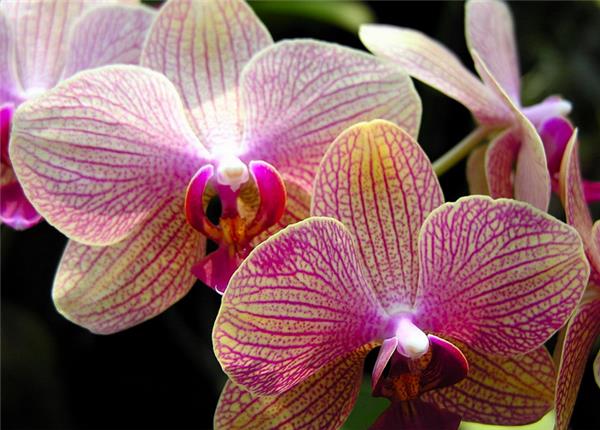
The Phalaenopsis orchid is a cut-flower ornamental plant in the orchid family (Orchidaceae), with more than 70 native species, most of which are produced in Asia, and it is also distributed in the Philippines, Malaysia, India and other places. The Phalaenopsis orchid is a monopodial epiphytic orchid with short stems and large leaves, so it is named for its butterfly-like flowers. Phalaenopsis orchids come in many colors, with graceful flower forms and fragrant scents; they are treasures among tropical orchids and have long enjoyed the reputation of "Queen of Orchids." The Phalaenopsis orchid is not only beautiful in appearance but also rich in cultural heritage, loved by many flower enthusiasts, and a darling of artists, often appearing in photographic works.
As a cut-flower plant in the orchid family, the Phalaenopsis orchid has about 100 species, native to North Africa, Eurasia, North America and Central America. The Phalaenopsis orchid has a short stem, generally enclosed by leaf sheaths, with fleshy leaves that are green on the upper surface, elliptical or sickle-shaped elliptical, with pointed tips and bases that are sometimes skewed or wedge-shaped, and it has broad, short sheaths; the inflorescence axis of the Phalaenopsis orchid is purple-green, somewhat zigzagged, usually bearing several flowers that open one by one from the base toward the tip; the flower bracts are ovate-triangular; the pedicel together with the ovary is green and slender; the flowers are white, beautiful in form, and long in blooming period; the dorsal sepal is nearly elliptical, and the petals are rhombic-circular with a narrowed base forming a short claw and have reticulate veins; the Phalaenopsis orchid likes to live in humid environments, is naturally fond of warmth and afraid of cold, and its suitable growth temperature is 15-20 degrees Celsius.
How long is the blooming period of a Phalaenopsis orchid?
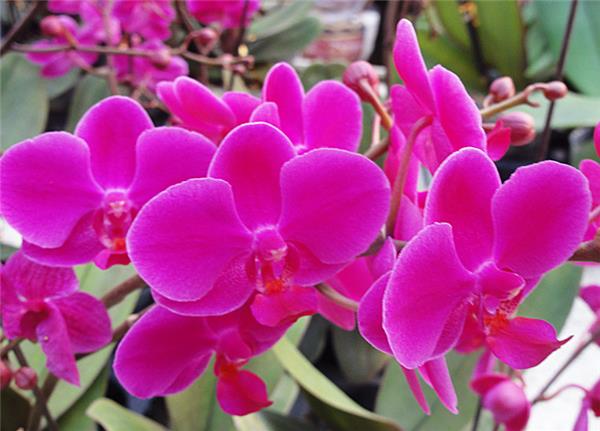
The scientific name of the Phalaenopsis orchid means, according to its original Greek meaning, "an orchid that looks like a butterfly." It can absorb nutrients from the air to survive and is very resilient, and can be said to be a major group among tropical orchids. It generally blooms around the Spring Festival, and the flowers can last 2-3 months. For such a long time, you can enjoy them well! And blooming during the Spring Festival adds even more festive cheer to the holiday! Do you want to grow one too?
When the Chinese New Year season arrives, a small flower bud will poke its head out first, and then the remaining flowers will open one after another. Each flower has 5 petals, with a lip embedded in the center. The flower colors are very beautiful, including pure white, goose yellow, crimson, as well as light purple, orange-red and azure blue. Quite a few Phalaenopsis varieties have two or three colors; some look as if they are embroidered with patterned stripes, while others look as if they have been evenly sprayed with colorful dots. It is a very beautiful flower, even surpassing the butterfly! Are you tempted yet?
Care of Phalaenopsis Orchids During the Blooming Period
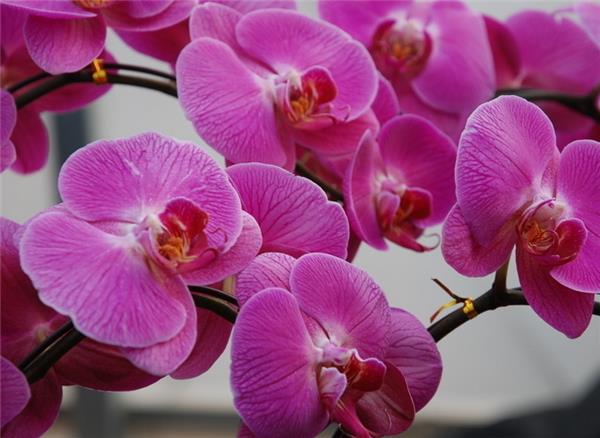
The blooming of the Phalaenopsis orchid is triggered by low temperatures, so in addition to fine management, the temperature should also be well controlled. First, keep the temperature above 20°C for 2 months, then lower the nighttime temperature to below 18°C, and after 45 days flower buds will form. After the flower buds form, keep the nighttime temperature at 18-20°C and the daytime temperature at 25-28°C. After 3-4 months it can bloom; during the blooming period the temperature should be slightly lowered, but not below 15°C. After the flower buds emerge, a support stake must be erected, that is, erect the stake before the flower stem extends and has not yet fallen over, and tie the flower stem to the stake, leaving space for the flower stem to elongate and thicken.
When the flowers wither, the faded flowers must be cut off as early as possible, as this can reduce the consumption of nutrients. I also know that when you grow flowers yourself and see them wither, you are already very sad, and having to cut them off is even sadder! But there is no way around it. If the old does not go, how can the new come back!
If you want it to bloom well again the following year, it is best to cut the flower stem off from the base. When the growing medium ages, it should be replaced in a timely manner; otherwise, air permeability will worsen, causing root rot and weakening the plant's growth or even death. It is generally best to repot in May, when new leaves grow out.