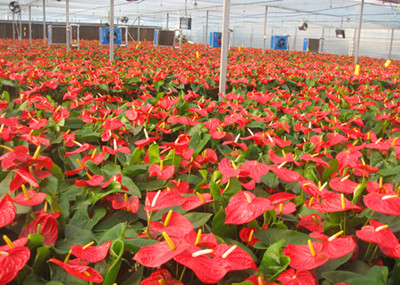
How to Grow and Care for Anthurium, with Anthurium Pictures
How to Grow and Care for Anthurium, How to Grow Anthurium, Anthurium Pictures
Anthurium is a true plant of red flowers paired with green leaves, striking yet not monotonous. Not only are ordinary households willing to grow it, but even formal conference halls are happy to use it to decorate a monotonous environment. However, some friends are unfamiliar with the methods and precautions for growing anthurium, so let me summarize them for you.
Anthurium likes humid air, generally around 70 percent under normal conditions, and such a high figure is usually unattainable in an ordinary home. But that does not matter; we can often wipe it with a clean damp towel or spray water around it. (But in order not to affect its ornamental value, it is still best not to spray water directly on it.)
2. Watering and Fertilizing
Generally speaking, the soil should be watered every week, alternating between letting it dry and keeping it moist. In this respect it differs from other plants: anthurium should not be watered unless the soil is dry, and once you water it, you must soak it thoroughly. In summer it needs more water, and in the other seasons less will do. Every half month, apply a 7-8% special nutrient solution or a fertilizer water diluted 500 times along with watering.
Also, generally speaking, when anthurium grows, its leaf stalk is degenerate, and the dried ones must be cut off in time. After flowering, when the flower stalk turns yellow, it must also be cut off as soon as possible from the base, leaving a 2 cm protective stub.
4. Temperature
Generally, when we grow anthurium at home, temperature is also very important. The most suitable temperature is between 16°C and 24°C, and it must not go below 12°C. We northerners all have heating at home, so this is not difficult. But it must not be placed on the radiator, and even being close to it is not acceptable. Too hot in summer is also not acceptable; above 30°C it must be placed in a ventilated, cool place, and water must be sprayed around it to cool it down.
5. Light
Generally, if anthurium is to grow normally, sunlight is indispensable, but it must be diffused light. In an ordinary home, in summer it must be kept out of direct sunlight, while in seasons such as autumn and winter it is best to let it receive sunlight, preferably placed by a window. The plant also needs to be rotated regularly to ensure it receives even light and to promote a full, rounded crown shape.
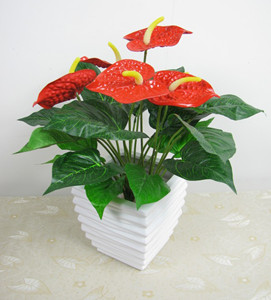
Anthurium likes humid air, generally around 70 percent under normal conditions, and such a high figure is usually unattainable in an ordinary home. But that does not matter; we can often wipe it with a clean damp towel or spray water around it. (But in order not to affect its ornamental value, it is still best not to spray water directly on it.)
2. Watering and Fertilizing
Generally speaking, the soil should be watered every week, alternating between letting it dry and keeping it moist. In this respect it differs from other plants: anthurium should not be watered unless the soil is dry, and once you water it, you must soak it thoroughly. In summer it needs more water, and in the other seasons less will do. Every half month, apply a 7-8% special nutrient solution or a fertilizer water diluted 500 times along with watering.
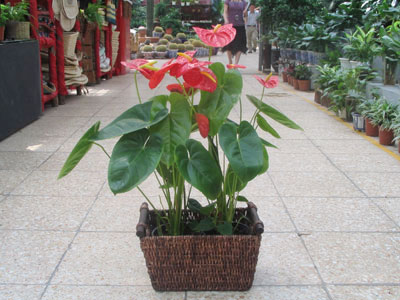
Also, generally speaking, when anthurium grows, its leaf stalk is degenerate, and the dried ones must be cut off in time. After flowering, when the flower stalk turns yellow, it must also be cut off as soon as possible from the base, leaving a 2 cm protective stub.
4. Temperature
Generally, when we grow anthurium at home, temperature is also very important. The most suitable temperature is between 16°C and 24°C, and it must not go below 12°C. We northerners all have heating at home, so this is not difficult. But it must not be placed on the radiator, and even being close to it is not acceptable. Too hot in summer is also not acceptable; above 30°C it must be placed in a ventilated, cool place, and water must be sprayed around it to cool it down.
5. Light
Generally, if anthurium is to grow normally, sunlight is indispensable, but it must be diffused light. In an ordinary home, in summer it must be kept out of direct sunlight, while in seasons such as autumn and winter it is best to let it receive sunlight, preferably placed by a window. The plant also needs to be rotated regularly to ensure it receives even light and to promote a full, rounded crown shape.