Detailed Explanation of the Key Technical Points for Growing Potted Grapes
Some homeowners with balconies like to grow potted grapes on their balconies at home. This not only decorates the balcony but also satisfies our desire to cultivate potted grapes; and of course, when they bear fruit, we can still eat delicious grapes. So what are the cultivation techniques for potted grapes? Below, the editor will explain the cultivation techniques for potted grapes to help everyone grow excellent grapes.
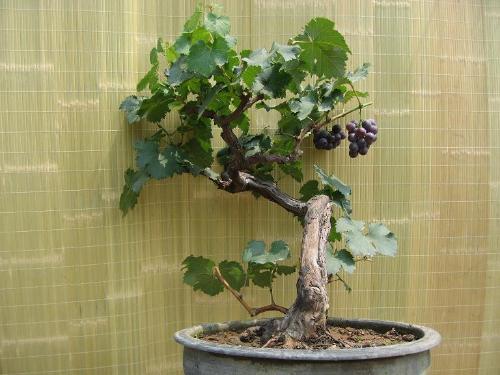
[Cultivation Techniques for Potted Grapes]
1. The Growing Environment for Potted Grapes
If it is a courtyard, a comprehensive arrangement for planting grapes and other fruit trees, flowers, forest trees, crops, or livestock can be made according to its area, light conditions, environmental conditions, and so on, with reasonable combinations so as to make full use of the ground and space. If there is a spacious rooftop platform, in addition to rooftop greening (beautification) and food use, its shading function accounts for a large proportion.
2. The Planting Season for Potted Grapes
Spring planting when the temperature is between 15-25°C is suitable, such as from early March to April; layering can begin in early April.
3. Preparatory Work for Growing Potted Grapes
Select good varieties: There are many grape varieties, such as Kyoho and Red Fuji. They mature early and have strong adaptability. High-quality varieties can be selected according to the local weather and the purpose of the fruit.
Soil layer selection: Choose sandy loam with deep soil layers and loose texture (it has good air permeability and the ground temperature rises quickly) as the best soil quality.
Land preparation: Prepare the land in the autumn and winter of the previous year. Before land preparation, apply about 1,500 kg of decomposed fertilizer per mu, then deep-plow the soil about 30 cm, break the soil into fine pieces, and form a seedbed 80 cm wide and 25 cm high.
4. Containers for Growing Potted Grapes
Available containers include clay pots, ceramic pots, purple clay pots, wooden pots, plastic flower pots, and so on, which can be selected according to conditions. For potted grapes in the first year, a container with a mouth diameter of about 20-25 cm can be used; after 2-3 years, a container with a mouth diameter of 30-40 cm can be used. It can be determined according to production volume and site space. Loose, fertile loam rich in organic matter and calcium is required. It is also possible to use local materials according to local conditions, choosing cultivation materials that are widely available, low in cost, free of pests and diseases, and pollution-free.
5. Preparation and Disinfection of Potting Soil for Potted Grapes
Commonly used formulas include: (1) 4 parts leaf mold, 3 parts garden soil, 3 parts coarse sand, 0.5 part bone meal; (2) 7 parts field soil, 2 parts coarse sand (or furnace slag), 1 part expanded chicken manure, 0.5 part bone meal. After the potting soil is mixed evenly, spray it uniformly with a 0.1% formalin solution (500 ml of chemical per cubic meter of potting soil). Then seal it with plastic film. After fumigating for a full day and night, remove the film, and after drying in the sun for 3-4 days, it can be put into pots for use.
6. Sowing Steps for Potted Grapes
If growing from grape seeds, buy good grapes you like, plant the seeds in soil after eating so they take root, and place them in a sunny place for seedlings to emerge; the following spring, the previous year's branches can put out many new shoots, so keep a few of the strongest ones; by May, with sufficient rain, the grapes grow quickly and the roots gradually develop; transplant them on a rainy day. In May of the third year, yellow-green flower buds can appear, and they will bloom and bear fruit.
If using cuttings for planting, after the flower pot is selected, it is best to soak it in 1% bleaching powder water for 5 minutes, take it out to dry, and then fill it with sterilized culture soil. The seedlings used for potted grapes can be directly rooted as cuttings in the flower pot to grow into seedlings. When cutting, it is best to insert 2 cuttings per pot so as to select and keep the better one, and keep the potting soil moist at all times. It is also possible to use 1-3 year old grape plants and transplant them into the pot with a soil ball before bud break. When transplanting, the plant's branches and vines should be heavily pruned, generally keeping 1-3 strong branches and vines. In the year of transplanting, the focus should be on restoring tree vigor, cultivating tree shape, and laying a good foundation, and do not let it bear fruit first.
7. Grape Management and Planting Techniques
Before planting, apply decomposed base fertilizer. After covering with soil and pressing it firm, water thoroughly to settle the roots. The soil coverage depth should reach the outside of the roots, and the aboveground part should have 3-4 bud eyes.
8. Fertilization for Potted Grapes
(In the south, base fertilizer can be supplemented in mid-to-late March; in northern regions, in mid-to-late April.) Apply 50 kg-100 kg of high-quality farmyard manure, 0.3 kg of urea, and 0.8 kg of superphosphate. The base fertilizer applied should be mixed with soil, and then covered with soil. Grapes have a high fertilizer demand, so apply base fertilizer in winter when leaves fall or before bud break; apply the first topdressing before flowering; apply bud-promoting fertilizer when the bud eyes begin to swell and the temperature steadily reaches 10°C. For topdressing: according to plant size, open a shallow ditch 30 cm-40 cm deep and 30 cm wide near the root end, mix the fertilizer with soil and bury it in the ditch, and after application, water and cover with soil. In the early stage of young fruit growth, nitrogen fertilizer should be dominant, with appropriate application of superphosphate and plant ash; when the fruit begins to color, phosphorus and potassium fertilizers should be dominant. For reasonable watering, after applying base fertilizer, water once so that the fertilizer penetrates into the lower layers, which helps the grape root system absorb it.
9. Controlling Fertilizer and Water for Potted Grapes
Generally, within 1 week before and after flowering, it is not suitable to water. Only after the fruit has set steadily can large amounts of water and heavy fertilizer be applied to promote fruit growth. In the rainy season, fertilizer nutrients may be lost. According to the fertilizer loss in the plot and the grape growth condition, the fertilizer amount should be increased as appropriate, using the "small meals, more often" method, applying less but frequently.
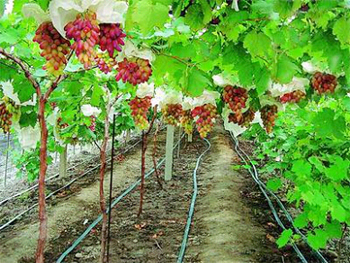
10. Loosening the Soil for Potted Grapes
After heavy rain or torrential rain, the surface soil in the vineyard will become compacted, causing the grape root system to lack oxygen, reducing resistance, and making it prone to disease. A deeper intertillage should be carried out once before the rainy season. During the rainy season, seize the intervals between rainy days for intertillage to increase soil permeability.
11. Removing Lateral Shoots and Thinning Shoots in Potted Grapes
In the rainy season, grapes are most prone to excessive vegetative growth, and the incidence of lateral shoots is very high. Pinch the growing tips and remove lateral shoots in time. For plants with too many new shoots, thin out some to facilitate ventilation and light penetration. Remove overcrowded and poorly developed branches as early as possible and keep strong branches, so that large grapes can grow. Pinching should be done when 4-8 leaves have grown above the flower cluster. After pinching, except that the top lateral shoot is repeatedly pinched while keeping 3-4 leaves, the remaining lateral shoots are pinched while keeping 1 leaf.
12. Flower Thinning and Fruit Thinning of Potted Grapes
There are techniques for pinching new grape shoots: new grape shoots must be pinched. Through pinching, a large amount of nutrients needed for new shoot growth can be saved, and leaf thickening and full flower buds can be promoted. This is crucial for improving the fruit set rate, yield, and quality of grapes. The method is briefly introduced below. Pinching time. For fruiting new shoots, generally pinch 3-5 days before full bloom, and at the latest at the beginning of flowering. For varieties with relatively serious flower and fruit drop, such as Kyoho and Purple Rose, pinching can be done 8-10 days before flowering. For new shoots whose leaves do not reach the required number after the first pinching, wait until lateral shoots grow.
13. Removing Tendrils and Thinning Clusters in Potted Grapes
Tendrils not only consume nutrients but also bring many diseases: after removing tendrils from one-year-old seedlings, they should be tied in time to make the plant grow upright. Insert a bamboo pole as thick as a thumb into the ground 15 cm deep at a distance of 15 cm from the seedling root, and tie the new shoots to it. When tying, distribute the new shoots evenly. The tying string should be made into a loose slipknot on the new shoot, leaving room for the new shoot to thicken, and the other end should be tied to the wire. When the new shoots of two-year-old and perennial seedlings are about 60 cm long, tie the new shoots in an arched shape. That is, pull the new shoots flat, place the fruit clusters at the highest point of the new shoots, and tie the new shoots to the trellis surface in order and at a certain spacing. This facilitates ventilation, light penetration, and prevents fruit-bearing branches from being broken by strong winds. After the flower clusters appear, thin the clusters as early as possible according to the load capacity of the grape vine. Keep 1-2 clusters on extension vines, keep only a single cluster on all fruiting branches, and do not keep fruit clusters on weak branches. Remove secondary and tertiary fruit clusters that grow later in time.
14. Changing the Soil for Potted Grapes
After the plant grows in the pot for 1-2 years, the original container space can no longer meet the requirements of root system growth and development, and the nutrients in the potting soil gradually decrease. Therefore, the container needs to be changed from small to large, or the potting soil needs to be replaced. This work is generally carried out when the dormant period is about to end and before growth begins. When changing pots or soil, part of the dead roots should be trimmed off, and water should be applied immediately after changing to help the plant recover growth.
15. Shaping Potted Grapes
1. Single-trunk form: Suitable for small and medium-sized potted plants. In the year of planting, set a bamboo pole or No. 8 iron wire in the center of the pot, about 1 m high. After the new shoots sprout, select and keep one strong shoot as the main vine, tie it to the bamboo pole, and pinch it when it grows to 80-90 cm; except for the top lateral shoot, which is allowed to grow, the remaining lateral shoots are repeatedly pinched while keeping 1-2 leaves. In winter pruning, well-matured branches and vines can be cut back to 50 cm. After sprouting in the second year, keep 3-5 strong new shoots on the main vine, and remove the remaining buds in time. In winter pruning, each new shoot is pruned while keeping 2-3 buds as a fruiting mother branch. After sprouting in the third year, keep 1-2 new shoots on each fruiting mother branch, and thereafter short pruning is carried out every year.
2. Fan form: In the winter of the year of planting, new shoots above 60 cm are shortened and kept as the trunk. In the following year, keep one new shoot every 10-15 cm and tie it obliquely. In winter pruning, short-prune them into fruiting mother branches with 1-3 buds. In the third year, keep 1-2 fruiting branches on each fruiting mother branch to bear fruit. The new shoots and fruit clusters are evenly distributed on one plane, and as the tree body grows larger, increase the flower pot and expand the fan surface.
16. Pest and Disease Prevention for Potted Grapes
Preventing bird damage (when grapes are about to ripen, birds specifically peck at the ripe grapes): Making newspaper bags for grapes works well. It not only reduces sunscald, prevents pathogen infection, and prevents bird damage, but is also convenient for making bags. Each large newspaper can be made into 4 paper bags, costing less than 1 fen. The bag is 27 cm long and 20 cm wide. Prepare 6-8 cm thin iron wire for later use. Sew the side of the bag with a sewing machine, staple the middle of the lower opening with a stapler, and leave a 6 cm ventilation hole on each side. If used in orchards with high temperature and high humidity in summer, the lower opening may not be sealed to enhance moisture discharge performance. Bag the fruit when the berries are the size of soybeans. Before bagging, the clusters need to be tidied and berries thinned, and fungicides, insecticides, and quick-acting calcium should be sprayed. Bagging time should be after the morning dew dries and before evening. Note that when bagging at noon, try to avoid the period of highest temperature and places with direct sunlight. The time for removing bags should be determined according to variety and market time. For medium-early maturing varieties and varieties that color easily, it is suitable to remove bags 7-10 days before harvest; for late-maturing varieties, it is suitable to remove bags 10-15 days before harvest. After removing the bags, leaves should be removed and the fruit turned.
Disease prevention and control: Before grape bud eyes sprout, spray 50-100 times Solibar or 3-5 degrees Baume lime sulfur mixture (adding 0.3% washing powder gives better results). For orchards where diseases such as rotten fruit disease occurred seriously last year, spread lime on the ground before the disease occurs; or spray 50% carbendazim 500-600 times solution under the trellis to control primary infection sources overwintering from the soil.
Focus on prevention and spray pesticides in time: For chemicals with a residual effect period of 17-21 days, spray once every 15 days. If rain occurs in between, shorten the number of days until the next spraying as appropriate. If heavy rain occurs immediately after spraying, spray again after the weather clears. If two adjacent chemicals are respectively alkaline or acidic, strictly control the interval time to prevent the two chemicals from acid-base neutralization.
Treat promptly when disease is first seen: Continuous rainy weather with high temperature and high humidity makes plants most susceptible to disease. Observe every day, and spray the appropriate pesticide as soon as disease is first seen. Use 70% Kebo 600 times solution, 80% phosethyl-Al 300 times solution, or 1:0.7:180 Bordeaux mixture to control downy mildew;
Use Bordeaux mixture as the main treatment, with other chemicals as appropriate: This method has a very good disease prevention effect. Spray 1:0.5:240 solution once before flowering, spray 1:0.7:220 solution once after flowering, spray 1:0.7:200 solution once during the grape enlargement period, spray 1:1:180 solution once after grape harvest, and spray 1:1:160 solution 1-2 times in autumn. If white rot or anthracnose occurs in between, spray the appropriate pesticide. These chemicals are mostly acidic, so the interval time from Bordeaux mixture should be strictly controlled.
Clear the orchard at the right time and curb the spread of disease sources: If disease occurs, because of high temperature and high humidity, disease spreads most easily. The orchard should be cleaned at all times. Remove diseased leaves, diseased branches, and diseased fruits from the orchard and bury them deeply or burn them. Remove weeds in the orchard in time. When cutting off diseased branches and diseased fruits, often clean and disinfect the scissors to prevent cross-infection.
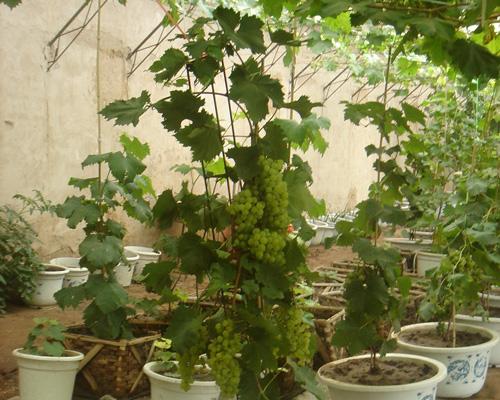
17. Overwintering and Freeze Protection for Potted Grapes
Overwintering management is mainly to prevent potted grapes from freeze damage and dehydration. The following protective measures can be selected according to local conditions: after winter pruning of potted grapes, dismantle the pot stand, water thoroughly, dig a trench or pit and bury them, with a burial depth of 30-50 cm from the ground; they can also be placed in a corridor or on a balcony and covered for the winter. No matter where they are placed, pay attention to checking the potting soil, keep it moist, and the temperature is best at 0-5°C.
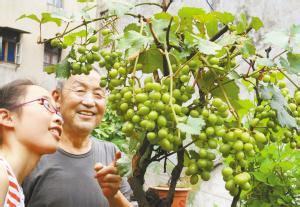
Zhuangxiu Network Pinching should be done when 4-8 leaves have grown above the flower cluster. After pinching, except that the top lateral shoot is repeatedly pinched while keeping 3-4 leaves, the remaining lateral shoots are pinched while keeping 1 leaf.
12. Flower Thinning and Fruit Thinning of Potted Grapes
There are techniques for pinching new grape shoots: new grape shoots must be pinched. Through pinching, a large amount of nutrients needed for new shoot growth can be saved, and leaf thickening and full flower buds can be promoted. This is crucial for improving the fruit set rate, yield, and quality of grapes. The method is briefly introduced below. Pinching time. For fruiting new shoots, generally pinch 3-5 days before full bloom, and at the latest at the beginning of flowering. For varieties with relatively serious flower and fruit drop, such as Kyoho and Purple Rose, pinching can be done 8-10 days before flowering. For new shoots whose leaves do not reach the required number after the first pinching, wait until lateral shoots grow.
13. Removing Tendrils and Thinning Clusters in Potted Grapes
Tendrils not only consume nutrients but also bring many diseases: after removing tendrils from one-year-old seedlings, they should be tied in time to make the plant grow upright. Insert a bamboo pole as thick as a thumb into the ground 15 cm deep at a distance of 15 cm from the seedling root, and tie the new shoots to it. When tying, distribute the new shoots evenly. The tying string should be made into a loose slipknot on the new shoot, leaving room for the new shoot to thicken, and the other end should be tied to the wire. When the new shoots of two-year-old and perennial seedlings are about 60 cm long, tie the new shoots in an arched shape. That is, pull the new shoots flat, place the fruit clusters at the highest point of the new shoots, and tie the new shoots to the trellis surface in order and at a certain spacing. This facilitates ventilation, light penetration, and prevents fruit-bearing branches from being broken by strong winds. After the flower clusters appear, thin the clusters as early as possible according to the load capacity of the grape vine. Keep 1-2 clusters on extension vines, keep only a single cluster on all fruiting branches, and do not keep fruit clusters on weak branches. Remove secondary and tertiary fruit clusters that grow later in time.
14. Changing the Soil for Potted Grapes
After the plant grows in the pot for 1-2 years, the original container space can no longer meet the requirements of root system growth and development, and the nutrients in the potting soil gradually decrease. Therefore, the container needs to be changed from small to large, or the potting soil needs to be replaced. This work is generally carried out when the dormant period is about to end and before growth begins. When changing pots or soil, part of the dead roots should be trimmed off, and water should be applied immediately after changing to help the plant recover growth.
15. Shaping Potted Grapes
1. Single-trunk form: Suitable for small and medium-sized potted plants. In the year of planting, set a bamboo pole or No. 8 iron wire in the center of the pot, about 1 m high. After the new shoots sprout, select and keep one strong shoot as the main vine, tie it to the bamboo pole, and pinch it when it grows to 80-90 cm; except for the top lateral shoot, which is allowed to grow, the remaining lateral shoots are repeatedly pinched while keeping 1-2 leaves. In winter pruning, well-matured branches and vines can be cut back to 50 cm. After sprouting in the second year, keep 3-5 strong new shoots on the main vine, and remove the remaining buds in time. In winter pruning, each new shoot is pruned while keeping 2-3 buds as a fruiting mother branch. After sprouting in the third year, keep 1-2 new shoots on each fruiting mother branch, and thereafter short pruning is carried out every year.
2. Fan form: In the winter of the year of planting, new shoots above 60 cm are shortened and kept as the trunk. In the following year, keep one new shoot every 10-15 cm and tie it obliquely. In winter pruning, short-prune them into fruiting mother branches with 1-3 buds. In the third year, keep 1-2 fruiting branches on each fruiting mother branch to bear fruit. The new shoots and fruit clusters are evenly distributed on one plane, and as the tree body grows larger, increase the flower pot and expand the fan surface.
16. Pest and Disease Prevention for Potted Grapes
Preventing bird damage (when grapes are about to ripen, birds specifically peck at the ripe grapes): Making newspaper bags for grapes works well. It not only reduces sunscald, prevents pathogen infection, and prevents bird damage, but is also convenient for making bags. Each large newspaper can be made into 4 paper bags, costing less than 1 fen. The bag is 27 cm long and 20 cm wide. Prepare 6-8 cm thin iron wire for later use. Sew the side of the bag with a sewing machine, staple the middle of the lower opening with a stapler, and leave a 6 cm ventilation hole on each side. If used in orchards with high temperature and high humidity in summer, the lower opening may not be sealed to enhance moisture discharge performance. Bag the fruit when the berries are the size of soybeans. Before bagging, the clusters need to be tidied and berries thinned, and fungicides, insecticides, and quick-acting calcium should be sprayed. Bagging time should be after the morning dew dries and before evening. Note that when bagging at noon, try to avoid the period of highest temperature and places with direct sunlight. The time for removing bags should be determined according to variety and market time. For medium-early maturing varieties and varieties that color easily, it is suitable to remove bags 7-10 days before harvest; for late-maturing varieties, it is suitable to remove bags 10-15 days before harvest. After removing the bags, leaves should be removed and the fruit turned.
Disease prevention and control: Before grape bud eyes sprout, spray 50-100 times Solibar or 3-5 degrees Baume lime sulfur mixture (adding 0.3% washing powder gives better results). For orchards where diseases such as rotten fruit disease occurred seriously last year, spread lime on the ground before the disease occurs; or spray 50% carbendazim 500-600 times solution under the trellis to control primary infection sources overwintering from the soil.
Focus on prevention and spray pesticides in time: For chemicals with a residual effect period of 17-21 days, spray once every 15 days. If rain occurs in between, shorten the number of days until the next spraying as appropriate. If heavy rain occurs immediately after spraying, spray again after the weather clears. If two adjacent chemicals are respectively alkaline or acidic, strictly control the interval time to prevent the two chemicals from acid-base neutralization.
Treat promptly when disease is first seen: Continuous rainy weather with high temperature and high humidity makes plants most susceptible to disease. Observe every day, and spray the appropriate pesticide as soon as disease is first seen. Use 70% Kebo 600 times solution, 80% phosethyl-Al 300 times solution, or 1:0.7:180 Bordeaux mixture to control downy mildew;
Use Bordeaux mixture as the main treatment, with other chemicals as appropriate: This method has a very good disease prevention effect. Spray 1:0.5:240 solution once before flowering, spray 1:0.7:220 solution once after flowering, spray 1:0.7:200 solution once during the grape enlargement period, spray 1:1:180 solution once after grape harvest, and spray 1:1:160 solution 1-2 times in autumn. If white rot or anthracnose occurs in between, spray the appropriate pesticide. These chemicals are mostly acidic, so the interval time from Bordeaux mixture should be strictly controlled.
Clear the orchard at the right time and curb the spread of disease sources: If disease occurs, because of high temperature and high humidity, disease spreads most easily. The orchard should be cleaned at all times. Remove diseased leaves, diseased branches, and diseased fruits from the orchard and bury them deeply or burn them. Remove weeds in the orchard in time. When cutting off diseased branches and diseased fruits, often clean and disinfect the scissors to prevent cross-infection.
17. Overwintering and Freeze Protection for Potted Grapes
Overwintering management is mainly to prevent potted grapes from freeze damage and dehydration. The following protective measures can be selected according to local conditions: after winter pruning of potted grapes, dismantle the pot stand, water thoroughly, dig a trench or pit and bury them, with a burial depth of 30-50 cm from the ground; they can also be placed in a corridor or on a balcony and covered for the winter. No matter where they are placed, pay attention to checking the potting soil, keep it moist, and the temperature is best at 0-5°C.
Zhuangxiu Network