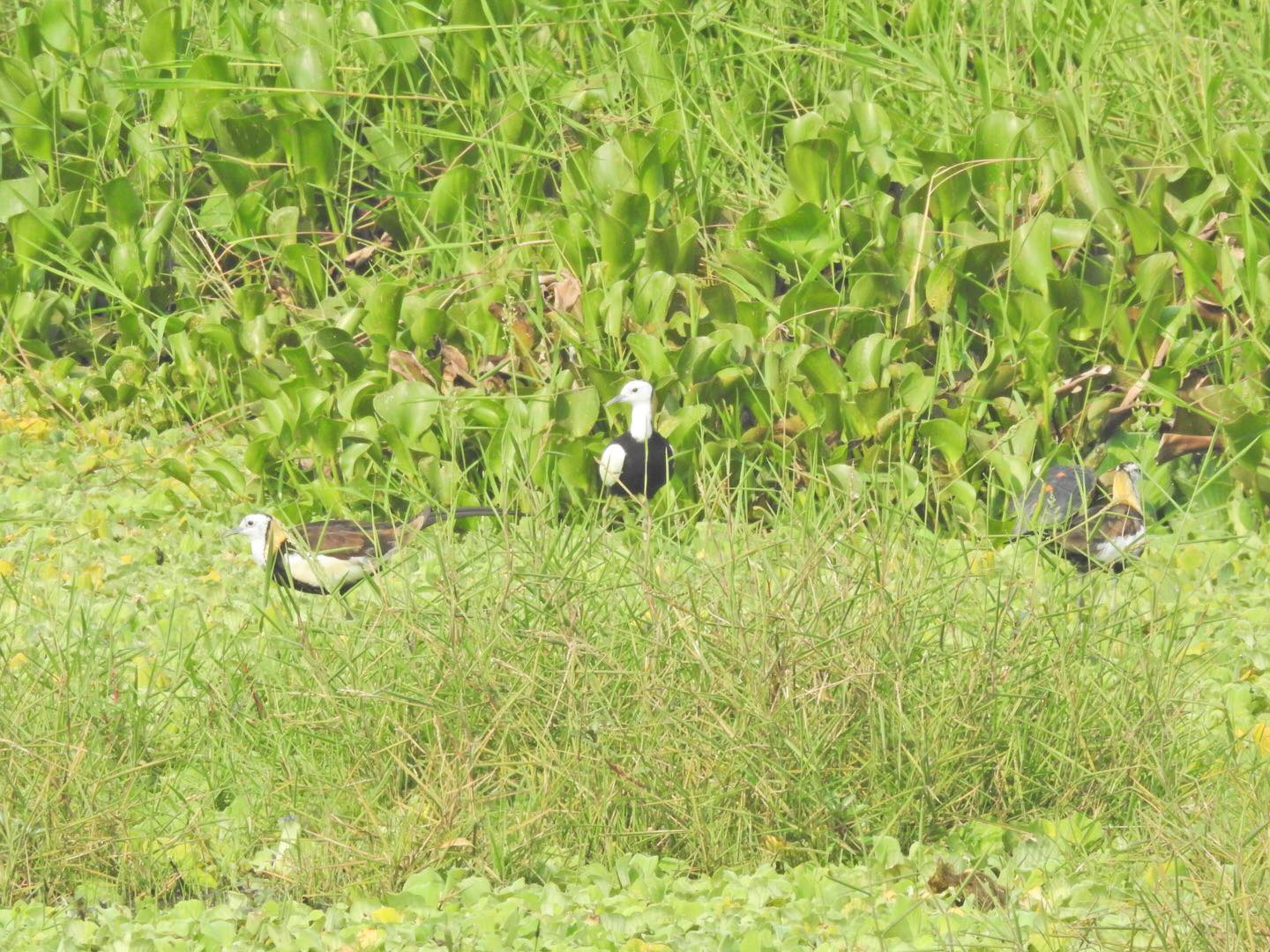
The habitat of the pheasant-tailed jacana reflects the current state of agricultural conservation, and the crisis of population aging is severe
In March this year, media reports pointed out that a green energy company was lobbying farmers in the Guantian area to lease their farmland as sites for installing solar photovoltaic panels, offering an annual rent of 40,000 yuan (higher than the going rate of 6,000 yuan per fen) on 20-year leases to attract farmer landowners to join; some farmers agreed, while others took a wait-and-see attitude, and the matter drew the attention of ecological conservation groups. This move is exactly the same as the solar installations on the fish ponds of Qigu, the salt fields of Budai and the ponds of Taoyuan, not only severely impacting wetland ecology, but also endangering disadvantaged farmers and fishermen and the agricultural and fishery production system, and further potentially affecting the national security issue and social issue of food self-sufficiency.
The country's first pheasant-tailed jacana breeding and release park was established in 2000 in Guantian, Tainan, because the high-speed rail passed through what was then the jacana's wintering area, Hulupi; under environmental impact assessment requirements, the public and private sectors cooperated to rent 15 hectares of Taiwan Sugar Corporation land and create a pheasant-tailed jacana breeding and release area, entrusting the bird society and the wetlands alliance with adoption, maintenance and management. At that time, there were fewer than 50 pheasant-tailed jacanas nationwide. After more than ten years of effort, habitat creation and incentive policies such as discovering nests in water chestnut fields proved effective, making the water chestnut fields of the Guantian area a friendly habitat for the pheasant-tailed jacana, and the number of pheasant-tailed jacanas nationwide has now exceeded 1,000.
Guantian is also the country's largest specialized water chestnut area, covering more than 300 hectares. Over the past decade or so, although a small number of middle-aged water chestnut farmers have joined, most of the farming labor there is still the original group of water chestnut farmers averaging sixty or seventy years old, some even over eighty! Not only is their physical strength far less than before, but with the lure of high profits from green energy companies, it is hard to ensure how much longer Guantian's water chestnut industry can be maintained.
Private land beside Meinong Lake in Kaohsiung was successfully turned into a wetland, attracting pheasant-tailed jacanas to come and breed.
Population aging is a major problem facing Taiwanese society; it not only impacts social stability, affects agricultural production and the food self-sufficiency rate, but also indirectly affects the wild animals and plants that depend on agricultural ecosystems, including water snakes, amphibians, dragonflies, fish and even the "pheasant-tailed jacana", all of which are victims. Just imagine: when a large amount of water chestnut field is leased to install solar photovoltaic panels and the area shrinks, the habitat is affected, and will the number of pheasant-tailed jacanas decline accordingly? The answer is predictable. Therefore, maintaining farmland area and agricultural ecosystems is also an important task for conserving biodiversity today, and the development of green energy policy should not be founded on the destruction of wetlands and agricultural and fishery environments. In addition to strictly supervising the behavior of green energy companies in developing wetlands, farmland and fish ponds, on the positive side, how can we respond positively to the reduction and degradation of the habitat area available to the pheasant-tailed jacana? The creation and restoration of pheasant-tailed jacana habitat may perhaps offer another feasible direction.
In 2017-2018, retired teachers Liu Xiaoshen and Huang Shumei, a couple living in Meinong, rented a piece of abandoned low-lying land beside Meinong Lake and planted aquatic floating-leaf plants, successfully attracting pheasant-tailed jacanas to come and build nests and breed; in the spring of 2019, the Kaohsiung Bird Society also mobilized volunteers to join the ranks of habitat creation. Meinong Lake is one of the very few freshwater ponds in Kaohsiung where pheasant-tailed jacanas appear and where the surrounding environment still retains farmland, and it is also a specialized production area for the aquatic crop "wild lotus", coinciding exactly with the pattern of the Guantian water chestnut area. If we can successfully carry out pheasant-tailed jacana habitat creation around Meinong Lake and extend such friendly environmental practices to the surrounding wild lotus fields and even to habitat improvement of Meinong Lake itself, although it will not directly help with the reduction in water chestnut field area in Guantian due to solar power development, it can still reduce the impact on the pheasant-tailed jacana population!
The Kaohsiung Bird Society mobilized volunteers in 2019 to join the ranks of creating pheasant-tailed jacana habitat around Meinong Lake.
On the other hand, the decline in farmers is also a major crisis for the survival of the pheasant-tailed jacana! Here, in addition to encouraging the public to eat more water chestnuts so that the water chestnut industry can continue to be maintained and the pheasant-tailed jacana habitat sustained, we also call on friends who care about environmental and ecological conservation to join the ranks of "habitat volunteers" and become a different kind of "ecological farmer", to ease the pressure of reduced cultivated area caused by the aging of farmers. There are now many retired people; rather than buying a piece of land to build a farmhouse, reducing agricultural production and ending up doing weeding and labor with no leisure, if one can participate as a habitat volunteer, contributing money if one has money and effort if one has effort, it not only helps maintain the existence of the wetland agricultural ecosystem, but also more actively conserves the indicator species and various organisms in the wetland, while also enriching retired life - two benefits at once, why not do it?
Meinong Lake in Kaohsiung is one of the very few freshwater ponds in Kaohsiung where pheasant-tailed jacanas appear and where the surrounding environment still retains farmland.
Today the pressure of population aging in Taiwan is pushing agriculture and farmland into an unprecedented crisis! If those who love agriculture, land and ecology can, through means such as pooling funds to buy land, donating money, donating land, trusts, and participating as habitat volunteers, leave their love for the environment and land to the next generation and become happy "ecological farmers", perhaps this is another turning point amid the crisis of the environmental and ecological protection movement!