What are the methods for rooting rose cuttings? A few common cutting methods explained
What are the cutting methods for rose flowers? What is the most convenient way to root rose cuttings? Let us give a brief introduction below.
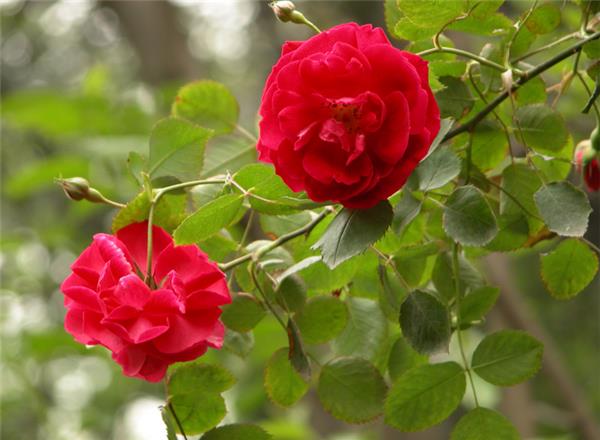
Cutting methods for rose flowers
1. Hardwood cuttings
Hardwood cuttings are also called dormant-wood cuttings. For roses grown in the open ground, from after leaf fall in autumn to before bud break in spring, use 1-year-old branches for cuttings. Usually you can select branches cut off during winter pruning that are free of pests and diseases, with solid xylem and plump buds, as cuttings. The cuttings are 10~12 cm long and have 3~4 buds.
In a high, dry, wind-sheltered, sunny spot, make a raised bed as the cutting bed. After leveling the soil, first cover it with plastic film, then insert the cuttings, to help raise the soil temperature and promote rooting. Insert the cuttings 1/2~2/3 into the soil, keeping 1 bud exposed above the soil surface, with a spacing of 8~10 cm, about 100~140 plants per sq m.
After insertion, in the Yangtze River basin they generally root in late February and send out new shoots in March. They can be transplanted in May~June. If hardwood cuttings are done in October, they can root before winter and sprout in spring, and the seedling quality is better.
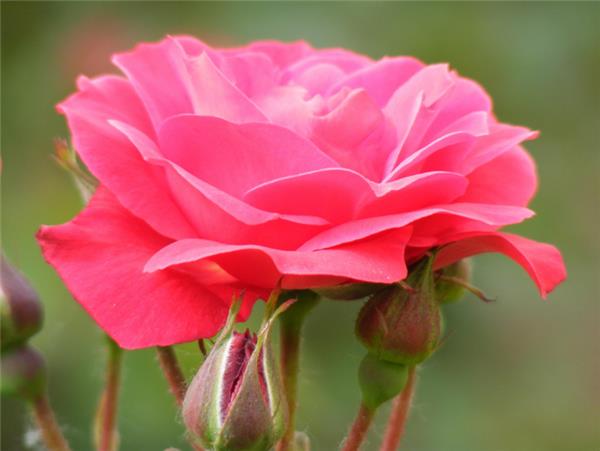
2. Greenwood cuttings
Greenwood cuttings are also called softwood cuttings. They are done during the growing season of the rose, using the new shoots of the current year. Generally carried out from June to October in summer and autumn. When the terminal flower of a new shoot has withered, cut off the branch section below the flower that is solid and has plump buds, as the cutting. The cutting is 10 cm long and has three buds; the cut at the upper bud is 0.6~0.8 cm from the bud tip, and the lower bud is 0.2~0.3 cm from the bud base; remove the leaves at the node inserted into the cutting bed.
Keep 1~2 nodes of buds on the above-ground part, with 1~2 leaves, and appropriately trim off some small leaves as needed. The cutting bed medium uses clean river sand or loose, breathable materials such as vermiculite, perlite, or rice-hull ash. The cutting spacing is 4~5 cm, with 400~600 cuttings per sq m.
For large-scale production, an automatic misting device can be set up to carry out full-sunlight seedling raising; for smaller scales, you can use a sprayer nozzle connected to a tap water pipe and control the misting time manually. About 10~15 days after insertion they root, and in about 20 days the seedlings can be lifted for use.

The most convenient way to root rose cuttings
First, after the rose flowers fade, cut off the spent flowers first. After one to two weeks, when the first axillary bud on the flowering branch has grown relatively thick and strong, you can cut a cutting with 3 nodes from the flowering branch.
Second, remove the leaves at the bottom, keeping only the top three or four leaves. Then use a clean, sharp blade to cut the lower flower-stalk surface into a slanted face, and insert it into a prepared bottle full of clean water; the cutting can be inserted about one-third of the way into the water.
Third, to make the cut grow new roots, it is best to use a dark-colored bottle, or wrap the outside of the bottle with a layer of black plastic film. At the same time, do not let the flowering branch be exposed to direct sunlight.
Fourth, to prevent the flowering branch from going moldy, it is best to change the clean water once a day.
Finally, after about three weeks, the flowering branch will grow roots. When the young roots have grown to about two cm, it can be transplanted into a pot. To improve the survival rate, at the beginning of transplanting it is best to water once a day, then gradually reduce it.
That is all for today's introduction to the cutting methods for rose flowers. I hope the above content can be helpful to everyone!