What to Do When Chaenomeles speciosa (flowering quince) Drops Its Leaves? Cause Analysis and Solutions
Summer is the peak growing season for Chaenomeles speciosa, but we often see some Chaenomeles speciosa dropping their leaves in summer. What should you do when Chaenomeles speciosa drops its leaves? Below we introduce the causes and solutions for leaf drop in Chaenomeles speciosa.
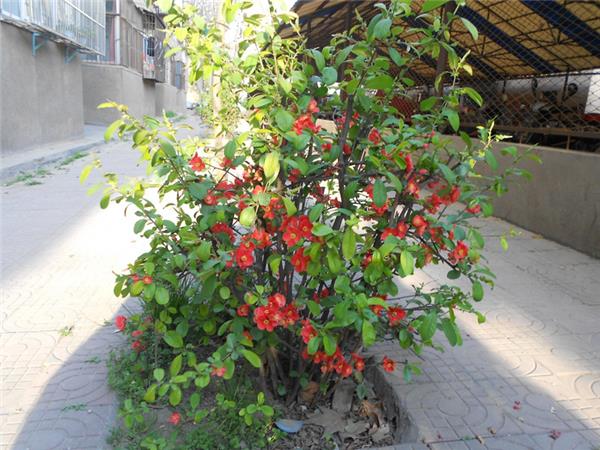
Causes and Solutions for Leaf Drop in Chaenomeles speciosa
1. Unsuitable soil
Growing Chaenomeles speciosa in pots also has certain soil requirements. Clayey soil cannot be used, as it hinders drainage and air movement around the root system of Chaenomeles speciosa and can also cause leaf drop.
Solution: You can use a loose, fertile sandy soil rich in humus with good drainage and aeration. You may appropriately place some decomposed cake fertilizer, animal hoof and horn, bones, etc. at the bottom of the pot as a base fertilizer to support the plant's growth and flowering.
2. Overwatering
During the growing period of Chaenomeles speciosa, it needs to be given sufficient water, especially in summer when temperatures are high and the potting soil dries out easily, so watering must be adequate. Note that Chaenomeles speciosa has a certain drought tolerance but is very afraid of waterlogging, so water accumulation in the potting soil must be avoided, otherwise the leaves will turn yellow and the plant may even die.
Solution: Watering Chaenomeles speciosa should follow the principle: when dry, let it dry out thoroughly; when watering, water thoroughly. Too much water will damage the root system through waterlogging and cause leaves to fall off.
3. Too little pruning
If Chaenomeles speciosa is pruned too little or not pruned at all, too many dead branches and the like will accumulate, and the plant will become too dense. Such a Chaenomeles speciosa without ventilation and air movement will also experience leaf drop.
Solution: After leaf drop in autumn or before bud break in spring, Chaenomeles speciosa should be pruned and shaped once. Cut off dead branches, leggy branches, crossing branches, overlapping branches and other branches that affect the tree shape, so that nutrients are concentrated, consumption is reduced, and ventilation and light penetration are improved. At the same time, more pruning can also promote flowering branches.
4. Pest and disease infection
The main pests and diseases of Chaenomeles speciosa include rust disease, aphids, etc. The occurrence of pests and diseases can also cause the phenomenon of leaves turning yellow and falling off in Chaenomeles speciosa.
Solution: If rust disease appears, spray a 15% triadimefon 1000-fold solution, spraying once about every 15 days, for 2 to 3 consecutive sprays, with good control results. If aphids appear, spray a 40% omethoate 1000-fold solution, or a 50% phoxim 1000-fold solution, or a 20% fenvalerate emulsifiable concentrate 2500-fold solution for control, with good results.
Next, let's look at the cultivation and management methods for Chaenomeles speciosa.
The planting site must be chosen in a sheltered, sunny place with relatively deep soil and good drainage. It should not be cultivated in low-lying, water-accumulating areas, nor should it be planted in windy spots, otherwise the branch tips are likely to dry up. Fertilizer and water management should be strengthened. Watering should be controlled by giving appropriate irrigation before bud break, before flowering and during dry summer periods, but drainage work must be done well during the rainy season. The principle of fertilizing is that fertilizer must not be lacking, otherwise the leaves are prone to turning yellow or falling off. It is best to apply organic base fertilizer once every year in autumn and winter or in early spring before the plant starts to grow, and then apply quick-acting fertilizer 1-2 times after flowering to promote fruit development and strong branches, so that there will be more flowers the following year. In March every year, thin out overly dense, overly weak and pest- or disease-damaged branches. After flowering, the top of the previous year's branches should be cut off, leaving about 30 cm at the base to encourage branching and increase the number of flowers the next year. Chaenomeles speciosa is easily harmed by aphids and red spider mites, so attention should be paid to their control.
That is all for today's introduction to the causes and solutions for leaf drop in Chaenomeles speciosa. We hope the above content has been helpful to everyone!