Bonsai Making Methods and Technical Key Points for Chaenomeles speciosa (Flowering Quince)
Chaenomeles speciosa bonsai is mostly shaped by wire wrapping combined with pruning. Because Chaenomeles speciosa grows quickly, be careful to remove the wire promptly after the shape is set. Below we introduce the bonsai making techniques for Chaenomeles speciosa in detail.
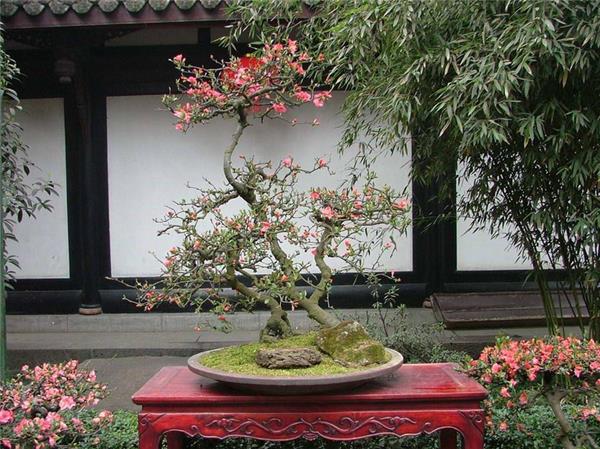
Bonsai Making Techniques for Chaenomeles speciosa
1. Material collection and propagation measures
Artificial propagation: mainly by division, cuttings and layering. Division is best done in early spring; dig up the clustered mother plant with its roots, cut it apart with a sharp knife, and replant so that each division has 2-3 stems; after planting, division can be carried out again in 3-5 years. Cuttings fall into two types, hardwood and softwood: hardwood cuttings are taken in February to March, with cuttings 10-15 cm long and inserted about 1B2 deep; softwood cuttings are taken in the plum rain season in June to July, inserted by the mud-dip method, and root relatively easily. Layering can be done in winter or spring; open a small trench beside the roots, bend a branch down to the ground, and mound it with fertile soil, and it will root on its own. By late autumn, cut the rooted layer free from the mother plant, and transplant it again the following spring.
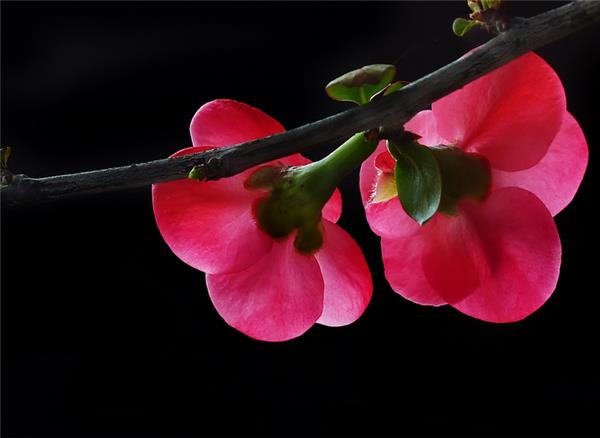
2. Potting process
Pot selection: Chaenomeles speciosa commonly uses deep rectangular or oval pots; square and round pots are also acceptable, while cascade styles use deep cylindrical pots. Zisha clay pots or glazed ceramic pots are preferable, though other materials are also acceptable.
Soil: it is not demanding about soil quality; slightly acidic or neutral soil both work, but loose, fertile leaf mold or garden soil with good drainage is best. When potting, put a layer of sand or vermiculite at the bottom of the pot to aid drainage.
Planting: it can be done in both spring and autumn, with the dormant period being preferable. Before planting, shorten thick roots and long roots, and do not let them coil in the pot. After planting, water thoroughly, place in a shady spot for 1-2 weeks, then move it to a spot with ample light.
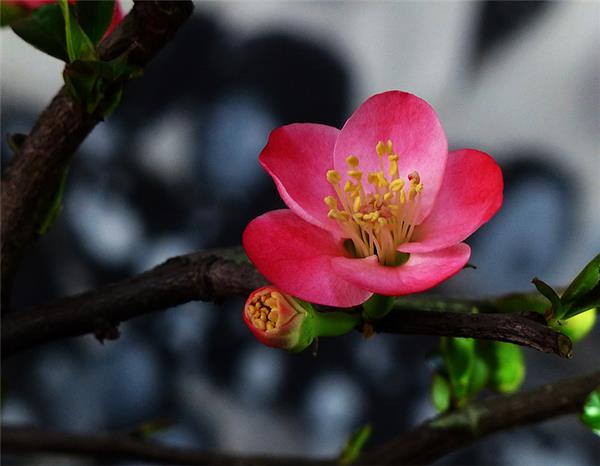
3. Shaping techniques
Processing: Chaenomeles speciosa is mostly shaped by coir-fiber wrapping, combined with pruning. Small bonsai are also often shaped by metal wire wrapping. Because Chaenomeles speciosa grows quickly, be careful to remove the coir fiber or metal wire promptly to prevent "wire bite." The processing period is best after flowering or during the dormant period.
Tree form: Chaenomeles speciosa is mostly made into slanting-trunk, curved-trunk or cascade styles. Emphasis should be placed on showing the vigor of its branches and trunk, with a character both firm and supple. An old specimen with slanting, horizontal branches and brilliant flowers is the most charming.
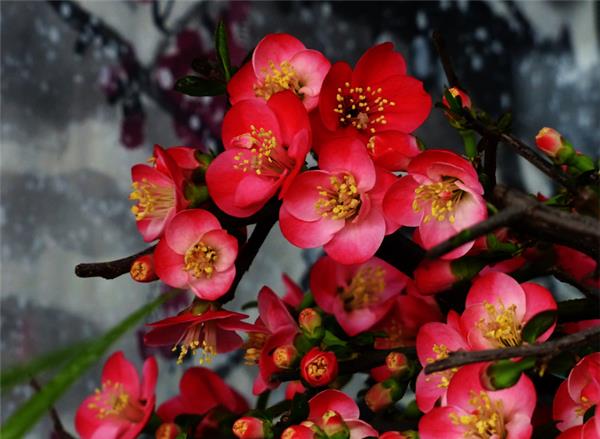
Next, we introduce the quick method for shaping Chaenomeles speciosa bonsai, as follows:
1. Cultivating the plant shape: for field-grown or potted Chaenomeles speciosa, prune out diseased, weak and dead branches so the interior of the clump is hollow, which helps ventilation and light penetration. Also select large branches with distinctive form for careful pruning, pruning 3-5 times that year so the branches twist and extend; the last pruning should be completed before the end of July, otherwise it will affect flower bud differentiation and result in sparse flowering the following year. At the same time, strengthen fertilizer and water management to ensure lush flowers and leaves.
2. Air layering: air layering can be done right after Chaenomeles speciosa flowers fade. First girdle the selected large branch 1-1.5 cm; if you apply 50-100 pp rooting powder, rooting can be advanced by 5-10 days. Then take a clean square plastic film with a side of 15-25 cm, drill a small hole in the center just large enough for the trunk to pass through, and cut from the middle of one side toward the center; slip the plastic film over the spot 10 cm below the girdle, tie it, then fold it upward into a pocket and fill it with prepared growing medium. The growing medium must be light and well aerated; generally use vermiculite or leaf mold, decomposed sawdust plus a small amount of garden soil, mix evenly, sprinkle in an appropriate amount of water, and sieve while damp. Fill with 0.25-0.5 kg of growing medium, then tie the plastic film at a point 5c above the girdle. In daily care, be careful to maintain the moisture of the growing medium inside the plastic film; if the medium turns white, inject water with a syringe, and pay attention to shaping.
3. Cutting free from the mother plant and cultivation: one month after air layering, white tender roots will successively emerge at the girdle; when the number of roots exceeds 10, the total length exceeds 50 cm, and the roots turn yellow, it can be cut free from the mother plant. Depending on the rooting situation, the size of the branch tip and the thickness of the main trunk, it can be cut free in 1-3 stages. After cutting down, remove the plastic film and plant it in a pot slightly larger than the soil ball; at the same time, prune some branches or remove some leaves to keep the balance between transpiration and water absorption. After keeping it in a shady place for two weeks, it can enter routine care. Because Chaenomeles speciosa roots quickly, it must be repotted once that year. In winter, the pot can be buried in the soil outdoors to overwinter. The following year it becomes a bonsai with an elegant antique posture, abundant flowers and lush leaves, and heavy fruit. The feature of this method is that the shaping time is short, requiring only 1 year; the root system is also uniform, and with slight root exposure it can become twisted; the roots are small, suitable for planting in various bonsai pots; the flowers are abundant and the leaves lush, with an elegant antique posture, and it can be produced in large quantities at one time. According to experiments, air layering on 10-year-old old branches can still succeed in one attempt. The shortcoming is that exposed roots are not easy to achieve, requiring more than 2 years of root raising.
with an elegant antique posture, and it can be produced in large quantities at one time. According to experiments, air layering on 10-year-old old branches can still succeed in one attempt. The shortcoming is that exposed roots are not easy to achieve, requiring more than 2 years of root raising.