How to graft Hall crabapple: grafting methods for Hall crabapple
The flowers of Hall crabapple are delicately colorful and highly ornamental, which makes it very popular. So, do you know the grafting methods for Hall crabapple?
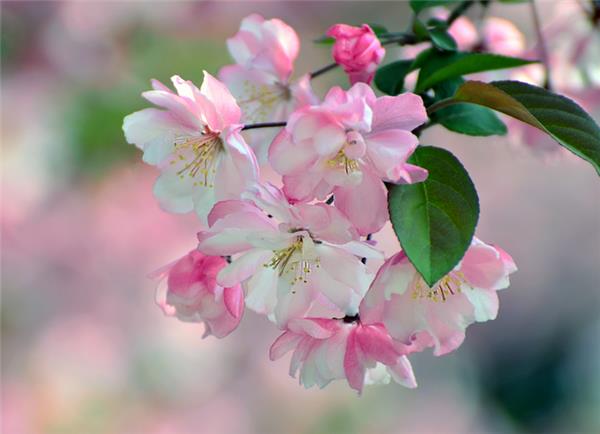
Grafting methods for Hall crabapple
For grafting crabapple, seedlings grown from seed are used as rootstock, and either stem grafting or bud grafting is carried out. In spring, when the sap flows and the plant sprouts, stem grafting is done; in autumn (between July and September), bud grafting can be done. For stem grafting, methods such as cut grafting and cleft grafting can be used. Select well-developed 1-year-old branches as scions, take the middle section (with 2 or more plump buds), and after grafting cover the scion with fine soil; for bud grafting, the "T" grafting method is mostly used.
1. Stem grafting of Hall crabapple:
The grafting time is generally best in early spring, when the terminal buds have just begun to swell. The scion is a plump, well-developed 1-year-old branch left from the previous autumn pruning, cut into sections 6 to 10 cm long, each with at least 2 plump buds. To retain moisture, the cut ends are often sealed with paraffin. When grafting, use a grafting knife to cut the scion into two symmetrical slanted faces of different sizes, one slanted face 1.5 to 2.0 cm long and the other 0.8 to 1.0 cm long. The cut faces must be smooth, preferably made with a single cut. At the same time, cut off the rootstock at about 20 cm above the ground, and on the north side of the rootstock cut surface make a downward slit 2.0 to 2.4 cm deep. Then insert the scion into the slit in the rootstock with the long cut face facing inward. The cambium on one side must be aligned with the cambium on one side of the rootstock; if the rootstock and scion are similar in thickness, it is even better if the cambium on both sides can be aligned. Finally, bind it with plastic strips. It is even better to bind a small plastic bag over the graft site to prevent water evaporation.
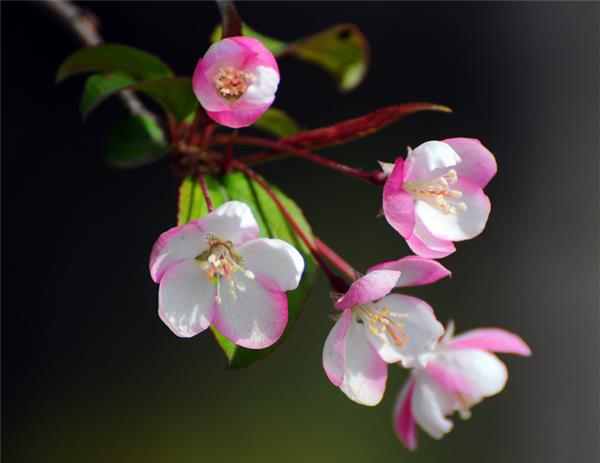
2. Bud grafting of Hall crabapple:
The grafting time is around August in autumn. Choose suitable seedlings as rootstock; the scion is crabapple, and 1-year-old branches that are robust, free of pests and diseases, with plump buds and upright growth should be selected, and grafted as soon as they are collected. Patch budding is a grafting method that is not restricted by season, is easy to perform, and has a high survival rate. Patch budding is similar to chip budding, but the bud used in patch budding does not carry xylem, so the cambium contact surface between rootstock and bud is larger, healing is easier, and the survival rate is higher. Grafting is carried out in three steps:
Cutting the rootstock: at the grafting site on the rootstock, choose a smooth spot, first make a horizontal cut at the lower part, deep enough to reach the xylem, then make a vertical cut downward along the xylem 2.5 cm above the horizontal cut, and remove the strip of bark.
Cutting the bud: the bud is cut in the same way as the rootstock, using the two-cut bud-cutting method. First make a horizontal cut 1 cm below the bud, then make a vertical cut downward along the xylem 1 cm above the bud, and remove the cut bud. The size of the bud piece is the same as the strip of bark removed from the rootstock.
Tying: press the cut bud onto the cut area of the rootstock, then tie it. It is best to use soft, elastic plastic strips for tying, as this gives a better seal. For early spring grafting, because the scion has no leaf stalk, when tying, the bud can be sealed inside the plastic strip together. For grafting in the growing season, leave a 1 cm long leaf stalk on the cut bud, and when tying, leave the bud and leaf stalk exposed outside.
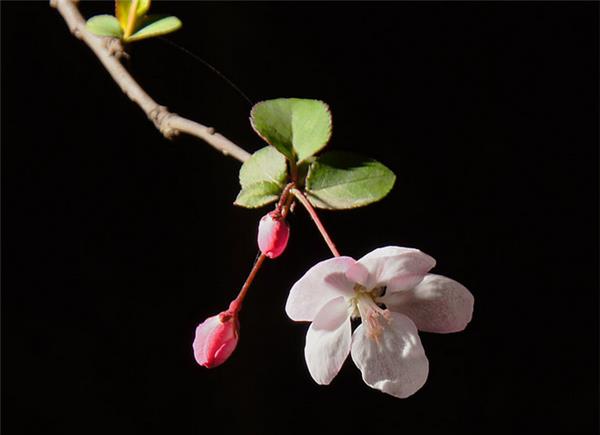
Care and management of Hall crabapple
(1) Soil for cultivation: the potting soil can be made by mixing 4 parts garden soil, 1 part organic fertilizer, 1 part river sand, and 4 parts leaf mold. During the growing season of Hall crabapple, the soil should be loosened once a month, which helps the roots of Hall crabapple absorb nutrients.
(2) Routine management of Hall crabapple: it is suitable to grow in an environment with sufficient light and good air circulation. The suitable temperature for growth is between 15 and 28°C. Ground-planted plants can withstand low temperatures of minus 150°C in winter, and potted plants can withstand low temperatures of minus 5°C. In summer, potted plants should be properly shaded, and at the same time misted with water to increase humidity and lower the temperature.
In winter, generally there is no need to move Hall crabapple indoors; simply bury the pot in soil. During the growing season there must be a sufficient water supply, as long as water does not accumulate. In spring and summer, water more; in summer when temperatures are high, water once in the morning and once in the evening; during the plum rain period and when there is prolonged rain with no clearing, pay attention to drainage to prevent water accumulation in the pot from rotting the roots; in autumn, reduce the amount of watering to inhibit growth, which is beneficial for overwintering.
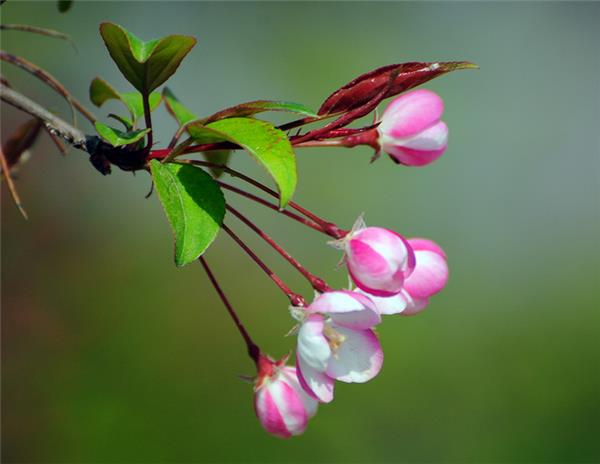
(3) For potted plants, apply a thin cake fertilizer solution once a month during the growing season; when flower buds appear, apply a quick-acting phosphorus fertilizer once; during flower bud differentiation, apply a quick-acting phosphorus fertilizer 2 to 3 times in succession, such as a mixture of 0.1% urea plus 0.2% potassium dihydrogen phosphate, which can promote the completion of flower bud differentiation in Hall crabapple; from after leaf fall in autumn to before sprouting in spring, stop topdressing.
Pruning should be done after flowering or during the dormant period, shortening overly long branches, encouraging side branches, increasing the formation of flower buds, and promoting the plant to form a good shape. Repotting should be done in early spring or late autumn; when repotting, the roots can be tidied and branches pruned, and rotted cake fertilizer or manure can be placed at the bottom of the pot as base fertilizer. For potted plants, heating in winter can be used to make Hall crabapple bloom earlier.
Stop topdressing.Pruning should be done after flowering or during the dormant period, shortening overly long branches, encouraging side branches, increasing the formation of flower buds, and promoting the plant to form a good shape. Repotting should be done in early spring or late autumn; when repotting, the roots can be tidied and branches pruned, and rotted cake fertilizer or manure can be placed at the bottom of the pot as base fertilizer. For potted plants, heating in winter can be used to make Hall crabapple bloom earlier.