How to Grow and Care for Malus halliana (Hall Crabapple) Flowers
Malus halliana is also known as "gut flower" and "homesickness grass." It symbolizes a traveler's longing for home and expresses the sorrow of parting. What I will share with you next is how to grow Malus halliana flowers.
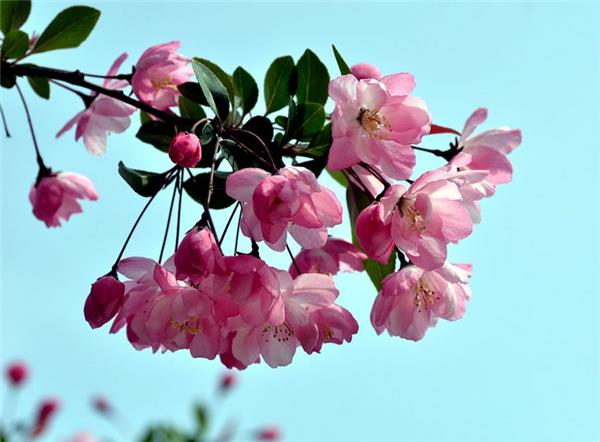
How to Grow Malus halliana Flowers
1. Soil: It has no strict soil requirements and can grow in slightly acidic or slightly alkaline soil, but it grows better in deep, loose, fertile, well-drained soil that is slightly clayey.
2. Sunlight: Malus halliana likes sunlight and is not tolerant of shade. It loves a warm, humid environment and is best grown in a sunny, sheltered spot.
3. Temperature: The optimal growing temperature is 15-28 degrees Celsius. Ground-planted plants can withstand low temperatures of -150 degrees Celsius in winter, while potted plants can withstand low temperatures of -5 degrees Celsius. In summer, potted plants should be properly shaded, and water should be sprayed to increase humidity and lower the temperature. In winter, it generally does not need to be moved indoors; simply burying the pot in the soil is enough.
4. Watering: During the growing season, there must be an adequate water supply, but do not let water accumulate. Water more in spring and summer. During high summer temperatures, water once in the morning and once in the evening. During the plum rain period and when there is prolonged rain without clearing, pay attention to drainage to prevent root rot caused by water accumulation in the pot. In autumn, reduce watering to inhibit growth, which helps it overwinter.
5. Fertilizing: Potted Malus halliana should be given a topdressing of thin cake fertilizer water once a month during the growing season. When flower buds appear, apply a quick-acting phosphorus fertilizer once. During flower bud differentiation, apply a quick-acting phosphorus fertilizer 2-3 times in succession, such as a mixed solution of 0.2% monopotassium phosphate plus 0.1% urea, to promote the completion of flower bud differentiation. After leaf fall in autumn and before bud break in spring, topdressing should be stopped.
6. Pests: Common pests of Malus halliana include Ceroplastes ceriferus, apple aphid, and red spider mite. The main disease is rust. Commonly used agents include sulfur preparations such as sodium dinitro-o-cresolate for rust control, colloidal sulfur, and systemic fungicides such as triadimefon. For spraying, options include 10% imidacloprid wettable powder at 1000-1500 times dilution, 40% methidathion emulsion at 1500 times dilution, and so on.
7. Pruning: First cut off weak branches, diseased branches, undesirable branches, and small branches growing from the main trunk. Then check for overlapping branches and prune them appropriately if present. It is best to also cut off upward-growing branches and try to let the buds spread out. If a branch is too long, it can be appropriately shortened, leaving 2-3 buds.
Next, let us take a detailed look at common pest control methods for the beloved Malus halliana.
(1) Ceroplastes ceriferus. The nymphs and adults of this pest specifically gather on leaves and branches to suck the sap of the flowers, causing weakened tree vigor, affecting photosynthesis of the ornamental plants, and worsening the damage. Control methods: 1) Combined with pruning, cut off infested branches and burn them centrally to reduce the overwintering population. 2) Scrape off or wipe off the pests with a bamboo strip or burlap. 3) During the nymph stage, spray 25% phosmet emulsifiable concentrate at 1000 times dilution, or 49% omethoate emulsifiable concentrate at 1000 times dilution, or 80% dichlorvos emulsifiable concentrate at 1000 times dilution for control, once every 7 days.
(2) Apple aphid. This pest gathers on the underside of leaves and tender shoots to damage the flowers. In the early stage, the leaf edges curl downward, and later the leaves bend and roll transversely from the leaf tip toward the petiole, affecting new shoot growth and flower bud differentiation. Control methods: 1) Before the plant sprouts, spray 5 degrees Baume lime sulfur mixture to kill overwintering eggs. 2) During the aphid damage period, spray 50% parathion emulsifiable concentrate at 2000 times dilution or 50% carbaryl wettable powder at 800 times dilution for control.
(3) Red spider mite. Red spider mite, also known as leaf mite, often feeds on both sides of the leaves of flowering plants, causing the leaves to dry up and fall off, affecting the growth of the whole plant. Control methods: 1) In winter, carefully find weeds as well as diseased plants and diseased leaves, and burn them. 2) Spray with a 300 times dilution of a wettable powder made by mixing 6% tetradifon and 6% dicofol.